Hotel
Museum
Public library
CastleBad Belzig
Eisenhardt Castle
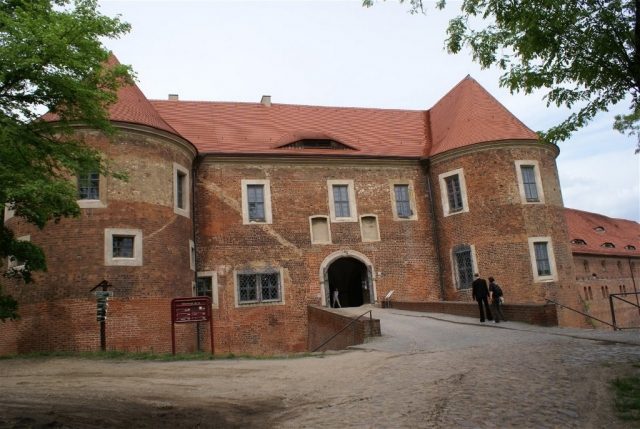
Eisenhardt Castle is a former castle complex on the edge of the town of Bad Belzig.
Eisenhardt Castle is located on a hill in the Hoher Fläming region in the federal state of Brandenburg, Potsdam-Mittelmark district, on the southwestern edge of the district town of Bad Belzig.
The hill is called Bricciusberg, which is indicated by the name of the St. Briccius Church located in its immediate vicinity.
A hilltop settlement from the early Bronze or Iron Age is presumed here. North of this hilltop settlement, the Slavic burgwall burgwardium belizi (presumably the center of the Slavic Gau Ploni, which belonged to the settlement area of the Hevelli) from the 9th to 11th century is presumed, which Emperor Otto III granted to the Archdiocese of Magdeburg in 997. After centuries of disputes, the burgwall came into the possession of the Ascanians in the 12th/13th century under Albrecht the Bear.
The hilltop castle included the settlement of Sandberg at its foot, where the resident castlemen have been documented since 1161. The castle changed owners several times between the Margraviate of Meissen, the Margraviate of Brandenburg, and the Archdiocese of Magdeburg. In 1272, a castellan "von Oppen" was appointed by the Saxon side, who was also the lord of the Niemegk lands. His land ownership was in both Brandenburg and Saxony. Eisenhardt Castle was besieged and largely destroyed by the Archdiocese of Magdeburg in 1395.
In 1423/1425, the castle, along with the Saxon electoral dignity, fell to the House of Wettin. From 1477, the master builder Arnold von Westfalen (after the Albrechtsburg in Meissen), commissioned by Elector Ernst of Saxony, was active at the castle to expand it into a fortress and residence equipped with stone cannons. In 1636, the building was severely damaged by Swedish troops during the Thirty Years' War. Its restoration only began in the 1680s under Elector Johann Georg III.
In the 18th century, major alterations took place, especially inside the castle. In 1815, the previously Saxon district of Belzig was annexed to Prussia. The newly established district administration moved into the castle, but this did not stop its further decay. It was not until 1849 that it was restored under Prussian King Frederick William IV.
Today, the castle houses a local history museum, a branch of the Bad Belzig registry office, a library focusing on the castle's history, and a hotel.
Take Mobile History with you
You are reading this text for free. Premium adds what matters on the road: descriptions read aloud, sites found through your camera, whole regions taken offline.
- Every description, including the ~17,700 Premium sites
- Audio guide: have descriptions read to you on location
- AR finder: see sites through your camera, with distance and bearing
- Unlimited saved sites
14 days free, then from €2.99 a month. Cancel anytime.
Source: Wikipedia · Licence: CC BY-SA 4.0 · Image: Roland Neubert, Halle (Saale)
This description draws on the facts documented in the linked Wikipedia article; Wikipedia content is licensed under CC BY-SA 4.0. Wording and editing: Mobile History.
Location: 52.1371, 12.5847