Youth Hostel
CastleSils im Domleschg
Ehrenfels Castle (Sils im Domleschg)
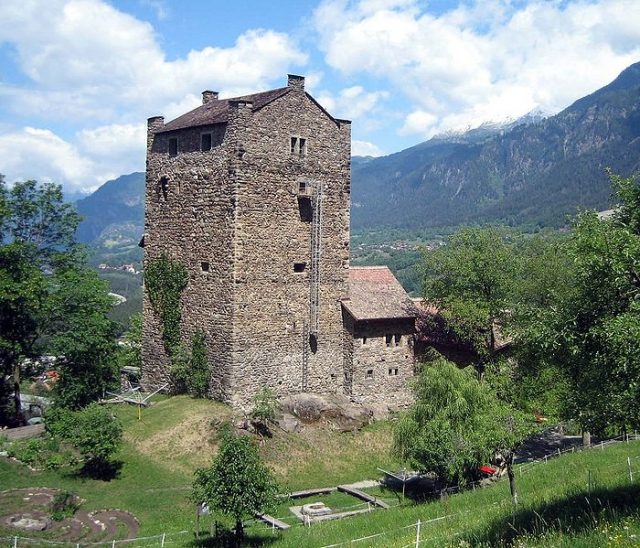
Ehrenfels Castle is a castle near Sils im Domleschg in the Hinterrhein district of Switzerland. It stands south above the village in a steeply sloping wooded area on a two-tiered rock outcrop on the way to the Hohenrätien Castle complex.
A four-story defensive tower on the highest point forms the center of the complex. Originally, a high entrance on the north side led into the second floor, but later the access was moved to the courtyard on the valley side. The southern second entrance was built in the 1960s. The complex was surrounded by a partly double curtain wall. The original surroundings were heavily altered by leveling during the restoration in the 1930s.
There is little documented history about the castle and its builders. The tower probably dates from the first half of the 13th century, the other buildings are younger. The curtain wall was probably built in the 14th century, the palas in the 16th century.
In 1257, the Lords of Ehrenfels are mentioned by name only once: In a purchase agreement dated in Reichenau between Baron Albrecht von Sax and Pfäfers Abbey, a "C. de Herinvels" appears as a witness. The later members of the Ehrenfels family belonged to the Lords of Schauenstein: In a document from Disentis dated November 21, 1320, Burchardus et Gotfridus milites, necnon Burchardus et Rudolfus de Herenfels accaeteri (and the others) de Schauenstein are mentioned. The castle itself is mentioned only once in the Domleschg Federal Letter of 1423: Junker Hermann von Ehrenfels was to serve the confederation with his fortress Ehrenfels.
Towards the end of the 15th century, the castle is said to have come into the possession of Cazis Monastery, and was apparently still inhabited by Rudolf and Kaspar von Ehrenfels-Schauenstein. Rudolf was a colonel of a regiment, Vogt of Fürstenau, his brother Kaspar owned Untertagstein Castle in Masein and acquired Haldenstein Castle in 1608.
Soon after 1600, Ehrenfels Castle was abandoned and began to decay. The last male representative of the Ehrenfels-Schauenstein family, Thomas Franz von Ehrenfels-Schauenstein, colonel of a regiment in the service of Emperor Charles VI, died in 1742. His inheritance and title passed to his sister's son, Johann Anton von Buol, Lord of Untertagstein Castle. In 1740, Nicolin Sererhard described the castle as a ruin.
Subsequently, the ruin was temporarily used as a quarry. The keep still stood almost at its original height, while the residential wing was completely removed except for a few wall remnants. The idea of using the castle stones for the construction of the Rhaetian Railway failed because breaking out the stones was more expensive than obtaining them from a quarry.
In 1933, the Swiss Castles Association acquired the heavily overgrown castle. Its first president, the controversial architect Eugen Probst (1873-1970), intended to rebuild the castle as a youth castle based on the German model, as part of an employment program for unemployed young people. At the end of July 1933, 25 young people began to clear the undergrowth of the heavily overgrown ruin, fell trees, and excavate the complex. The tower was also fortified. After an interruption due to financial reasons, work continued in 1936 and was completed in the following years. Since the restoration work was carried out without archaeological-scientific supervision, there is no documentation of the original findings; descriptions are therefore based on the brief documentation by Erwin Poeschel.
In 1953, the castle was acquired by the Swiss Youth Hostels Association (SJH) and today belongs to the Swiss Foundation for Social Tourism, Zurich. Since then, Ehrenfels has been used as a youth hostel, but is only available to groups.
Take Mobile History with you
You are reading this text for free. Premium adds what matters on the road: descriptions read aloud, sites found through your camera, whole regions taken offline.
- Every description, including the ~17,700 Premium sites
- Audio guide: have descriptions read to you on location
- AR finder: see sites through your camera, with distance and bearing
- Unlimited saved sites
14 days free, then from €2.99 a month. Cancel anytime.
Source: Wikipedia · Licence: CC BY-SA 4.0
This description draws on the facts documented in the linked Wikipedia article; Wikipedia content is licensed under CC BY-SA 4.0. Wording and editing: Mobile History.
Location: 46.6966, 9.4517