Agricultural didactic and research institute
CastleOstinghausen
Düsse Castle (Ostinghausen)
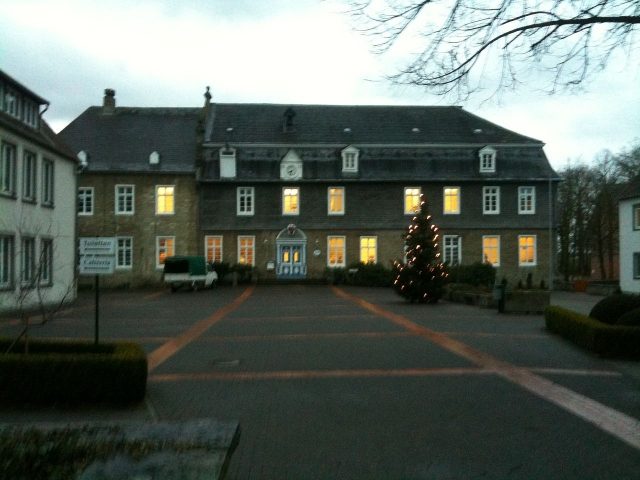
The Agricultural Center Haus Düsse with the Center for Renewable Resources NRW is a moated castle built in 1641 by Adrian van der Düssen and today serves the Chamber of Agriculture of North Rhine-Westphalia as a central teaching and research institution for animal and plant production.
The Agricultural Center Haus Düsse is located in the district of Bad Sassendorf-Ostinghausen, 10 km northeast of Soest, approximately midway between Soest and Lippstadt. Ostinghausen should not be confused with the neighboring Oestinghausen, about 7 km northeast of Soest.
Haus Düsse is located on the northern edge of the Soester Börde. The average altitude is 70 m above sea level. The soil quality indices were set between 58 and 78 soil points. The soils originated from loess deposits. In contrast to other known, comparable German soils, the Soester Börde is characterized by higher precipitation. The average annual precipitation is 750 mm and the average annual temperature is 9.2 °C.
Soil development at Haus Düsse has been strongly influenced by high moisture levels and fluctuating groundwater. Predominant soil types of the experimental farm are Gley-Parabraunerden and Parabraunerden-Gleye. In depressions and valley locations, Gleys, brown alluvial soils, and alluvial Gleys also occur. The water-holding capacity of the soils is good. Humus content ranges between 2 and 4%, and silt content is approximately 80%. Almost all soils at Haus Düsse are very sensitive to pressure and prone to silting. Therefore, soil cultivation should not be too fine.
Due to the natural conditions of Haus Düsse, which apply to a large area of the Soester Börde, cereal cultivation has always played a prominent role here. A sensible adaptation in the selection of crop types to the site conditions has taken place.
Before 1927
In 1231, the "Rittergut Ostinghausen" (knightly estate Ostinghausen) was first mentioned in a document. It belonged to the extensive possessions of the Count of Arnsberg. Until 1641, the knightly estate was owned by various Westphalian noble families. On December 5, 1641, Friedrich Freiherr von Fürstenberg sold it to Adrian van der Düssen.
Van der Düssen was the son-in-law of the Dutch statesman Jan van Oldenbarnefeld. In this role, he became entangled in the religious disputes of the time. Due to his involvement in a murder plot against Prince Maurice of Orange, he had to flee from Holland, specifically from Rotterdam to Hamm in Westphalia. During the Thirty Years' War, he was a colonel and general war commissioner in Tilly's army. During this time, he acquired large landholdings in Bettinghausen. After his return from military service, he built a moated castle as a new manor house on the knightly estate Ostinghausen, which was located near Bettinghausen and had been abandoned until then. The construction, which began in 1641, was completed in 1655 and was named "Haus Düsse".
Already in 1741, Haus Düsse changed ownership through marriage to the Ledebur-Wicheln family. Friedrich Clemens von Ledebur-Wicheln was born at Haus Düsse in 1770. In 1889, Friedrich von Landsberg-Velen und Gemen acquired the estate. On August 15, 1907, Haus Düsse became a provincial estate of the Provincial Association of the Province of Westphalia.
In 1927, the livestock care and milking school was founded. The management of the estate was carried out jointly with the provincial estates and hospitals Eickelborn and Benninghausen. In 1937, Haus Düsse was then taken over as an experimental farm.
1927: Founding of the Livestock Care and Milking School
In the course of the new establishment of milking schools in Prussia during the 1920s, the Chamber of Agriculture for the Province of Westphalia decided to set up a livestock care and milking school. At that time, there was a noticeable shortage of well-trained milking personnel in agricultural practice. In addition, young farmers were to be thoroughly trained in milk production and treatment, feeding, livestock care, and husbandry. The goals were to improve milk quality and the economic efficiency of dairy farming.
On October 3, 1927, the board of the Chamber of Agriculture decided to establish a livestock care and milking school at the then provincial estate Haus Düsse in Ostinghausen. The first course with six milkers was conducted from January 2 to February 29, 1928.
After lengthy negotiations, the Landesbauernschaft (State Farmers' Association) bought the provincial estate Haus Düsse for 385,000 Reichsmark on March 1, 1937. At that time, the property comprised about 93 hectares of land, including the castle, horse stable, pig stable, cow stable, sow stable, and two barns.
1950: Takeover by the re-established Chamber of Agriculture Westfalen-Lippe
Due to the Second World War, experimental and teaching activities increasingly ceased from 1940 onwards. After the end of the war, Haus Düsse served for several months as a camp for liberated foreign workers. From February 1946 to August 1950, the British Army of the Rhine established an agricultural army technical school at Haus Düsse. After the takeover on August 18, 1950, the Chamber of Agriculture Westfalen-Lippe intensified its experimental work and training activities in accordance with the great agricultural demand.
1951-1955: Expansion of the School Facilities and Cattle Husbandry
In August 1951, ownership of all Düsse properties and facilities was transferred to the Chamber of Agriculture Westfalen-Lippe. The years of reconstruction brought with them a high demand for food and changed production techniques. This required intensive training and advice for all those involved in agriculture. For this purpose, in addition to the already resumed courses, consultant seminars, advanced training seminars for farm managers, and, after their introduction, specialized courses for milking machines were established.
Extensive construction measures created the spatial conditions for the new tasks. The cow stable in the inner courtyard was replaced north of the Ahse by cattle stables suitable for training: two tie-stall barns, an open loose housing stable, calf stables, a milking parlor, milk room, ceiling-loaded hay, straw, and feed storage, as well as high and drive-through silos. In place of the old cow stable, the seminar building with several training, conference, and dormitory rooms was built.
1960-1963: Expansion of the Boarding School and the Pig Fattening Testing Station
After a consolidation phase, the boarding school was modernized and expanded in the early 1960s. The pig fattening testing stable, built in 1938/39, no longer met the dynamic activities of pig breeding, neither technically nor in terms of capacity. Therefore, a new, spacious fattening testing station, separate from the training farm, was built between 1960 and 1963.
1968-1980: Haus Düsse becomes an inter-company training center
Agriculture, like industry, was eventually caught by the wave of mechanization. Extensive investments in machinery required larger production units and specialization in a few branches of farming. To ensure that the training of young people continued to have a broad professional dimension despite the limitations of efficient production facilities, inter-company training was introduced in 1968 as part of the Vocational Training Act (BBiG). The existing training workshops were modernized or newly built and adapted to the rapidly increasing number of participants and visitors by expanding accommodation and support facilities. As an inter-company training center for animal production for the Westfalen-Lippe chamber area, Haus Düsse received new training workshops as part of model projects and federal funding. Existing stables were modernized. In 1970, a pig breeding, pig fattening, and bull fattening stable were built. Additionally, training workshops for pig breeding (1972), pig fattening (1974), and bull fattening (1980) followed. The open dairy cow stable (20 cows) was converted into a cubicle loose housing stable (56 cows) in 1976. For course operations, the school practical training facility was built in 1971 as a special exercise and demonstration building. This was supplemented by a second section in 1980. The rapidly increasing number of participants overwhelmed the existing support and accommodation facilities. Therefore, in 1976/77, an administration building with a large kitchen, dining hall, day and leisure rooms, and a guesthouse were built. As part of the experimental and testing system, the pig fattening testing station was expanded by one wing each for feed value performance testing (1968) and for special feeding experiments (1980).
1982-1989: Further Expansion Stage of the Teaching and Research Institute
The experimental and training facilities created so far, as well as the support and accommodation facilities, underlined the central usability of Haus Düsse for education and training, as well as for illustrative advice. To be able to offer an even more comprehensive range, the teaching exhibition for construction and technology was built in 1982. In 1984, it was significantly expanded with an outdoor area. In 1983, the Teaching and Research Institute for Small Animal Breeding Unna-Königsborn (LVA) was relocated from Unna-Königsborn to today's "Agricultural Center Haus Düsse" in Bad Sassendorf. In this context, cattle and pig farming, a laying hen stable, and a young poultry fattening stable were added. For timely inter-company training, some existing facilities were replaced by the training workshops for calf rearing (1985) and feed storage and processing (1985). The multi-purpose hall built in 1984 completed the range of exercise and demonstration rooms. In the summer of 1987, the construction of the "Sow Husbandry" training workshops began, which was completed in 1988. In addition, Haus Düsse, in cooperation with the Westphalian-Lippe state associations of beekeepers and purebred poultry breeders, received an experimental and teaching apiary (1983) and a purebred poultry stable (1987). The facilities were connected by a forest nature trail and a plant teaching garden.
1990-1998: Structural Changes in Haus Düsse
On January 1, 1990, the Institute for Performance Testing in Animal Breeding, Eickelborn, was integrated into the Teaching and Research Institute. Immediately thereafter, extensive new construction and renovation measures began. These were intended to improve health and hygiene status and adapt the stables to a changed testing methodology. Already in 1991, a new quarantine stable as an outdoor hut stable for calves could be put into operation. Also in 1991, another former tie-stall barn was completed, which was converted into an open-front stable for group housing. In the following years, further stables were gradually converted. New approaches were taken with an outdoor climate open-front stable for fattening pigs and the completely renovated cubicle loose housing stable, which was also built as an open-front stable.
To ensure the basic supply of electricity and heat energy to Haus Düsse, a bio-power plant was put into operation as a pilot project in 1995. Based on renewable raw materials, it provides both forms of energy via a combined heat and power plant or direct combustion. Stimulated by the Ministry for Environment, Spatial Planning and Agriculture, the "Center for Renewable Resources" was conceived and established in Haus Düsse from 1995 onwards. It has since been active for the whole of NRW. The Hemp Association is also based within the framework of the center. For advice, demonstration and information, an exhibition pavilion with a teaching garden was opened in 1997. At the same time, renewable raw materials are processed in field trials to obtain advisory documents on this topic.
After the closure of the Teaching and Research Institute for Small Animal Breeding Krefeld-Großhüttenhoft of the Chamber of Agriculture Rhineland, the testing and research in the poultry sector for North Rhine-Westphalia was conceived in Haus Düsse, so that in 1998, in a converted stable that can be used alternatively for chicken and turkey fattening, the first feeding trial with turkeys could be completed.
Expansion stages since 1983
Further expansion stages of the Agricultural Center underscore the central usability of Haus Düsse for education and training, as well as for illustrative advice. In recent years, the following measures have been carried out to meet the increased requirements:
- 1983 Relocation of the Teaching and Research Institute for Poultry Farming from Unna to Haus Düsse and establishment of a laying hen and young poultry stable.
- 1990 Affiliation of performance testing in animal breeding for the state of North Rhine-Westphalia.
- 1991 Construction of the calf quarantine station (LPA Eickelborn)
- 1992 Conversion of the bull stable (LPA Eickelborn)
- 1993 New construction of an open pig fattening stable
- 1994 Construction of the open-front stable for dairy cows
- 1995 Establishment of boar performance testing
- 1995 Opening of the bio-power plant
- 1996 Conversion of the bull stable (LPA Eickelborn)
- 1997 Establishment of the Center for Renewable Resources
- 1999 New construction of a bull fattening stable
- 1999 Haus Düsse under a new name: Agricultural Center (LZ) Haus Düsse
- 2000 Conversion of the heifer stable
- 2000 Establishment of ecological pig farming
- 2002 Conversion of the milking parlor in the dairy cow stable
- 2002 Construction of the Soest district office on the Haus Düsse premises
- 2002 Construction of a new quarantine stable for the LPA cattle
- 2003 Construction of a new pig fattening stable with integrated piglet rearing
- 2003 Construction of a biogas plant for the Center for Renewable Resources
- 2003 New construction of a hut system for calf rearing
- 2003 Conversion of the old calf and young cattle stable into a cow stable with an automatic milking system
- 2004 Establishment of the Center for Electronic Applications in Agriculture (ZEL)
- 2004 Establishment of a vocational school class for agriculture at the Lippe Berufskolleg Lippstadt
- 2005 Conversion and modernization of sow husbandry
- 2006 Teaching exhibition for renewable energies opened
- 2006 Responsibility for inter-company training in animal production for all of NRW
- 2007 Conversion of laying hen husbandry
- 2008 New construction of a drive-through silo system
- 2009 Conversion of the pig fattening experimental technical center
- 2010 Redesign of the construction teaching exhibition
- 2010 Conversion of the LPA pig
In addition, Haus Düsse, in cooperation with the Westphalian-Lippe state associations of beekeepers and purebred poultry breeders, received a teaching apiary (1983) and a purebred poultry stable (1987). These facilities are connected by a plant teaching garden.
Head of the Teaching and Research Institute
- 1927-1934: Fritz Nöthen
- 1934-1967: Bernhard Brüning
- 1968-1986: Bernhard Edeler
- 1986-1987: Karl-Heinrich Hoppenbrock (acting)
- 1987-1998: Gerhard Beckmann
- since 1999: Gerhard Haumann
Mission of the Agricultural Center Haus Düsse+
Development
In the teaching operation, the focus was initially on professional milker training. Later, the training of farmers' sons and daughters in milking, as well as in livestock and hoof care, was added. From 1937 to 1969, the milk control assistant courses were the main focus. While hand milking, quality control, and livestock care were initially in the foreground, West Germany experienced a veritable milking machine invasion in the 1950s. Thus, Haus Düsse became one of three federal technical schools for machine milking. In specialized courses, the technique of machine milking was taught until 1967. As a result of the restructuring of agriculture and especially of dairy farms, the demand for full-time milkers decreased. The inter-company training of young farmers in animal husbandry moved into the center of course activities. In addition to cattle husbandry, pig husbandry, which gained great importance in Westfalen-Lippe, became a training focus. With the expansion of the farm facilities, the number and variety of courses and further training events such as seminars, conferences, or visits grew. The range of participants extended from apprentices to master candidates and farm managers to teachers and consultants.
In total, more than 60 different types of courses have been conducted to date (a total of 125,000 participants). The focus was on courses for livestock care and inter-company training, with more than 40,000 participants. Almost 200,000 interested parties attended the advanced training conferences and seminars. Including the 360,000 visitors, mostly farmers, but also many school classes and consumers, well over half a million people used the Düsse training and further education facility, including 30,000 from Europe and overseas.
In the field of experimentation and testing, the task changed similarly to the training area, in line with the changes in agriculture. With the takeover of the experimental farm, the focus was on increasing yields in both arable farming and livestock farming. With scarce supply, breeding and production-technical resources were developed. With the wave of mechanization after the war, new cultivation and harvesting methods in arable farming and stable housing and feeding methods in livestock farming emerged. These include the introduction of the tractor, the combine harvester, slurry technology, the milking machine, and EDP-controlled feeding technology. In addition to the aspects of quantitative production, the aspects of production quality and, most recently, environmentally friendly food production were added.
Main Task Today
The task of the Agricultural Center is to develop practical, cost-effective, and animal-friendly production methods for North Rhine-Westphalian agriculture, and to impart skills and knowledge in education and training.
In the publications of the Federal Plant Variety Office's value testing results, Haus Düsse often leads in cereal yields. Therefore, Haus Düsse forms a research focus for the entire Ruhr-Hellweg region, primarily addressing questions of intensive cereal cultivation.
Another research focus lies in the development of cultivation techniques for new crops. Here, field beans, peas, sunflowers, flax, and more recently, green fallow and miscanthus are to be mentioned. Also, experiments requiring very high technical effort, such as soil cultivation, crop rotation, and slurry experiments, are primarily carried out here. In a large plant cultivation teaching garden, the diversity of crop types and varieties grown on arable land and grassland is demonstrated to non-agricultural visitors, and the structure of hybrid varieties is shown. Also, a variety of species suitable for renewable raw materials can be seen here.
This effectively underlines the long-standing important position of Haus Düsse in the field of livestock farming, now also in the field of plant production, for the benefit of Westphalian-Lippe agriculture.
Course Programs
- Basic course in inter-company training, in milk production, cattle, calf, pig, and sheep farming
- Basic course in inter-company training in horticulture and landscaping
- Advanced and further training courses for farmers, animal keepers, hoof trimmers, milking and feeding consultants, agricultural specialists from Germany and abroad
- Courses for part-time farmers
- Courses for beekeepers, purebred poultry, rabbit, and fur animal breeders
- Courses in nature and landscape conservation
- Inter-company practical courses for apprentices and interns in agriculture, rural home economics, and horticulture and landscaping
- Further training courses for farmers, part-time farmers, rural women, agricultural employees, teachers, further training courses for foreign farmers and specialist consultants
- Information conferences on modern food production of animal and plant origin
- Educational conferences for farmers and rural women
- Topics: Developments in animal breeding, feeding, husbandry, crop production, and marketing
- Conferences and further training events in the field of renewable raw materials
Experiment and Testing Tasks
- Feeding trials for physiological and technical improvement of livestock nutrition
- Feeding trials for sows, piglets, and fattening pigs
- Feeding trials for laying hens and broiler chickens
- Husbandry trials for testing technical developments and stable equipment
- Stable climate design
- Functional reliability considering animal welfare requirements
- Performance tests for ruminants, fattening pigs, laying hens, and fattening poultry
- Own performance testing for fattening performance of dual-purpose and beef cattle
- Fattening performance and carcass evaluation of herd book pigs
- Progeny testing of boars for fattening and slaughter performance
- Product testing for crossbred animals and hybrid origins in fattening pigs, laying hens, and fattening poultry
- Feed value performance tests in fattening pigs, laying hens, and fattening poultry
- Arable farming and plant protection trials for cereals, rapeseed, maize, and renewable raw materials
- National variety trials, value tests, and trials on cultivation techniques, fertilization, and crop rotation
Specialist Information, Consumer Education, Public Relations
- Farm visits
- Information events for consumers
Topics:
- Production of milk, meat, and eggs with special attention to quality and consumer demands
- Information events for teachers and students
Topics:
- Applied biology
- Animal and environmentally friendly plant and animal production considering economic and ecological aspects
- Düsse Farmers' Market
every year on the 2nd Sunday in September
Farm Overview+
- Farm area: 278 ha
- Land use:
- Arable land 225 ha
- Grassland 12 ha
- Forest 22 ha
- Farmyard/roads/buildings 19 ha
- Climate and Evaluation
- Altitude: 70 m above sea level
- Soil quality index: 58 - 78
- Precipitation: Average 750 mm p.a.
- Temperature: Average 9.2 degrees Celsius
- Livestock farming
- Dairy cows 100
- Fattening bulls 50
- Testing places for bulls (LPA) 400
- Suckler cows 10
- Ewes 40
- Sow places 260
- Pig fattening places 1,500
- Piglet rearing places 1,200
- Pig individual pens (LPA) 800
- Sows/fattening pigs according to organic/alternative guidelines 30/180
- Laying hen places 9,000
- Fattening poultry places 5,000 or
- Turkey cocks 1,000 or
- Turkey hen places 2,000
- Bee colonies 4
- Personnel: 70 positions
Facilities+
The facility is rented out for various purposes; for example, it offers excellent rehearsal opportunities even for larger musical groups. The three accommodation houses have single and double rooms. A total of 136 beds are available, 124 of which are in rooms with shower/bath.
The premises offer space for conferences and meetings, conventions and assemblies, seminars and training courses, as well as professional development, also for those interested outside of agriculture. For training sessions of 10 to 160 people, 16 conference rooms are available. A versatile media technical equipment is available to support teaching and learning. There are also special rooms for working with computers.
Haus Düsse has child-friendly facilities and provides childcare. A cafeteria is located in the immediate vicinity of the training and seminar rooms. In the evenings, the rustically furnished Westfalenkeller offers a meeting point for guests.
For sports, in addition to walking paths, facilities for bowling, table tennis, and billiards are provided.
Center for Renewable Resources NRW+
The Center for Renewable Resources (ZNR) in NRW has been located on the premises of the Agricultural Center Haus Düsse since 1996. This refers to agricultural and forestry products that can be used materially or energetically. The aim of the center is to work at the interface between agriculture and upstream and downstream sectors. For this purpose, an information pavilion with a teaching garden, a wood heating system, and a biogas plant offer practical demonstration possibilities. The target group for the conferences consists not only of farmers but also includes the areas of education, technology, wood heating and biogas, processing, trade, science, and application.
The motto of the center is: "If you want forest, you must use wood".
Key Areas of Work
- Energy from biomass (wood, oils, biogas, other)
- Biodegradable materials based on starch and sugar
- Project support, e.g., hemp project, bioenergy project
- Cultivation trials for various renewable raw materials
- Permanent exhibition in the information pavilion in timber construction
- Teaching garden with raw material-providing plants
- Biogas trials
Take Mobile History with you
You are reading this text for free. Premium adds what matters on the road: descriptions read aloud, sites found through your camera, whole regions taken offline.
- Every description, including the ~17,700 Premium sites
- Audio guide: have descriptions read to you on location
- AR finder: see sites through your camera, with distance and bearing
- Unlimited saved sites
14 days free, then from €2.99 a month. Cancel anytime.
Source: Wikipedia · Licence: CC BY-SA 4.0
This description draws on the facts documented in the linked Wikipedia article; Wikipedia content is licensed under CC BY-SA 4.0. Wording and editing: Mobile History.
Location: 51.6342, 8.1901