Hotel
CastleDaun
Daun Castle
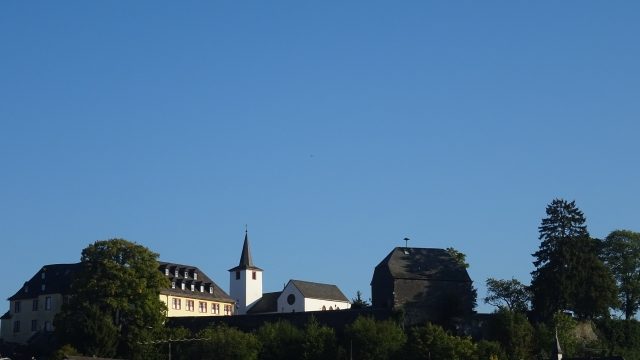
Daun Castle is the ruin of a hilltop castle. It was the ancestral seat of the Lords of Daun, of Oberstein on the Nahe, of Densborn near Gerolstein, of Bruch near Wittlich and Zievel near Euskirchen. Before the time of the Lords of Daun and later counts, the basalt hill was probably a Celtic refuge castle and subsequently a Roman watchpoint.
The castle has been destroyed several times, most recently in the Palatinate War of Succession in 1689 by French troops of Louis XIV, like most Eifel castles. Today, only a curtain wall and a small bastion tower with loopholes remain of the former castle complex, which is presumably over 1000 years old.
The Amtshaus (administrative building), which emerged from the hunting lodge of Elector Karl III. Joseph of Lorraine from 1712 through several alterations and additions, is now used as a hotel. Below the castle are several restored Burgmannenhäuser (vassal houses), which are also listed as historical monuments.
Individual finds have proven the existence of a Celtic refuge castle from around 700 BC. Around 50 BC, a fortified Roman watchtower was located on the site, as can be concluded from the discovery of a tomb. Towards the end of the 9th century, Daun Castle was built as the town residence of the Lords of Daun, who resided at the "Altenburg" near Schalkenmehren.
In the middle of the 14th century, Daun consisted of the castle and the town built closely against the steep rock. Daun had town rights, and the Burgmannen collected tolls for the lord of the castle, Aegidius von Daun, known as "the mad Gilles". Aegidius had received the town of Daun as a fief from King John of Bohemia in 1340. He distinguished himself as an impartial arbitrator in several disputes, but some smaller knights allied against him. Aegidius won this dispute in 1348 and reconciled with his enemies.
However, intrigues and complaints about robber knights in his jurisdiction accumulated. In addition, the small free county of Daun was sandwiched between the archbishoprics of Trier and Cologne. In 1352, a military campaign by Balduin against Daun had been settled by a peace treaty; details are not documented. Gilles was obliged to pay damages but did not appear for the hearing. He felt unjustly treated.
A year later, Archbishops Balduin of Trier and Wilhelm of Cologne joined forces to capture Daun Castle under the pretext that Gilles was a robber knight. Finally, the castle was conquered, and Gilles was forced into feudal lordship under Balduin. However, the castle was hardly damaged in the process. Since then, Daun belonged sovereignly to the Electorate of Trier, spiritually still to the Archbishopric of Cologne. The Burgmannenhäuser below the castle and the town were razed and destroyed. The castle building itself was divided. To pay damages, Aegidius had to incur heavy debts and therefore sell large parts of his office and the house Nannstein to Balduin. Thus, Balduin of Trier received the house Nannstein, a tower, and the castle ring. Wilhelm of Cologne received the house Rodemacher with its own wall. But two years later, Gilles was living in the castle again, so he had the right of residence there. In later decades, several branches of the family shared the houses in the form of a Ganerbenburg (jointly inherited castle). Aegidius' grandson, Johann, planned to rebuild the town of Daun in 1398, but this did not materialize. The new Daun was built on the other side of the castle; the steep side towards the Lieser was only resettled in the 19th century.
In 1643, the lords of the castle were elevated to the status of Imperial Counts and now called themselves "Counts and Lords of and to Daun". The last count to inhabit Daun Castle was Philipp Ernst von und zu Daun. In 1657, his brother, Wilhelm Johann Anton Graf Daun, entered Austrian service. His son Count Wirich Philipp von und zu Daun made a military career there, and his son Leopold Joseph von Daun, Field Marshal General of Maria Theresia of Austria and Prince of Tiano, gained fame in the Seven Years' War. This line of the Counts of Daun also died out in the 18th century.
The building had been severely damaged since the Thirty Years' War, but there were no funds for renovation. In 1637, the plague had decimated half the population, and hardly any taxes were collected. Looting soldiers continued to roam the country long after the war ended. Since the death of Count Philipp Ernst in 1671, the buildings were used by the Elector's officials. A portion of the collected tithes went to the descendants in Austria. In 1689, the town and castle were destroyed by French troops of King Louis XIV, who razed most of the castles and palaces in the Eifel and Palatinate during the Palatinate War of Succession. The town was plundered, and the Catholic church was used as a stable.
The next Elector of Trier, Karl Joseph of Lorraine, had the heavily damaged main house rebuilt as a hunting lodge in 1712. His coat of arms can still be seen above the main entrance today; it was restored in the 1990s. The descendants of the former count, who lived in Austria, had to co-finance the new construction of the castle. The rubble of the other buildings and the remaining property were therefore sold by the community of heirs to the Elector in 1714. They merely reserved ownership of the castle, but it soon became clear that the rental income did not cover the maintenance costs. They therefore sold the half-ruined castle and all property rights to Elector Franz Ludwig in 1722.
In 1793, during the French Revolution, the Electorate was confiscated, and all possessions were auctioned off. Daun Castle was now ownerless and stood empty for a long time, further destroyed and devastated by the occupation. In 1815, the town and Daun Castle came into Prussian possession. Daun became the seat of the chief forestry office, and the Amtmannshaus served as an administrative building. At the eastern end of the castle complex, there is still a large barn (tithe barn) with a half-hipped roof from 1740 with the Trier cross in the keystone of the wide gate.
An Evangelical church in neo-Gothic style was built on the castle grounds from 1865 to 1867. It was primarily intended for the Prussian officials, as the population of the former Electorate was largely Catholic at that time.
In 1948, the state of Rhineland-Palatinate took over sovereign rights. In 1957, the town of Daun became the owner of the castle. In 1978, the main building passed into private ownership and was developed into a hotel (Schloss-Hotel Kurfürstliches Amtshaus) in the following years.
Take Mobile History with you
You are reading this text for free. Premium adds what matters on the road: descriptions read aloud, sites found through your camera, whole regions taken offline.
- Every description, including the ~17,700 Premium sites
- Audio guide: have descriptions read to you on location
- AR finder: see sites through your camera, with distance and bearing
- Unlimited saved sites
14 days free, then from €2.99 a month. Cancel anytime.
Source: Wikipedia · Licence: CC BY-SA 4.0 · Image: Jörg Heldt
This description draws on the facts documented in the linked Wikipedia article; Wikipedia content is licensed under CC BY-SA 4.0. Wording and editing: Mobile History.
Location: 50.1976, 6.8310