To be privately owned
CastleBinau
Dauchstein Castle
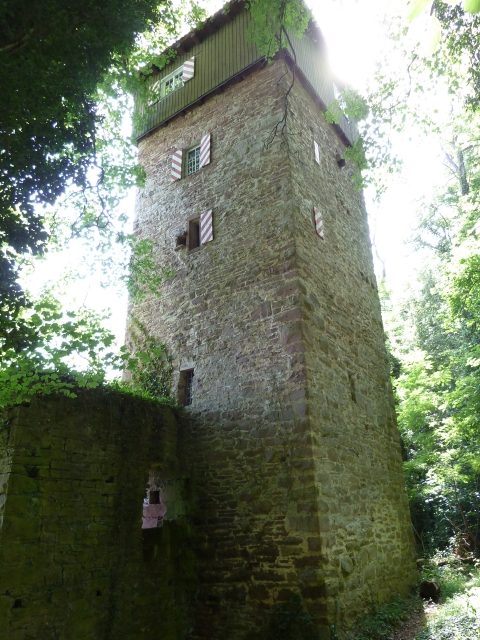
Dauchstein Castle near Binau in the Neckar-Odenwald district in Baden-Württemberg is believed to have been built around 1030 as a toll castle for Neckar shipping. According to tradition, the collection of the road toll was carried out with the help of a chain stretched across the Neckar, which was only lowered (gedaucht) after the required toll had been paid, hence the name Dauchstein. Ludwig Hildebrandt, however, sees the etymological derivation Tahenstein/Tugstein/Duckstein/Dauchstein, which is now commonly known as Tuffstein (tuff stone).
Location+
The hilltop castle is located in the southern Odenwald on the Neckar above the B 37 and is built on a rock plate. It stands on a hill of calcareous tuff formed by a highly calcareous water source.
The origins of the castle are largely unknown. Around 1080, a Kuno von Tahenstein is mentioned (once) in a document, whose seat did not necessarily have to be Dauchstein. Only at the beginning of the 14th century do further documentary mentions appear. A piece of scaffolding wood found on the residential tower in 2004 by local historian Ludwig Hildebrandt was recovered by the State Office for Monument Preservation and its felling time dated to the winter of 1334/1335, which may be an indication of the construction period of the residential tower. Hildebrandt assumes that at that time the castle was rebuilt on the orders of the Palatine Counts, who then occupied Dauchstein Castle with a ministerial family, who from then on called themselves von Bynheim and appear in documents in 1343/44 with Heinrich von Bynheim.
In 1359, Johann von Binheim, with his wife Ysengret von Helmstatt, sold some smaller meadows and fields in Zuzenhausen to Gerung von Helmstatt. After the Lords of Binheim apparently died out in the male line at the end of the 14th century, the castle passed to the Lords of Helmstatt (Asbach branch). From 1398–1421, Ysengret's brother, Swicker the Elder von Helmstatt, appears as lord of the castle. From 1423–1426, his son Swicker the Younger, and from 1423–1448, his brother Hans. The construction of the palace, of which only remnants are still visible today, also falls into this period. Hans von Helmstatt and his wife Margarete von Angelach finally sold Dauchstein Castle and the village of Binau to Dieter von Bödigheim in 1448.
In the second half of the 16th century, the two daughters of Georg von Bödigheim, Margarete and Felicitas, married the brothers Hans Dieter III. and Hans Hans VI. Landschad von Steinach. Around this time, the castle in Binau was built, where the local nobility resided in the future. In 1605, Hans Ulrich Landschat wrote about the father of the two Steinachs married to the Bödigheim sisters, Christoph II., in a chronicle: "His two sons had two sisters from Bodickheim as wives, so that they received the magnificent estate of Binau". Hildebrandt assumes that it was the Landschad von Steinach who built the castle in Binau, and not, as previously assumed despite apparently missing documents, the von Bödigheim.
Since Dauchstein Castle was no longer used as a residence after the construction of the castle, it was left to gradual decay. On May 2, 1629, Dauchstein Castle and Binau were then sold to the Lords of Hunoltstein. Around 1676, a prison in the basement of the residential tower and a presumably newly built guardhouse are reported. However, this is said to have been built only after the decay of the palace. In 1706, the property passed to Johann von Violäth, and between 1714 and 1763, the Barons von Adelsheim appear as owners. In 1767, Count Andreas von Riaucour and in 1771 his son-in-law Carl Theodor von Schall-Riaucour appear as lords of the castle.
Current Use+
Since the late 1990s, the castle has been in private ownership. The new owners secured the complex, made the residential tower habitable again, and uncovered the filled-in cellar.
Correction: Dauchstein Castle was owned by Countess v. Waldkirch until the end of the 19th century. The property also included the castle in Binau and some lands. The then Privy Councillor Heinr. Propfe bought all of Countess Waldkirch's property in the municipality of Binau, including Dauchstein Castle, from her in 1869. He lived with his family in the castle in Binau. In early 1960, the State Office for Monument Preservation issued requirements for securing the castle. Under the direction of a master builder Ringel, who was well versed in dry stone masonry, the tower and the surrounding area were secured with the cooperation of mainly Heidelberg students. Inside, the rooms on the respective floors were expanded and provided with electricity and water connections. In coordination with the Monument Preservation Office, a wooden attic was built as the completion of the defensive tower. The municipality of Binau built a new access to the castle. During excavations, a number of historically valuable objects were unearthed in the so-called dungeon inside the defensive tower. The objects found there are state property.
On June 2, 1999, the castle was sold from the Propfe family estate to a private "castle collector".
Complex+
Of the castle complex today, essentially only the residential tower remains. The other buildings (palace and the 1.7 meter thick shield wall) are ruins and only recognizable in remnants. The former palace has largely disappeared after the demolition of part of the rock plate. The residential tower, often mistakenly described as a keep, is 20 meters high and covers an area of 6 x 6 meters. In addition, the tower has two special features: its latrine was not exposed as usual, but internal with a drainpipe to the outside. Also, the floors of the residential tower are not connected by wooden stairs or ladders, but by very narrow and low staircases in the outer wall.
At the beginning of the 20th century, the tower was renovated and provided with an additional floor. From the top floor of the residential tower, there is a view of the Neckar and the Obrigheim nuclear power plant on the other side of the Neckar.
The slope on which the castle is located appears to have been terraced in the past. In old views around 1900, the castle was still widely visible. Today, however, the slope is overgrown with forest trees, so that the castle can only be made out from certain angles from the Neckar valley. There are two water sources on the castle grounds.
Take Mobile History with you
You are reading this text for free. Premium adds what matters on the road: descriptions read aloud, sites found through your camera, whole regions taken offline.
- Every description, including the ~17,700 Premium sites
- Audio guide: have descriptions read to you on location
- AR finder: see sites through your camera, with distance and bearing
- Unlimited saved sites
14 days free, then from €2.99 a month. Cancel anytime.
Source: Wikipedia · Licence: CC BY-SA 4.0 · Image: Bernd Walter
This description draws on the facts documented in the linked Wikipedia article; Wikipedia content is licensed under CC BY-SA 4.0. Wording and editing: Mobile History.
Location: 49.3690, 9.0731