To be privately owned
CastleVilseck
Dagestein Castle
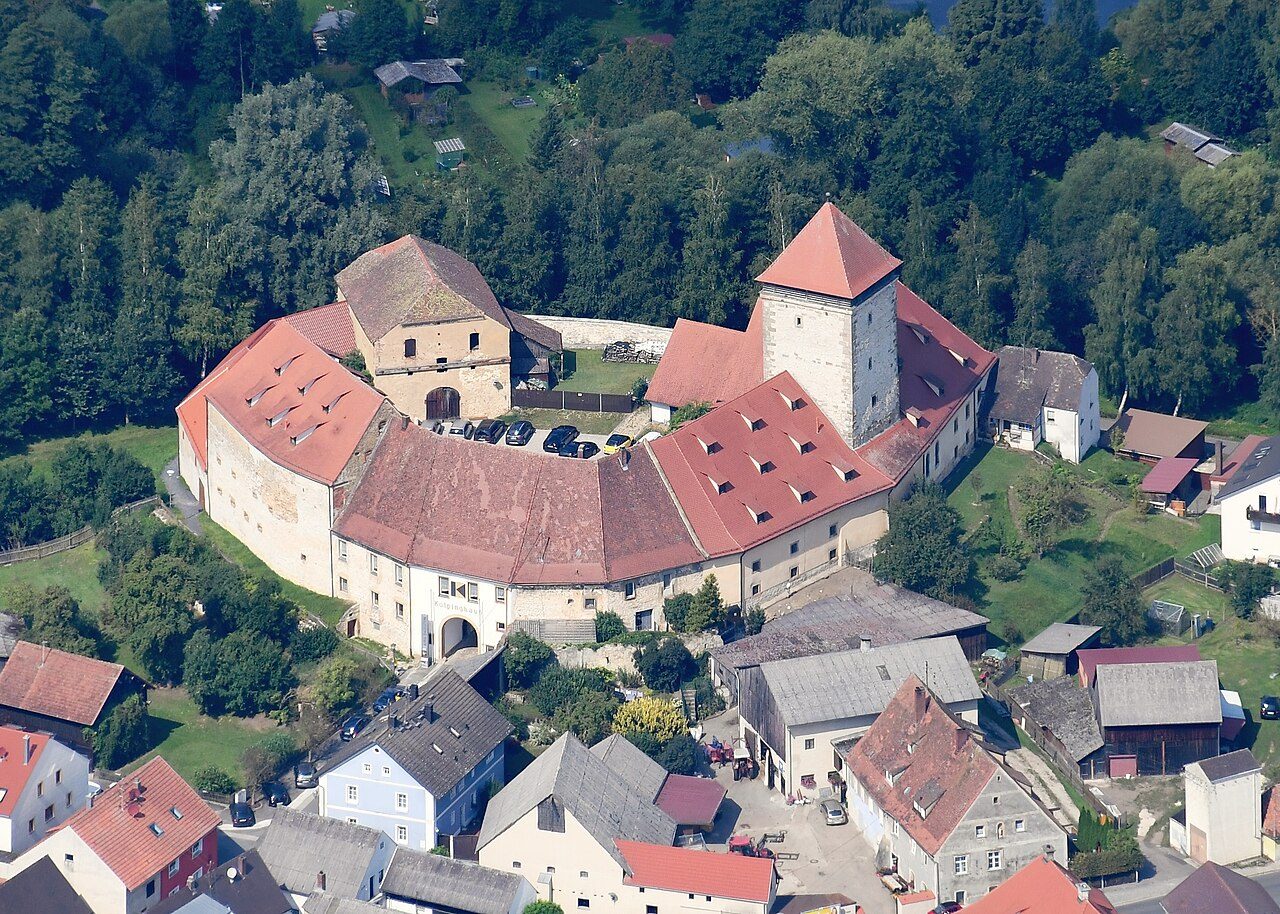
Dagestein Castle is a castle located within the town at an elevation of approximately in the city of Vilseck, Schlossgasse 6-8, in the Bavarian district of Amberg-Sulzbach. It is one of the early castles in the Upper Palatinate.
The beginnings of the lowland castle, which was first documented at the end of the 12th century, are unclear. Archaeological investigations inside the castle complex have so far yielded no concrete evidence for an early medieval foundation of the complex.
In 1185, Vilseck was first mentioned in a document as part of the possessions of the Prince-Bishopric of Bamberg. In 1205, a Megelaus von Dagestein was named in a document, and after the extinction of the Dagestein family, the lords of the castle named themselves after the aspiring town of Vilseck. The castle was expanded into a moated castle in the 15th century. During the feud between Götz von Berlichingen (Knight with the Iron Hand) and the Bishop of Bamberg, it was plundered and burned in 1512, but then rebuilt. In 1552, the complex, which was by then mainly used as a granary and prison, was conquered by Margrave Albrecht Alcibiades of Bayreuth. Around 1730, extensive new constructions took place, and in the course of secularization, parts of the castle were sold to Vilseck citizens in 1802. In the years 1796/97, the robber captain Franz Troglauer was imprisoned in the castle for several months. Today it is owned by the city; from 1999 to 2002, extensive renovations were carried out on the keep.
Description+
The castle complex is a medieval structure grouped around an inner courtyard with a ring wall, gatehouse, tithe barn (granary), zwinger, and a five-story Romanesque keep. The oldest surviving above-ground structural remains are parts of the ring wall, which date back to the 11th/12th century. The lower floors of the keep of Dagestein Castle were built around 1200; this sandstone masonry consists of ashlar blocks. Its entrance is located several meters high (high entrance). The castle chapel of St. George was formerly located on the second floor of the keep.
In terms of security, the castle was protected to the east and southwest by the zwinger and to the east and west by a moat, which is now filled in.
Take Mobile History with you
You are reading this text for free. Premium adds what matters on the road: descriptions read aloud, sites found through your camera, whole regions taken offline.
- Every description, including the ~17,700 Premium sites
- Audio guide: have descriptions read to you on location
- AR finder: see sites through your camera, with distance and bearing
- Unlimited saved sites
14 days free, then from €2.99 a month. Cancel anytime.
Source: Wikipedia · Licence: CC BY-SA 4.0 · Image: Carsten Steger / CC BY-SA 4.0 via Wikimedia Commons
This description draws on the facts documented in the linked Wikipedia article; Wikipedia content is licensed under CC BY-SA 4.0. Wording and editing: Mobile History.
Location: 49.6136, 11.8089