Museum
CastleCoppenbrügge
Coppenbrügge Castle
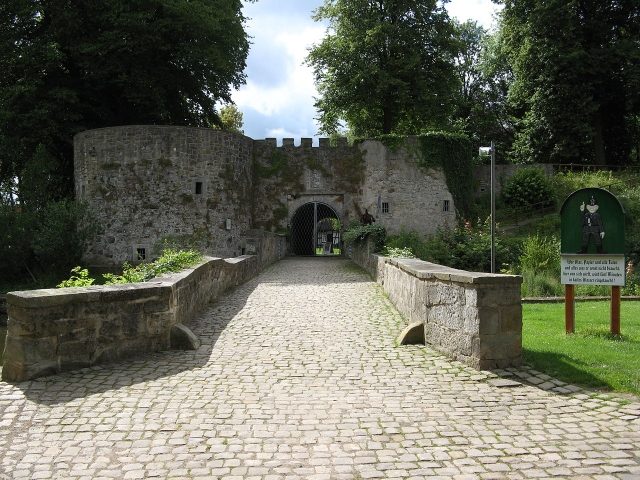
Coppenbrügge Castle, also known as Schloss Coppenbrügge, is the well-preserved ruin of a moated castle in the municipality of Coppenbrügge in the district of Hameln-Pyrmont in Lower Saxony.
Between 1280 and 1300, the Counts of Spiegelberg built a moated castle complex as the center of their county and to secure the old military and trade route from Aachen to Königsberg, which led over a corduroy road through a swampy area near the castle. In 1303, the castle was first mentioned in a document with its new construction. After the castle was severely damaged during the "Spiegelberg Feud" in 1434 - the counts were branded as robber knights - the now impoverished Spiegelbergs inherited the County of Pyrmont in 1494 and rebuilt the castle in the early Renaissance style. The new seat of the Spiegelberg counts became Pyrmont Castle; an administrator remained at Coppenbrügge Castle.
From 1631, the castle was in Nassau possession and was already dilapidated by 1697. At this time, it was the meeting place of Tsar Peter the Great on his journey with the "Grand Embassy" from Moscow to Amsterdam with Electress Sophie of Hanover and her daughter Sophie Charlotte of Hanover.
In the 18th century, the castle was renovated in the Baroque style, resembling a palace, by the House of Nassau-Orange. After its sale to the Kingdom of Hanover in 1822, the castle was demolished, and around 1870, the outbuildings followed, except for a half-timbered house (chancery building) at the back of the castle courtyard. In 1945, the ruin was briefly used as a quarry. Afterwards, the former chancery building served as the seat of the Coppenbrügge district court and is now used as a museum.
Special Features+
A linden tree on the castle wall was named "Peterlinde" (Peter's Linden). It commemorates the meeting of the Russian Tsar Peter I in 1697 with the Electress and her politically significant children, which was so friendly, crowned with an evening celebration, that historians speak of a "Ladies' Peace of Coppenbrügge". The meeting at Coppenbrügge is said to have initiated a turning point in the development of Europe, preventing a war between Austria and Brandenburg-Prussia.
Take Mobile History with you
You are reading this text for free. Premium adds what matters on the road: descriptions read aloud, sites found through your camera, whole regions taken offline.
- Every description, including the ~17,700 Premium sites
- Audio guide: have descriptions read to you on location
- AR finder: see sites through your camera, with distance and bearing
- Unlimited saved sites
14 days free, then from €2.99 a month. Cancel anytime.
Source: Wikipedia · Licence: CC BY-SA 4.0 · Image: http://commons.wikimedia.org/wiki/File:Burg_coppenbr%C3%BCgge_front.JPG?uselang=de
This description draws on the facts documented in the linked Wikipedia article; Wikipedia content is licensed under CC BY-SA 4.0. Wording and editing: Mobile History.
Location: 52.1183, 9.5481