Hotel
CastleColmberg
Colmberg Castle
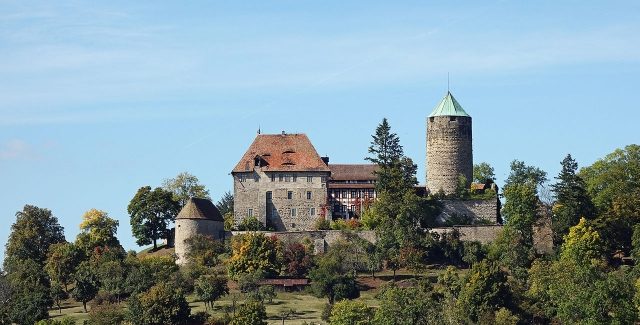
Colmberg Castle, also known as Kolbenberg Castle, is a spur castle on the 511 m above sea level "Heuberg" in the Altmühltal, 35 meters above the market town of Colmberg in the district of Ansbach in Bavaria.
Traces of Neolithic hunters were found on the Heuberg (formerly Eichelberg), located directly above the village of Colmberg. During the Celtic period, there may even have been a small settlement there. The entire upper Altmühltal consisted of primeval forest on the hills and swamps near the river and streams at the beginning of the Middle Ages.
After 720, the local area was taken possession of by the Frankish kings and used as a hunting ground. Charlemagne himself is said to have hunted aurochs here, which the place name Auerbach (Colmberg) still commemorates today.
During the Carolingian era, around the year 770, a small palisade castle with a wooden tower was built here on the 511-meter-high mountain spur, 54 meters above the valley floor, to oversee the entire area from the source of the Altmühl near Hornau to the bottleneck near Frommetsfelden. The rectangular shape of the inner castle complex still proves this today.
Counts of Truhendingen
After Colmberg came into the fiefdom of the Counts of Hohenlohe in 1128, the old fortification was expanded into an imperial castle between 1150 and 1240 under the German emperors and their bailiffs, and in 1254 it passed to the Counts of Truhendingen. They had Colmberg Castle administered by poorly paid bailiffs, who exploited the then lawless state for their own benefit through arbitrary abuses. The oldest court records of the imperial city of Rothenburg attest after 1274 to an almost endless chain of complaints about crimes committed by Colmberg officials before the local court, e.g., unpaid debts, unfulfilled guarantees, trespassing, robbery, deprivation of liberty, theft, and arson. Finally, in 1293, it was not the then Truhendingen bailiff, but the entire Colmberg Castle that was outlawed. Because the Counts of Truhendingen fell into ever greater financial difficulties, they separated from this ill-reputed fortress, a documented robber baron castle. Colmberg was finally sold on July 13, 1318, together with the city of Leutershausen and the surrounding area, for 6200 pounds (Swabian) Haller Pfennige to Burgrave Friedrich IV of Nuremberg.
Franconian Hohenzollerns
For almost 500 years, this fortress and its surroundings were an important possession of the Hohenzollerns, which they pledged three times due to debts, but always redeemed. Their bailiffs from here monitored access to the imperial city of Rothenburg ob der Tauber, with which the burgraves maintained an extremely strained relationship. And so, in 1407, the castle became the gathering place for all Hohenzollern vassals and their allies in a warlike conflict with Rothenburg and its mayor Toppler, which arose from a feud. An estimated 10,000 men marched under the leadership of Burgrave Friedrich VI to besiege the imperial city. Rothenburg finally had to negotiate and allow five castles in its own possession to be razed. Due to the enormous costs incurred by the victorious war against Rothenburg, Friedrich VI now moved his main residence to Colmberg Castle. Here, the maintenance costs were considerably cheaper than at Cadolzburg or in Nuremberg.
After the successful campaign against the Turks, in which he saved the life of Sigismund of Luxembourg, who was elected German king in 1410, Friedrich was granted the hereditary dignity of Margrave and Elector of Brandenburg on April 30, 1415, as a thank you: Burgrave Friedrich VI became Margrave Friedrich I (Brandenburg). Due to the newly acquired territory, he was often in Northern Germany and left the government of the local margraviate to his wife Elisabeth of Bavaria-Landshut (called "Schöne Else"), who still resided here. When Friedrich died in 1440, the castle became the widow's residence of "Schöne Else" for two years. The pictures of the famous couple can still be found today in the castle chapel above the harmonium.
After the death of "Schöne Else", the castle remained the center of the margravial Oberamt Colmberg. The administrators of the Oberamt Colmberg were called Oberamtsleute or bailiffs (their representatives in the local bailiwick). However, the Hohenzollerns also had their problems with their castle bailiffs, because they could not adequately supervise them from Berlin or Ansbach. Allegedly, the Colmberg bailiff Rüd had captured a Rothenburg councilor passing by with a wagon train and left him to rot in the castle dungeon. In any case, in 1449, the Rothenburg soldiers plundered 18 margravial villages throughout the upper Altmühltal and burned them down together with the Upper Suburb of Leutershausen. Because they could not storm the walls of the fortress - which was bombarded with catapults - the village of Colmberg was also reduced to ashes. In return, Margrave Albrecht Achilles, for his part, had his soldiers burn down many Rothenburg villages within the so-called Landhege from here.
However, not only the Rothenburg offensive in 1449, but also all later attacks, including those during the Peasants' War, failed at the well-fortified wall rings and moats of Colmberg Castle. In 1525, "Red Konrad", who had previously destroyed around 200 castles and palaces in Franconia, had to surrender to the strong walls. Shortly before the Thirty Years' War, the projecting bastion with small cannons was added to the southern outer wall ring. The imperial general Tilly, who wanted to conquer the castle in 1631, was unsuccessful in his attempt to take the fortress. During the Thirty Years' War, the castle was thus a reliable protection for the surrounding population. During the subsequent Baroque period, however, the castle lost its importance. The margravial chief official was mostly in Ansbach and was represented by the bailiff or castellan.
Under Prussian and Bavarian Administration
After the abdication of the last Margrave Alexander in 1791, Colmberg was under Prussian administration until 1806. When the Kingdom of Bavaria reorganized the territory of the former Margraviate handed over by Napoleon I, Colmberg Castle became the seat of a Rentamt (revenue office) in the Leutershausen district court in 1810, which saved the castle from being sold for demolition.
Private Ownership
When the Leutershausen district court was abolished at the beginning of 1880 and the local Rentamt was moved to Ansbach, the Bavarian state sold the castle, which had become useless to it, to the Würzburg merchant Rösner. In 1888, the castle then passed into the possession of Alexander Freiherr von Siebold and was sold in 1896 to Major Klingebeil, who committed suicide in 1903 by jumping from the outer wall. His widow Käthe Klingebeil-Glüber lived in the castle for another 24 years.
From 1927, the castle was owned by Ernst Arthur Voretzsch, German envoy in Lisbon and from 1928 to 1933 ambassador to Japan. His nephew Ernst Adalbert Voretzsch, castle administrator in Colmberg, became a chief operations leader in the Einsatzstab Reichsleiter Rosenberg (ERR) during the Nazi era and deposited 25 truckloads of looted cultural assets, including icons from Pskov and Novgorod, in Colmberg. In 1946, 1178 icons and paintings from this collection were restituted to the Soviet Union by the US occupation forces in a first shipment.
After Voretzsch's death in 1964, Colmberg Castle then came into the possession of the Unbehauen family from Colmberg, who still own the castle today.
Architectural Description+
Comberg Castle is a medieval sectioned castle. The lower part of the palas with the Kemenate dates from around 1150, and the approximately 35-meter-high four-story round keep, with walls up to 6 meters thick made of bossage stones with holes, connected by a walkway to the battlement of the inner wall, dates from around 1250. Margrave Albrecht Achilles had the castle chapel on the 1st floor of the Kemenate building (women's house in the middle part of the castle) furnished. The Gothic tracery of the chapel and the foundation charter of May 3, 1451, are still preserved.
The keep had a deep well (draw well). The court loggia next to the keep still commemorates the high and low justice exercised at the castle by the Colmberg chief official. On the second floor below the palas were the castle dungeons, no longer accessible today, above which the medieval kitchen with its storage rooms was located. The armory on the ground floor had no access to the castle courtyard; this was only possible on the inside via an external staircase with a barrel vault, which led to the knight's hall on the first floor. All enemy attacks failed at the well-fortified castle complex, with an earthen rampart and moat, a double wall ring and outer well, a 1.3-meter-thick ring wall, and a neck ditch towards the mountain ridge.
Around 1700, the half-timbered building still preserved today on the right side of the castle courtyard, the margravial Kastenamt (revenue office), was built above the ground floor of the former stables, whereby old parts of the castle complex were demolished, e.g., the accesses to the outdoor latrines. The southern wall of the inner courtyard was also demolished, allowing the sun to finally shine into the castle courtyard. Before that, it must have been very dark, damp, and cold in winter here. Opposite the inner gate, a horse stable was built leaning against the outer wall, as there were no longer any stables.
The oldest known description of the fortress was written by the margravial surveyor and engineering lieutenant Johann Georg Vetter in 1732:
A princely Ansbach, well-built castle, which is equipped with a beautiful high tower built of pure ashlar pieces, with a castle chapel, granary, castellan's dwelling, castellan's and official's house, as well as with a double wall and various towers, lies to the north of the village of Colmberg on the mountain.
When the castle came into Rösner's possession in 1880, he invested considerable funds to at least secure the castle's existence. However, he is said to have broken off and sold the uppermost stone layers of the outer wall. Under Alexander Freiherr von Siebold, Colmberg Castle was later restored in the Gothic style.
When the tiled roof of the keep was swept away by a severe storm in August 1928, Voretzsch had it replaced by a copper dome, which is still present today.
Towards the end of World War II, the town of Colmberg was severely damaged on April 17, 1945. The castle was also shelled by American troops. However, the damage was limited.
The Unbehauen family finally converted the castle into a hotel with a restaurant.
Take Mobile History with you
You are reading this text for free. Premium adds what matters on the road: descriptions read aloud, sites found through your camera, whole regions taken offline.
- Every description, including the ~17,700 Premium sites
- Audio guide: have descriptions read to you on location
- AR finder: see sites through your camera, with distance and bearing
- Unlimited saved sites
14 days free, then from €2.99 a month. Cancel anytime.
Source: Wikipedia · Licence: CC BY-SA 4.0 · Image: https://commons.wikimedia.org/wiki/File:Burg_Colmberg,_4.jpg
This description draws on the facts documented in the linked Wikipedia article; Wikipedia content is licensed under CC BY-SA 4.0. Wording and editing: Mobile History.
Location: 49.3603, 10.4082