To be privately owned
CastleLehre - Flechtorf
Campen Castle
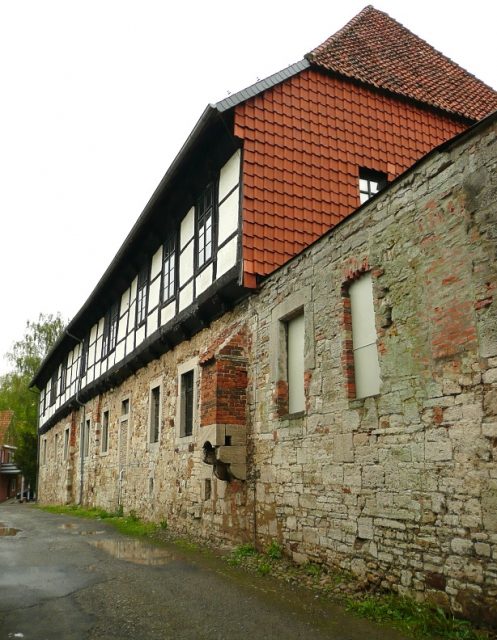
Campen Castle, also known as Schloss Campen, is a former lowland castle in Flechtorf, a village in the municipality of Lehre in the district of Helmstedt in Lower Saxony.
The castle complex is located south of the old village center of Flechtorf on an elevated plateau in the Schunter floodplains between two river arms. On the 80 x 100 m plateau, only a few remnants of the former castle walls remain. Of the historical buildings, a part of the princely administrative building from the 16th century is still present, which features a stone ground floor and a half-timbered structure built on top.
The castle was probably built some time before its first mention in 1279 on an island enclosed by two arms of the river Schunter, to protect the trade route Braunschweig-Altmark. The Welf ministerialis family of Blankenburg, first attested in 1158, was enfeoffed with the castle and subsequently named themselves after it. However, already in 1326, Knight Jordan von Campe had to renounce his rights.
The first documentary mention of Campen Castle occurred in 1279 in connection with the conquest of the castle by Duke Henry the Wondrous and Duke Albert the Fat. They were in a dispute with Otto I as Bishop of Hildesheim and captured 70 of his vassals during the taking of the castle. Four siege ramparts, recorded on a map from 1740, bear witness to the siege at that time. Today they are no longer visible in the terrain. Among them, 300 meters from the castle, is the Pallwall, which was also used as a redoubt and is a square ringfort with dimensions of 40 x 40 meters from an unknown, but probably medieval, period. A medieval farmstead was discovered at the Pallwall during an excavation in 2000. It was covered by a thick layer of fire and weapon parts, such as crossbow bolts, were found. Therefore, it is assumed that the farmstead was destroyed during an attack on the castle in 1279.
In later centuries until 1512, the castle repeatedly changed owners through pawning by the Dukes of Braunschweig, including the von Saldern, von Knesebeck, and the city of Braunschweig. As a Merian engraving from 1654 also shows, Duke William the Younger (Braunschweig-Lüneburg) had the castle expanded into a five-winged palace complex between 1585 and 1596. This included a gatehouse, a stable, a cavalier's house, a prison, and a pleasure garden.
In 1706, the castle became part of the Principality of Braunschweig-Wolfenbüttel and served as a princely administrative building. The administrative building with its outbuildings later became the Campen domain. It was acquired by the municipality of Flechtorf in 1860, reforested, and leased in parcels. An innkeeper bought the castle complex in 1875.
In the 18th and 19th centuries, the postal route Braunschweig–Calvörde ran over the former castle.
20th Century
By the 20th century, only the two-story main building of the castle's original structure remained. On April 1, 1932, the Hitler Youth leased the main building at the instigation of the Braunschweig NSDAP Gauleiter Hartmann Lauterbacher. A "Gau leadership school" was established as a central training center for the HJ leadership. It was named "Albert-Leo-Schlageter-Haus" after the Freikorps fighter executed in 1923. According to a statement by "Reichsjugendführer" Baldur von Schirach, this was the first "leadership school" of the HJ ever. Lauterbacher later played a decisive role in the establishment of the Academy for Youth Leadership of the Hitler Youth in Braunschweig. From May 1932, courses for up to 40 participants from the Hitler Youth, Jungvolk, and League of German Girls took place in Campen. On January 8, 1933, the school was closed due to lack of funds.
Shortly after the seizure of power in 1933, Campen Castle temporarily continued to serve as a training location, conference center, and junior leader school for the Hitler Youth. In 1937, it was acquired by the NSDAP. After World War II, the castle became the property of the state of Lower Saxony. In 1970, the municipality of Flechtorf rejected taking over the complex, as renovation would have cost approximately 500,000 DM. Today, it is again in private ownership and serves as a residence.
Take Mobile History with you
You are reading this text for free. Premium adds what matters on the road: descriptions read aloud, sites found through your camera, whole regions taken offline.
- Every description, including the ~17,700 Premium sites
- Audio guide: have descriptions read to you on location
- AR finder: see sites through your camera, with distance and bearing
- Unlimited saved sites
14 days free, then from €2.99 a month. Cancel anytime.
Source: Wikipedia · Licence: CC BY-SA 4.0 · Image: http://de.wikipedia.org/wiki/Datei:Burg_Campen_Hauptgebaeude.jpg
This description draws on the facts documented in the linked Wikipedia article; Wikipedia content is licensed under CC BY-SA 4.0. Wording and editing: Mobile History.
Location: 52.3524, 10.7093