Museum
CastleSchlüchtern - Elm
Brandenstein Castle
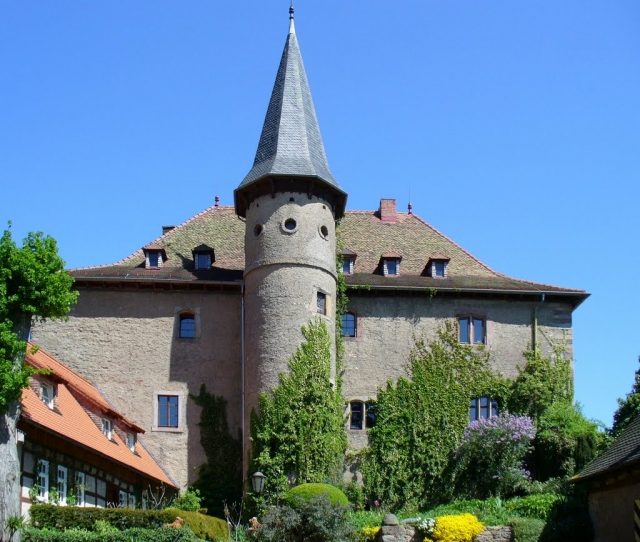
Brandenstein Castle is a high medieval castle in the Hessian Landrücken near Schlüchtern-Elm in the Main-Kinzig district, Hesse. The hilltop castle is located at 325 meters above sea level, four kilometers east of the city center of Schlüchtern and about 1200 meters east-southeast of Elm on a wooded mountain cone in the Bergwinkel region. The location offers a good view over the Kinzig valley. The surrounding mountain is now mostly forested, with a traditional orchard occupying the south slope.
History of Ownership
The castle was mentioned in 1278 in the oldest surviving documentary evidence as the property of Hermann von Brandenstein. In 1307, it passed, along with associated estates, the later Amt Brandenstein, as a fief of the Prince-Bishopric of Würzburg to the Counts of Rieneck-Rothenfels. In 1316, it came into the possession of Ulrich IV von Hanau. From 1424 to 1540, the castle was initially pledged, and later also held as a fief, by the Lords of Eberstein. After their extinction, the castle reverted to Hanau. In 1717, the castle, along with the associated Amt, was pledged by Hanau for a loan of 100,000 guilders to the Landgrave of Hesse-Kassel and has since been administered as part of the Landgraviate. The pledge sum served Count Johann Reinhard III, the last male member of the Hanau comital family, to secure the Hanau-Lichtenberg passive fiefs of the Diocese of Strasbourg and the Archdiocese of Mainz beyond his death for his only daughter, Landgravine Charlotte Christine, married to Hereditary Prince Ludwig (VIII) of Hesse-Darmstadt, and their heirs.
After the death of Count Johann Reinhard III in 1736, Landgrave Friedrich of Hesse-Kassel inherited the County of Hanau-Münzenberg and thus also Brandenstein Castle. However, the Amt Brandenstein was initially administered as a part of the Landgraviate, although due to the special circumstances in the family of the Landgraves of Hesse-Kassel, the County of Hanau-Münzenberg was treated as a secundogeniture for younger princes for over half a century. Only when Landgrave Wilhelm IX – initially regent in Hanau – also inherited the Landgraviate, were the Amt and Brandenstein Castle again assigned to the County of Hanau-Münzenberg, now practically a complete part of Hesse-Kassel. In 1803, the Landgraviate of Hesse-Kassel was elevated to the Electorate of Hesse, but then, on the losing side in the Austro-Prussian War of 1866, it ceased to exist as an independent state through annexation into the Kingdom of Prussia. The castle now belonged to the Prussian state.
In 1895, it returned to the hands of a Brandensteiner: The Württemberg officer Gustav von Brandenstein bought the castle. In 1905, Alexander von Brandenstein took over the property. In 1909, he married the daughter of the legendary Count Ferdinand von Zeppelin and was appointed Count by King Wilhelm II of Württemberg on the occasion of the wedding. He then bore the family name Brandenstein-Zeppelin. The castle remains in the family's possession to this day. The current owner of the castle is Constantin Graf von Brandenstein-Zeppelin.
Construction History
The castle was probably built after 1243 by a branch of the Lords of Steckelberg to secure their Vogtland territory. After 1316, the castle was expanded by Ulrich IV von Hanau as an administrative seat. In the 15th century, the castle was extended. Due to the raids and highway robbery of Mangold II von Eberstein and his feud against the imperial city of Nuremberg, the castle was bombarded and conquered in 1522 by order of Emperor Charles V by troops under the command of the Franconian district captain Count Georg II von Wertheim. After 1540, after reverting to the Counts of Hanau, the castle was converted into a Renaissance palace. During the Thirty Years' War, it served as a refuge for the inhabitants of the surrounding villages.
Since 1872, the 144 m long Brandenstein Tunnel of the Flieden-Gemünden railway line has passed through the castle hill in the area of the access road about 100 m in front of the castle. In 1895/96, Gustav von Brandenstein renovated the castle he had newly purchased.
Museums+
Since 1970, a wooden tool museum has been located in the former stable. Over 800 historical wooden objects – from hand-carved clothespins to flour sack beating machines – have been collected here. For several years, the exhibition area has also been increasingly extended to the publicly accessible courtyard.
On the upper floor, a collection on the life and work of the physician and Japan researcher Philipp Franz von Siebold, the great-great-grandfather of the current lord of the castle, can be visited.
In the vicinity of the castle, there is a forest exhibition with artworks made from natural materials and an arboretum and dendrology educational trail.
Take Mobile History with you
You are reading this text for free. Premium adds what matters on the road: descriptions read aloud, sites found through your camera, whole regions taken offline.
- Every description, including the ~17,700 Premium sites
- Audio guide: have descriptions read to you on location
- AR finder: see sites through your camera, with distance and bearing
- Unlimited saved sites
14 days free, then from €2.99 a month. Cancel anytime.
Source: Wikipedia · Licence: CC BY-SA 4.0 · Image: Thomas Eichler
This description draws on the facts documented in the linked Wikipedia article; Wikipedia content is licensed under CC BY-SA 4.0. Wording and editing: Mobile History.
Location: 50.3567, 9.5713