The Castle can be visited
Cultural Events
CastleBad Bodenteich
Bodenteich Castle
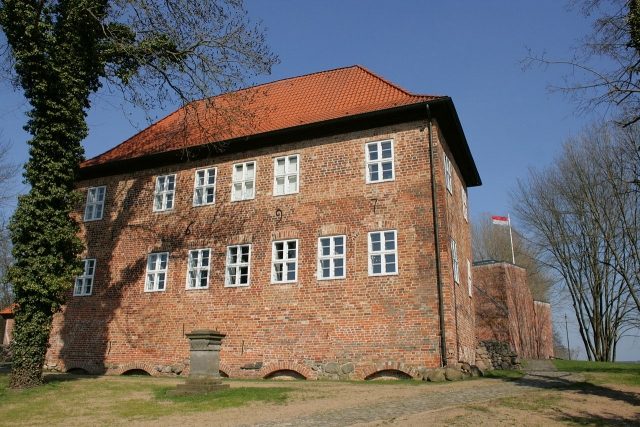
Bodenteich Castle is a former moated castle in Bad Bodenteich in the district of Uelzen. It was built around 1250 as the seat of the noble family of Badendieck or Bodendike on an artificially raised castle mound in a damp lowland area. From the 14th to the 19th century, the castle served the Dukes of Lüneburg as an official residence for the administration of the Bodenteich district. The preserved and reconstructed remains of the castle complex today represent a historic building ensemble used for cultural events.
Bodenteich Castle is located on an earth mound and was situated on the edge of a lake and a moor, which were drained in the 18th century. The castle complex consisted of an outer bailey and a main castle. Nothing more is known about the nature of its fortifications. According to tradition, the complex was surrounded by double moats and ramparts.
Today's castle buildings date from the period after the Hildesheim Diocesan Feud around 1520, as the castle was destroyed during it. Archaeological excavations on the castle mound uncovered a settlement layer with ceramic remains from the 9th to 10th centuries. In the cellar of a former half-timbered building of the castle, the remains of a stone tower were found, which is attributed to the castle's origin in the 13th century. It had a diameter of eight meters and its two-meter-thick walls consisted of fieldstones. Next to the former tower, the manor house was later built, which was originally probably executed in Gothic style. In the area of the outer bailey, there have been several farm buildings since modern times. These included a granary, a cattle, pig, and sheep stable, and a prison.
In the area of the main castle is the keep from the 14th century. The mighty, almost square tower has external dimensions of around 11 meters. It has a wall thickness of 3.5 meters and was built of bricks. Its original height is estimated at 30 meters. According to tradition, the district prison was located in the lower room of the tower in 1681. The three floors above served as a granary. After a large town fire in Bodenteich in 1808, the tower was largely demolished to obtain building material. Today it has a height of 8.5 meters and has a viewing platform at a height of 4.5 meters.
Due to the settlement remains from the 9th/10th century found on the castle mound, it is assumed that the first fortification was built during this period. It could have served as a defensive structure of the Billungers against the westward advance of the Wends and could belong to a line of fortifications with complexes in other places, such as Bardowick and Lüneburg.
The first bearer of the name of the Bodenteich family is mentioned around 1145 with Theoderico de Bodendiche. It is presumed that the knights left a small motte in the village around 1200 and built the castle. It was first mentioned in a document in 1293 in a contract. In it, Duke Otto II of Brunswick and Lüneburg sold the minting rights of the city of Lüneburg and to the estates. Around 1347, the castle was sold to the Dukes of Lüneburg, who made it their administrative and judicial seat. From 1393 until the beheading of Ludolf von Bodenteich in 1474 in Lüneburg, the castle was the seat of robber knights. During the Hildesheim Diocesan Feud, the castle was besieged and destroyed after its capture. Between 1638 and 1918, a brewery was located on the premises. Its brew house was rebuilt in 2005. When the Bodenteich district court was established in 1852, it was located in the former castle until 1859. Until 1859, the castle was also the seat of the Bodenteich district. From 1871 to 1971, the castle buildings were in private ownership as a manor. In 1971, the municipality of Bodenteich acquired the complex and placed it under monument protection in 1972. In 1983, the castle buildings were restored. Today, the site with its historic buildings serves as a venue for various events, such as shooting festivals, Christmas markets, music concerts, exhibitions, baking days, and medieval markets. The local spa administration and the castle museum are located in the historic building ensemble.
Take Mobile History with you
You are reading this text for free. Premium adds what matters on the road: descriptions read aloud, sites found through your camera, whole regions taken offline.
- Every description, including the ~17,700 Premium sites
- Audio guide: have descriptions read to you on location
- AR finder: see sites through your camera, with distance and bearing
- Unlimited saved sites
14 days free, then from €2.99 a month. Cancel anytime.
Location: 52.8342, 10.6831