School of music
CastleWitten
Berge Castle
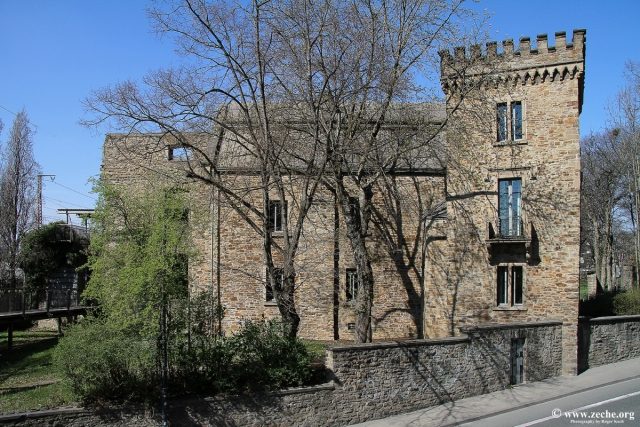
Haus Witten, also known as Burg Berge zu Witten, is a former knight's seat in the south of Witten's city center, built by Rötger von Witten and his brother Franco around 1470. Today, it houses the music school, indoor and outdoor event spaces, and a cafe/restaurant. It is located approximately 90 m above sea level.
The first documented mention dates back to 1479. The manor was situated on a slope leading to the Ruhr, partially protected by a ditch and a moat fed by the Huistenbecke stream.
During the Jülich-Cleves War of Succession in 1651, Haus Witten was set on fire by the troops of Duke Charles of Lorraine.
Gerhard Wennemar von der Recke, lord of the court of Witten, had the house rebuilt in 1701 and enriched with Baroque stylistic elements.
In 1790, the complex was leased by the merchant Johann Friedrich Lohmann from Schwelm, who established a cast steel factory and a grain distillery on the premises, and acquired it around 1815. Renovations in 1878 significantly altered the appearance of the house.
Haus Witten in World War II+
Due to its poor condition, Haus Witten was sold to the city of Witten in 1937 and used by the Hitler Youth.
Towards the end of World War II, the house was severely damaged by air raids on December 12, 1944, and March 19, 1945. What remained were primarily the street-facing tower, parts of the residential wing, and the outer walls of the three wings. For many decades, Haus Witten remained a ruin.
After the bombing, parts of the building, such as gables, were removed to secure the ruin. In 1964, further substance losses occurred due to renewed stabilization work. It was considered to preserve the remains of Haus Witten as a "maintained ruin." From 1975 to 1988, the ruin was then restored in nine construction phases. During this process, further building fabric at risk of collapse was also removed.
Restoration+
Since 1988, new perspectives have developed with the support of the state government. Haus Witten was to offer new spaces for the adult education center and music school, as well as for other cultural projects through expansion. A historical reconstruction was to be avoided. The newly constructed building parts were deliberately designed to contrast with the old substance in terms of material and form. The head of the Westphalian Office for Monument Preservation, Eberhard Grunsky, legitimized this concept with the condition of the ruin after World War II:
“What is protected as a monument is not Haus Berge in its form before World War II, but the existing fragmentary remains. The task of monument preservation will therefore not be to restore a former appearance by supplementing the ruin. The primary task of monument preservation is seen in conceiving and executing the new building parts necessary for use as independent constructive units, so that interventions in the historical substance are limited to the indispensable minimum.”
– Eberhard Grunsky: Haus Berge zu Witten. Text for the groundbreaking ceremony on November 22, 1992. Witten 1992, p. 3.
Between 1992 and 1996, under the direction of architects Hans Busso von Busse and Eberhard Carl Klapp, the complex was rebuilt using steel, concrete, and glass elements, while preserving the former floor plan and wall remnants. In 1998, it was awarded the North Rhine-Westphalia Architecture Prize by the Association of German Architects BDA. Striking building elements include the differently shaped steel windows and doors in contrast to the unplastered old building fabric, the regular concrete coffers of the ceilings, and various other steel elements such as columns, supports, stairs, and facade parts.
Current Use+
Today, Haus Witten houses, among other things, the municipal music school, the Witten Integration Office, and a restaurant. There are also various event rooms, including a cinema and concert hall. Furthermore, it is possible to get married in the premises of Haus Witten. In the basement of the house, there is also a small permanent exhibition with historical finds related to Haus Witten and the city of Witten itself. The inner courtyard and the concert hall serve as venues for ExtraSchicht, the Kultursommer, and the Wittener Tage für neue Kammermusik. Since 2011, it has been a station on the Route of Industrial Heritage, thematic route 11 Early Industrialization.
Take Mobile History with you
You are reading this text for free. Premium adds what matters on the road: descriptions read aloud, sites found through your camera, whole regions taken offline.
- Every description, including the ~17,700 Premium sites
- Audio guide: have descriptions read to you on location
- AR finder: see sites through your camera, with distance and bearing
- Unlimited saved sites
14 days free, then from €2.99 a month. Cancel anytime.
Source: Wikipedia · Licence: CC BY-SA 4.0 · Image: http://www.zeche.org/
This description draws on the facts documented in the linked Wikipedia article; Wikipedia content is licensed under CC BY-SA 4.0. Wording and editing: Mobile History.
Location: 51.4317, 7.3359