Museum
Restaurant
CastleGeestland - Bad Bederkesa
Bederkesa Castle
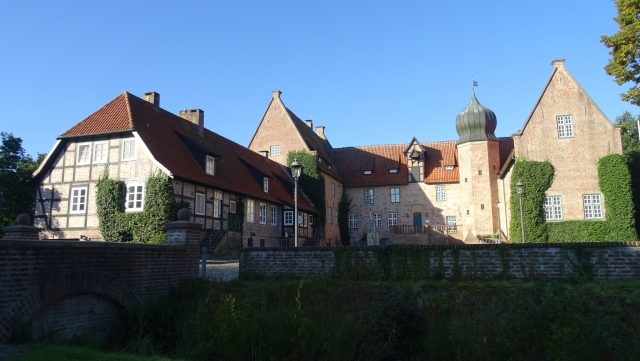
Bederkesa Castle is a lowland castle in Bad Bederkesa, a district of the city of Geestland in Lower Saxony. In front of it stands the Bederkesa Roland statue.
The construction of the castle dates back to the 12th century. Archaeological and scientific investigations confirm that around 1200, wooden buildings stood on the castle grounds. The builders were the Knights of Bederkesa.
The city of Bremen acquired half of the lordship in 1381 and finally the castle and lordship of Bederkesa in 1421.
By 1460, a stone house was erected, which is today the south wing of the castle. In 1536, the north wing was built, which was connected to the other part by the central wing in 1579.
Copper engravings by the architect Wilhelm Dilich (1571–1650) around 1600 show the castle surrounded by a moat.
In 1654, Field Marshal Hans Christoph von Königsmarck took possession of the castle for the Swedish royal house. In 1662, the Swedish Queen Hedwig Eleonora pledged the property to her field marshal, who had the castle's ramparts and bastions dismantled. Swedish rule in the Duchy of Bremen-Verden ended in 1712 with the Great Northern War.
In 1720, the castle fell to the Electorate of Hanover. Subsequently, the castle underwent numerous alterations, such as the demolition of half of the north wing in 1793 and the stair tower in 1749. In 1859, the Bederkesa district office was dissolved, and the castle lost its centuries-long function as an administrative seat. The Prussian government (the Kingdom of Hanover had become a Prussian province in 1866) sold the castle in 1881, and it was then used as an inn and excursion restaurant.
The by then very dilapidated Bederkesa Castle was purchased by the Wesermünde district in 1975. It was completely restored, with the north wing and the stair tower, which had been demolished in the 18th century, also being rebuilt.
Present Day+
Today, the castle serves as the district museum for natural and cultural history and houses the archaeological heritage conservation office of the Cuxhaven district and a restaurant.
Take Mobile History with you
You are reading this text for free. Premium adds what matters on the road: descriptions read aloud, sites found through your camera, whole regions taken offline.
- Every description, including the ~17,700 Premium sites
- Audio guide: have descriptions read to you on location
- AR finder: see sites through your camera, with distance and bearing
- Unlimited saved sites
14 days free, then from €2.99 a month. Cancel anytime.
Source: Wikipedia · Licence: CC BY-SA 4.0 · Image: Jörg Heldt
This description draws on the facts documented in the linked Wikipedia article; Wikipedia content is licensed under CC BY-SA 4.0. Wording and editing: Mobile History.
Location: 53.6265, 8.8424