The Castle can be visited
CastleSchöntal-Aschhausen
Aschhausen Castle
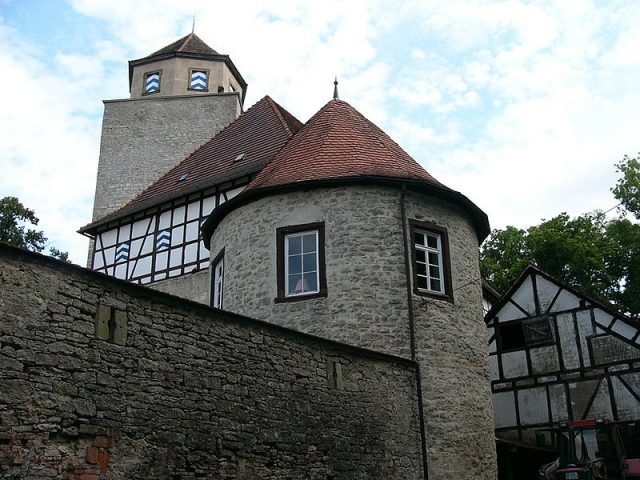
Aschhausen Castle is located in Aschhausen in the Hohenlohe district.
A Theoderich de Askehusen was already mentioned in 1165. The oldest part of the castle is the keep, which was built in the 13th/14th century. As early as 1537, a round tower was built to the south of the keep, which burned down in 1945 and was rebuilt. In 1579, a new building was added below the original castle district. Since 1315, the castle was a Mainz fief and fell back to Mainz after the extinction of the Lords of Aschhausen in 1657.
In 1732, the castle essentially acquired its present form with the two towers and the elongated main building. After the castle passed to the Duchy of Würzburg in the 19th century, Elector Friedrich granted it as a fief to Johann Friedrich Karl Graf von Zeppelin in 1803. The property also included the Aschhausen castle mill, which was sold in 1960. From 1894, electricity was generated here, and on November 16, 1894, Aschhausen was the first village to have electric light.
The end of the 15th century marked a time of upheaval. The loss of power of Emperor Charles IV and the election of Charles V increased insecurity on the roads in the German Empire. Robber knights roamed around, traveling merchants or envoys feared nocturnal attacks and could no longer feel safe. Although an eternal public peace was decided at the Diet of Worms in 1495, this measure did not contribute to settling the unrest. Seven years earlier, in 1488, Franconian and Swabian imperial estates had joined forces under the leadership of Nuremberg to form the so-called Swabian League. The aim of the alliance was to reduce attacks on traders and other travelers through cooperation. In 1489, the League was finally appointed as the imperial executive, i.e., the executive power.
In the middle of the 16th century, the robber knight Hans Thomas von Absberg kidnapped merchants from imperial cities in Franconia and Swabia on their trade journeys and demanded a high ransom for their release. To reduce the risk of being caught by troops of the Swabian League, he sought allies who would support him in his raids and hide his prisoners in their castles when in danger. Hans Georg von Aschhausen also supported him, hoping to replenish his dwindling riches a little. In 1523, the League sent its troops to raze a total of 23 "robber nests" to the ground. The League's troops, consisting of 10,000 foot soldiers and 1,000 horsemen, carried 100 cannons and 30 arquebuses with 900 hundredweights of gunpowder as armament. On June 14, they reached Aschhausen Castle and blew it up to prevent the return of the Aschhausen family.
The woodcut by Hans Wandereisen shows the destruction of the castle in 1523. One can see the burning castle complex. An outer enclosure is followed by an inner wall, interspersed with defensive towers. Behind it are several buildings and two larger towers. Smaller buildings and upper floors are made of half-timbering. On the main building, a coat of arms is visible above the doorframe and a protruding entrance area. Parts of the Swabian League's troops can be seen on the right and left of the image.
Take Mobile History with you
You are reading this text for free. Premium adds what matters on the road: descriptions read aloud, sites found through your camera, whole regions taken offline.
- Every description, including the ~17,700 Premium sites
- Audio guide: have descriptions read to you on location
- AR finder: see sites through your camera, with distance and bearing
- Unlimited saved sites
14 days free, then from €2.99 a month. Cancel anytime.
Source: Wikipedia · Licence: CC BY-SA 4.0 · Image: https://commons.wikimedia.org/wiki/File:Aschhausen01.jpg
This description draws on the facts documented in the linked Wikipedia article; Wikipedia content is licensed under CC BY-SA 4.0. Wording and editing: Mobile History.
Location: 49.3692, 9.5434