To be privately owned
CastleMicheldorf
Altpernstein Castle
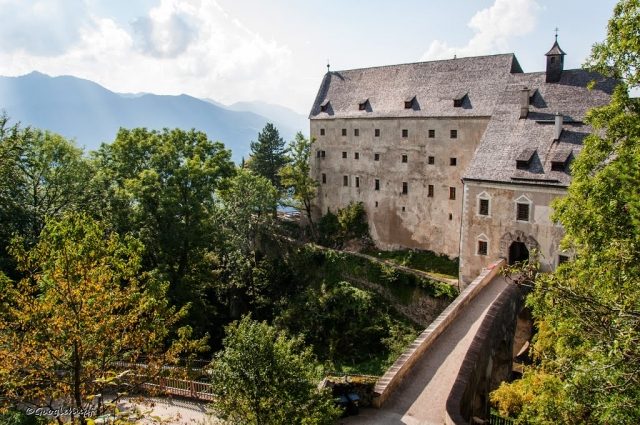
Altpernstein Castle is a medieval castle in Micheldorf in Upper Austria in the district of Kirchdorf an der Krems in the Traunviertel region. It is a spur castle with a neck ditch on a slope of its local mountain, Hirschwaldstein. The castle stands about 400 meters above the Kremstal valley, at an altitude of 900 meters above sea level. It is surpassed by its local mountain by a good 200 meters.
As the castle stands on a rocky outcrop, it is surrounded on three sides by almost vertical cliffs and on the fourth side by a moat. It is only accessible via a masonry bridge, which replaced a drawbridge in the 18th century.
The entrance to the castle is the lowest point of the roughly saddle-shaped rock on which the structure was built. From the guest terrace, it can be seen that the rock on the valley side extends up to the third floor, just below the roof truss.
The castle was built around 1000 and was mentioned in documents in 1160 and 1207. Pillung von Pernstein (documented 1170–1200) – he was a ministerialis of the Otakars – and his descendants were followed in 1222 by the Truchsener (Ministerial Heinrich von Grafenstein, 1255: Ulrich von Truchsen), who were able to convert the previous fief into free allodial property. This was acquired in 1337 by Governor Eberhard von Walsee. In 1394, Johann I von Liechtenstein was appointed castellan by the then Duke of Austria, Albrecht III of Habsburg. However, he fell into disgrace and only knew his property together with his family as a prisoner. In 1529, the castle was redeemed by Christoph Jörger, and in 1581 it passed into the possession of the Jörgers. Under the Jörgers, there was extensive building activity: the longhouse was built, which today makes up a large part of the complex. In 1607, they built the marble fountain in the inner courtyard. From 1623, the castle was owned by Adam Graf von Herberstorff, who was responsible for the incidents known as the Frankenburger Würfelspiele. After his death in 1629, Kremsmünster Abbey acquired the lands from his widow and is still their owner.
The castle is leased by the Catholic Youth of Upper Austria from Kremsmünster Abbey and is used as a meeting center. This began as early as 1946, when the newly founded Catholic Youth renovated the first rooms of the then completely uninhabitable castle to use them for events such as rural work weeks for male and rural youth weeks for female adolescents. In 1961, the still valid lease agreement between the owner and the Diocese of Linz was signed.
Complex+
The Burgstüberl (castle pub), guest terrace, castle chapel, castle dungeon, knight's hall, and event room are publicly accessible, while the majority of the rooms are either private rooms of the castle team, which manages and maintains the castle, or rooms for seminar participants. After the castle was handed over to the Diocese of Linz, the then very dilapidated building was renovated and has been fully utilized again since the 1960s. In the last 20 years, a part of the supporting rock was blasted to create a cold storage room under the baroque chapel. Due to an error, cracks appeared in the chapel, which is thus structurally endangered.
The 650 m² roof, covered with larch shingles, was last renewed in 2006.
The current outer castle gate was originally the innermost of the three gates in the gatehouse. Before the second siege of Vienna by the Turks, it was clad with old iron harnesses and breastplates, which still remain on the gate today. It has thus been in use for at least 320 years.
The inner courtyard of the castle is the smallest of its kind in Austria and probably also the smallest castle courtyard in Europe. Also noteworthy is the marble fountain, which testifies to the wealth of its builder (presumably Hans V. Jörger). Since no marble is found in the vicinity, it had to be imported, which represented a great financial expense in the 17th century.
Castle Team+
The castle team usually consists of nine people who live in and manage the castle. In addition to the persons responsible for building services, castle management, office, kitchen responsibility, Burgstüberl, and the content manager, the diocesan youth chaplain and at least one civilian servant also belong to this team. Since autumn 2008, there has also been a FSJ (Voluntary Social Year) position at the castle. The group, mostly young people, lives at the castle all year round, as it is never closed at any time of the year. Usually, a castle team member works at the castle for two to five years before leaving. Only the youth chaplain is exempt from this rule, as he retains his position as chaplain for a longer period. Civilian servants and volunteers are only at the castle for the duration of their commitment (nine or ten months). The castle team has existed since 1974.
Take Mobile History with you
You are reading this text for free. Premium adds what matters on the road: descriptions read aloud, sites found through your camera, whole regions taken offline.
- Every description, including the ~17,700 Premium sites
- Audio guide: have descriptions read to you on location
- AR finder: see sites through your camera, with distance and bearing
- Unlimited saved sites
14 days free, then from €2.99 a month. Cancel anytime.
Source: Wikipedia · Licence: CC BY-SA 4.0 · Image: Google Hupf
This description draws on the facts documented in the linked Wikipedia article; Wikipedia content is licensed under CC BY-SA 4.0. Wording and editing: Mobile History.
Location: 47.8850, 14.1567