Hotel
Museum
Restaurant
CastleAbenberg
Abenberg Castle
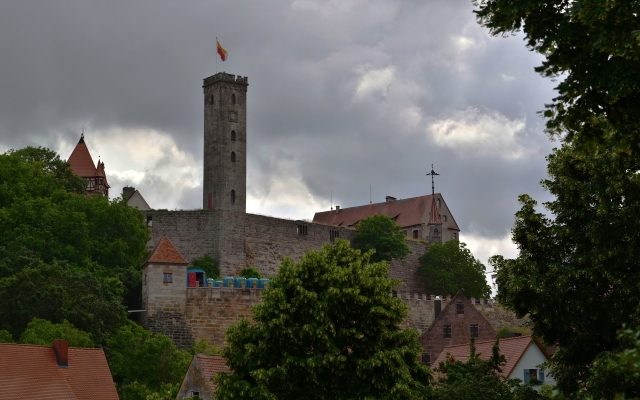
Abenberg Castle stands above the eponymous Middle Franconian town of Abenberg in the Bavarian district of Roth. The hilltop castle is occasionally referred to as the Crown of the Rangau.
In the 11th century, the Abenberg family emerged. Under Count Adalbert II (before 1040 to after 1059), the first castle was largely built of wood. Under Count Rapoto (1122–1172), it was replaced between 1130 and 1140 by one of Bavaria's most imposing stone castles (40 × 40 meters). The Abenberg noble family, whose last count Friedrich II was praised by Tannhäuser in the 13th century for his promotion of poetry, died out around 1200.
In 1236, the town and castle came into the possession of the Hohenzollerns, the then burgraves of Nuremberg (see also Konrad IV), through marriage, after the male line of the Abenbergs had died out with Count Friedrich II. From 1230–1250, the Nurembergers replaced the Salian-era building with a partial new construction, which they hardly used. For this, the curtain wall was demolished and the main castle was expanded to double its size. The front was thickened and the fortified castle gate was erected at the southeast corner. The curtain wall built at that time is the oldest preserved part of the castle.
In 1296, the castle was sold to the Prince-Bishopric of Eichstätt, which established an administrative office there and reinforced the weakly fortified northwest corner with a square tower.
In the 15th, 16th, and 17th centuries, a series of renovations took place. From 1496, the east front was provided with new administrative buildings. New utility buildings were constructed inside the castle. Subsequently, the castle fell into disrepair. In 1799, St. Otmar's Chapel collapsed.
In 1806, through secularization, the Kingdom of Bavaria came into possession of the castle and sold it for demolition. It was not until 1875 that the Munich art dealer K. J. Zwerschina acquired Abenberg Castle and saved it from total destruction. He rebuilt some towers, such as the 33-meter-high Luginsland. The next owner, the Kammersänger Anton Schott, continued Zwerschina's work between 1881 and 1913. After that, however, the castle again fell into disrepair.
The town of Abenberg acquired half of the castle in 1982 and the rest in 1984. To finance the renovation and maintenance, on March 8, 1986, together with the district of Roth and the administrative district of Middle Franconia, it founded the Abenberg Castle Special Purpose Association, which took over the castle as owner. The goal was to preserve the monument and culturally revitalize it. An operating concept in the form of a museum and a catering establishment was developed.
In the same year, extensive renovation work began, which lasted until the mid-1990s, followed by further expansion and conversion work, which concluded in 2001 with the opening of the Lace Museum. During the work, excavations took place from 1988 to 1992, providing information about the building's historical stages.
Excavation Results+
Through ceramic finds and post holes, the first wooden castle, dated to the 11th century, was proven in 1991. However, a reconstruction of the complex is no longer possible.
The first stone castle was built in the 12th century and consisted of a 40 × 40 meter main castle. The main building was a freestanding residential tower with a footprint of 15.6 × 14.6 meters, which rose in the middle of the castle courtyard. The masonry was 2.5 meters thick and consisted of sandstone ashlar. Directly south of the main castle stretched a large meadow, which Wolfram von Eschenbach describes in Parzival as a tournament field with "anger ze abenberc" and complains about its poor condition. The meadow was the only tournament field proven in Bavarian castles.
Today+
The castle houses a restaurant, the castle hotel, a conference center, as well as the House of Franconian History and the Abenberg Lace Museum.
Every summer, various concerts and the Feuertanz Festival take place on the castle grounds as part of the Burg Abenberg Open Air.
Miscellaneous+
- In the twelfth album of the French-Belgian comic series Michel Vaillant by Jean Graton, "The Knights of Königsfeld," the fictional Königsfeld Castle has the appearance of Abenberg Castle. The comic contains many detailed drawings of the castle complex. Jean Graton had stayed at the castle for two days to create photographic templates for the drawings. The comic album was created in 1965.
- The castle was repeatedly the workplace of a tower writer. Reinhard Knodt resided in the east tower from September 12 to October 10, 2004. During this time, Knodt worked literarily, attended public events, and presented works at readings in literary circles and schools. In 2007, Gerd Scherm followed him in the role of tower writer.
Take Mobile History with you
You are reading this text for free. Premium adds what matters on the road: descriptions read aloud, sites found through your camera, whole regions taken offline.
- Every description, including the ~17,700 Premium sites
- Audio guide: have descriptions read to you on location
- AR finder: see sites through your camera, with distance and bearing
- Unlimited saved sites
14 days free, then from €2.99 a month. Cancel anytime.
Source: Wikipedia · Licence: CC BY-SA 4.0 · Image: Peter Schneider
This description draws on the facts documented in the linked Wikipedia article; Wikipedia content is licensed under CC BY-SA 4.0. Wording and editing: Mobile History.
Location: 49.2434, 10.9628