Registry office
Beer Garden
CastleCoburg
Bürglaß Castle
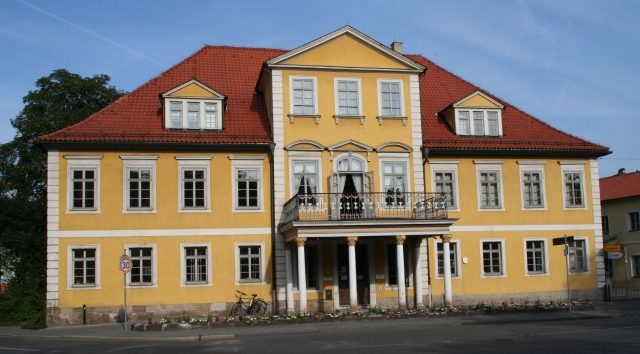
On Oberer Bürglaß street, opposite the back of the State Theatre in Coburg, stands the neoclassical Bürglaß-Schlösschen from the 18th century, which until the 1950s was called the Bulgaren-Schlösschen or Augusten-Palais. After his abdication, it served Tsar Ferdinand of Bulgaria as his residence for 30 years until 1948. Today, the castle is used as a registry office.
Original Building
Before the current Schlösschen was built between Oberer Bürglaß street and Theaterplatz, two houses stood on the same site, belonging to a larger area (also called Gottsmannshausen), which the Gottsmann family from Neuhaus am Rennweg acquired in 1572. In 1611, the property reverted to the sovereign. Duke Friedrich Wilhelm of Saxe-Gotha-Altenburg sold the house to Captain Georg von Bachstedt in 1652. In 1721, it was acquired by Dietrich von Henniges auf Rothenhof. He sold it in 1734 to the widowed Duchess Elisabeth Sophia of Saxe-Coburg-Meiningen, who sold it in 1737 to the merchant Friedrich Matthäus Scheler. In 1757, Hereditary Prince Ernst Friedrich was allowed to use the estate as a stately home. In 1794, Prince Friedrich Josias acquired the area and initiated the complete reconstruction of the two Gottsmann houses into the Bürglaßschlösschen in its current form.
New Building
Field Marshal Prince Friedrich Josias was the youngest son of Duke Franz Josias. In 1794, despite many military successes, Friedrich Josias bitterly requested his dismissal after tensions with the Chancellor of Emperor Franz II, in whose service he stood. The new castle was to serve him as a retirement home. After only ten months of construction, he was able to move into his domicile.
The building, covered by a high hip roof in the neoclassical style, is actually a simple two-story structure on a rectangular floor plan. The clever articulation of both long fronts by three-story central risalits extending far into the roof and two attached dormer gables on each side makes the Schlösschen appear well-proportioned. Above the main entrance on the street side, a mighty balcony rests on four columns, thus forming an open drive-through hall. In the triangular gable of the central risalit, Prince Josias had the Latin inscription Per actis laboribus (After work done) affixed, which was later removed. In the antechamber to the staircase inside the Schlösschen, the unknown architect placed a column-supported rotunda as a surprising stylistic element. On the first floor, Josias had a reception hall furnished, which is articulated by plastically painted pilasters. Two semicircular niches for Empire stoves are crowned by stucco reliefs. The room is visually expanded by its wall coverings with finely painted landscapes and ancient ruins on canvas.
During his retirement in Coburg, Prince Josias, through skillful negotiations, saved the city from looting when, in 1806, the French General Augereau quartered his Napoleonic troops in the city. The discussions were held in the reception hall of the castle.
After Josias' death in 1815, the property reverted to the ducal house of Saxe-Coburg. From 1816, Duchess Auguste used the Schlösschen as her widow's residence, which led to the name Augusten-Palais. In 1842/43, major alterations followed for Ferdinand von Coburg-Koháry, from the Catholic line of the ducal house, for use as a Coburg residence. Prince August von Coburg-Koháry and his wife Clementine von Orleans eventually used the palace temporarily.
Meanwhile, in 1840, the Court Theatre was built in the immediate vicinity, the construction of which cost the considerable front garden several meters. In 1902, Prince Philipp acquired the Augusten-Palais, where he lived his last years and died in 1921. His nephew Prince Cyrill became the new owner, before in 1925, his father Ferdinand, Tsar of Bulgaria until 1918, took over the castle, which quickly acquired the name Bulgaren-Schlösschen among the Coburg population. Ferdinand von Coburg-Kohary lived here and in the Tsar's Villa in the Hofgarten until his death in 1948. Only after that did the name Bürglaß-Schlösschen become established.
Josias Garden+
A wide door in the central risalit of the rear facade of the Bürglaß-Schlösschen leads via a few steps into the park-like garden that Prince Josias had laid out when his castle was rebuilt. The garden extended, as there was no Court Theatre, Schlossplatz, or Theaterplatz yet, to Ehrenburg Castle and, on the street side, to the Oberer Bürglaß, which at that time still ran straight towards the castle. It was designed as a landscape park with winding paths, fountains, and sightlines, and surrounded by a fence. On its western flank, the fish market regularly took place. The Josias Garden, as the park was called after the death of the popular prince and is still called today, lost more than three-quarters of its area due to the creation of the Schlossplatz in 1819 and the later construction of the Court Theatre and the new road that leads around the theatre. After its reduction, it was initially surrounded by a low wall with a fence on top, which delimited it from the new Theaterplatz. A garden gate flanked by two lion heads allowed passage to the Theaterplatz. In 1911, grateful citizens erected a larger-than-life monument to Prince Josias in his garden. Proudly, dressed in the uniform of an Imperial and Royal Field Marshal, he points with outstretched arm to his castle. At the unveiling of the monument, Duke Carl Eduard, Crown Prince Boris of Bulgaria, and the Belgian Count de Mérode were present. Today, the monument stands at the transition from the Theaterplatz grounds to the Josias Garden.
During the Second World War, the artfully forged fence, like many other fences in Coburg, was dismantled, as the metal was needed for the armaments industry. After 1948, the low wall and the now useless garden gate were also removed, except for a few remnants. The lion heads now adorn the garden entrance of the Schlösschen. In the street-side part of the garden, a large basin fountain stood in front of the main entrance until 1840, its sandstone central column was moved to the rear part of the garden, where it still stands today.
Current Use+
After 1948, the Schlösschen, which had belonged to the city since 1919, was initially used as a scenery and prop storage for the neighboring State Theatre. In the early 1960s, the city decided to renovate the building in accordance with monument preservation standards and to house the registry office stylishly within it. Prince Josias' reception hall has since served as a wedding room, the other rooms as offices and archives. In the 1990s, Coburg's largest beer garden was established in the Josias Garden, much to the chagrin of some residents who, due to the nightly noise, have so far tried in vain to have the operation shut down.
Take Mobile History with you
You are reading this text for free. Premium adds what matters on the road: descriptions read aloud, sites found through your camera, whole regions taken offline.
- Every description, including the ~17,700 Premium sites
- Audio guide: have descriptions read to you on location
- AR finder: see sites through your camera, with distance and bearing
- Unlimited saved sites
14 days free, then from €2.99 a month. Cancel anytime.
Source: Wikipedia · Licence: CC BY-SA 4.0
This description draws on the facts documented in the linked Wikipedia article; Wikipedia content is licensed under CC BY-SA 4.0. Wording and editing: Mobile History.
Location: 50.2602, 10.9667