To be privately owned
CastleHöfen
Boveri Castle
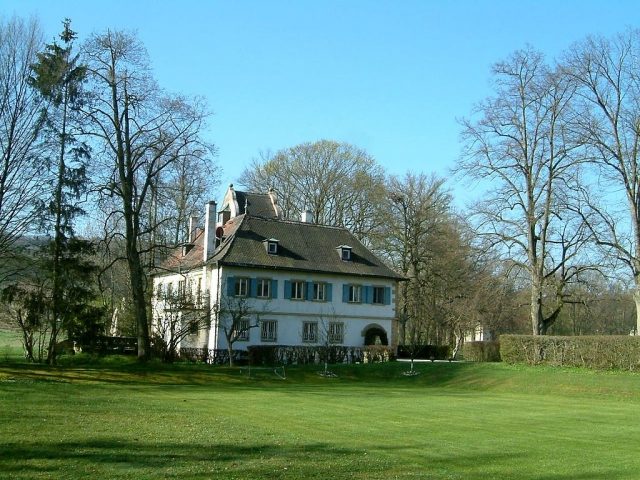
The estate of the writer Margret Boveri provides insight into the eventful history of the small castle near Höfen. It is a building that breathes history - that "Seehaus" (Lake House) that day-trippers coming from the Bamberger Bruderwald must pass just before their destination, the shady garden of the rural inn Melber. Few will know that Federal President Theodor Heuss was a guest here, as was the Nobel laureate and discoverer of the rays named after him, W.C. Röntgen, or the aircraft designer Willy Messerschmitt. The small castle is closely associated with the name and family of the writer and journalist Margret Boveri, who spent her summers here and who would have celebrated her 100th birthday on August 14, 2000, which is reason enough for us to take another look at the history and present of this house.
For life has returned, after Silvia and Thomas Herzog acquired the property four years ago and moved into the first floor after a partial renovation. "It was our dream," the two say, and explain that they had "crept around the house" for years. It was fate that almost at the same time as their wedding bells rang, the owner of the "Seehaus," structural engineer Hans Schleicher from Bamberg, passed away, and his nephew Gerhard Hergenhahn, living in the USA, offered the inheritance for sale. Aware that the two art dealers would appreciate the history of the house, Silvia and Thomas Herzog were awarded the contract for the three-hectare property. Silvia Herzog is a little "pre-burdened": the daughter of the Bamberg art dealer Walter Senger grew up in the Jesuit castle in Sambach.
His Life's Work
Hans Schleicher had acquired the "Seehaus" from Margret Boveri in 1968, and although he never moved in, he considered the renovation his life's work. Thus, Silvia and Thomas Herzog were able to limit themselves to the essentials when they took over. On the upper floor, subsequently installed walls were removed, and the generous flow of rooms was restored. Floors, windows, and doors were preserved, as were the two tiled stoves. Plumbing and heating were brought up to modern standards. The ground floor, where the elderly Hedwig Seipel lived until her death in autumn 1999, remains untouched for now. She was Margret Boveri's housekeeper and spent over 50 years here.
A Treasure Trove
It is a blessing that Hans Schleicher also knew how to preserve historical documents, because with the house he had also acquired boxes full of letters, invoices, records, and photos from Margret Boveri, which have now passed into the possession of the Herzogs. "A treasure trove," enthuses 32-year-old Thomas Herzog, and he never tires of rummaging through the documents. In the stairwell, pictures recall times when Margret Boveri spent summers with her parents in Höfen. Originally, of course, the "Wassersitzeshofstatt zu Höfen" was ecclesiastical property; in 1565, the then owners, three brothers von Rabenstein, had sold the estate to the Bamberg Cathedral Chapter. This included the "large lake" (today the Seewiese), the Brudersee beyond the Bruderwald (today also a meadow), and the lake in Unteraurach. In the "Seehaus" sat the "Seeknecht" (later "Seevogt"), who, as an agent of the Cathedral Chapter, was responsible for water management. As can be seen from the records of the Höfen teacher Deckelmann, in 1711 - after the medieval Seehof had become dilapidated - a Baroque house with a small stable was built. In the "Saal" - today the living room of the Herzog family - the ecclesiastical gentlemen are said to have regularly gathered for carp dinners. After secularization, Hofkammerrat Thomas Schuster, who died in 1804, acquired the property. His granddaughter Caroline married the Royal Hofrat Joseph Elsner, who took care of the expansion of agriculture and drained the two aforementioned lakes. In contrast to Elsner, who increased the property and died in 1879, his son-in-law, Dr. Theodor Boveri, a physician, sold and leased part of the fields and the mill. Boveri died in 1891, his widow Dr. Toni Boveri, née Elsner, on the other hand, was very fond of Höfen and lived from May to September in the "Seehaus," which was rebuilt in 1903. In place of the single-story stable, a two-story side wing with two rooms was added, and the old house was connected to the new wing by a small tower. Theodor and Toni Boveri had four sons: Oberregierungsrat Albert Boveri (died 1918) was district administrator (today Landrat) in Bamberg II; Theodor (died 1915) was Professor of Zoology at the University of Würzburg; Walter (died 1924) was co-founder of "Brown, Boveri und Cie. Aktiengesellschaft," a significant company in the Swiss machinery industry; Robert (died 1934) was director of Brown, Boveri und Cie. After the death of the second son, Professor Theodor Boveri, the three brothers sold the Höfen property to a trust company, which then sold the individual parts to the miller and some Höfen farmers. Only the "Seehaus," the garden, and the dams around the Seewiese remained in the possession of the Boveri family and later passed to Margret, born on August 14, 1900, in Würzburg, the daughter of Professor Theodor Boveri, who died in 1915, and his wife, Marcella O'Grady, who had also been a professor of biology at American universities before her marriage. Margret Boveri resumed the records about the "Seehaus" that had been interrupted after her father's death: "In autumn 1943, I found the house, which had been empty since 1939 (my mother's last stay), in a state of indescribable neglect and did what was possible in those times without craftsmen to restore some order. Furthermore, there was a threat of confiscation for a BdM home by the Bamberg district leader Zahneisen. To make the house habitable in winter, work was first done on building a well, and second on supplying electricity." Margret Boveri further tells of the renewal of the garden, which had become almost overgrown in 30 years ("Since it would have been pointless to sell the trees during the period of monetary devaluation, I converted the wood into material for building a garage"). And she looks back and reports on her grandfather Theodor, who hated Höfen and never stayed overnight here, but always drove back to Bamberg in his chaise, where he "spent grandmother's considerable fortune on his many hobbies."
Came to Nothing
How much Höfen meant to her can be seen from how Margret Boveri recapitulates the partial sale: "Uncle Albert, who officially managed Höfen from Bamberg but probably disliked it as much as his father, urged that it be sold. The decision was made at a family conference in 1917. My mother and I resisted in vain. My mother and I wanted to buy the whole thing. Uncle Walter, in whose company BBC our money was held, prevented that. Then we decided to at least take over the house and garden." Margret Boveri bitterly notes that in the inflation, the 100,000 marks raised for the properties and the mill "came to nothing." The mill was bought by the long-time tenant Friedrich, with whose heirs Josef Ullein the Boveris apparently had a constant feud. "These difficulties and the disturbance caused by people walking, cycling, and more recently, motorized people passing our house on our footpath probably contributed to the family (...) rarely coming to Höfen, so that eventually all the work for the house first rested on my mother, then passed to me."
Why did Margret Boveri leave records and photos in the "Seehaus" when she sold it in 1968? We don't know. Perhaps she simply believed that the documents belonged in Höfen. We have rummaged enough through old files - everyday life catches up with the new owners again: customers are waiting in the shop. Another glance over the wide meadow landscape, which spreads peacefully in late summer between the avenues, back to the small castle. As Margret Boveri wrote? "Old houses radiate what was lived in them." How right she is.
Political Fighter
Margret Boveri was born in Würzburg on August 14, 1900. She studied English, history, and German and received her doctorate in philosophy in Berlin. Extensive travels took her to the Mediterranean countries and the Near East before she became an editor for foreign policy at the "Berliner Tageblatt" in the mid-1930s, and then at the magazine "Atlantis." She reported as a foreign correspondent for the Frankfurter Zeitung from Stockholm, New York, and Lisbon. After 1943, she lived as a freelance writer and author partly in Höfen, partly in Berlin, where she advocated for reunification and died on July 6, 1975, at the age of 74. Margret Boveri was awarded the Federal Cross of Merit. She received the German Critics' Prize in 1968 for "Tage des Überlebens" (Days of Survival). Her autobiography, in which she also dedicated a chapter to Höfen, is titled "Verzweigungen" (Ramifications).
Take Mobile History with you
You are reading this text for free. Premium adds what matters on the road: descriptions read aloud, sites found through your camera, whole regions taken offline.
- Every description, including the ~17,700 Premium sites
- Audio guide: have descriptions read to you on location
- AR finder: see sites through your camera, with distance and bearing
- Unlimited saved sites
14 days free, then from €2.99 a month. Cancel anytime.
Source: Wikipedia · Licence: CC BY-SA 4.0
This description draws on the facts documented in the linked Wikipedia article; Wikipedia content is licensed under CC BY-SA 4.0. Wording and editing: Mobile History.
Location: 49.8485, 10.8989