To be privately owned
CastleFürstenau
Bishop Castel (Fürstenau)
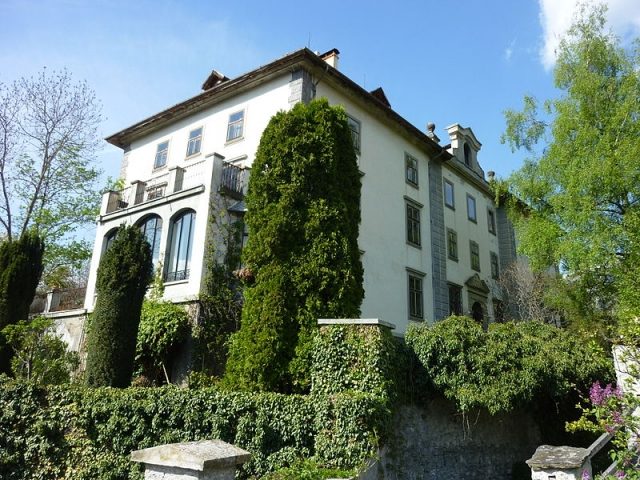
The Episcopal Castle, also known as "Lower Castle", is located in Fürstenau in Domleschg in the Swiss canton of Graubünden. Together with Fürstenau's other castle, Schauenstein Castle or "Upper Castle", it originally formed part of the medieval fortifications.
The construction of the Episcopal Castle dates back to the reign of Bishop Heinrich von Montfort of Chur around 1270. In the Buoch der Vestinen from 1410 it says: The vesti Fürtnow buwt der egenant byschoff Heinrich von Montfort zu den ziten, do man zalt anno domini MCCLXXII. Possibly an earlier mention from 1257 also refers to the castle.
In 1283, however, Bishop Konrad III. von Belmont documented at the castle (in castro Fürstenowe); the affiliation of the County of Tyrol to the Diocese of Chur was recorded. From that early period, the square keep with a side length of around ten meters has been preserved at the eastern corner. The medieval residential building is presumed to be in the southwest; in 1635, Master Mang Tauscher from Allgäu built a roof truss, which, with its length of 62 feet, corresponded to the length of the castle without the tower. Further major alterations took place under Bishop Ulrich VII. von Federspiel from 1709 to 1711 and after the city fire of October 27, 1742, under Bishop Benedikt von Rost. During the last alterations, the castle received its current appearance.
Fürstenau Castle was then the administrative center of the episcopal rule in Domleschg and on Heinzenberg. The bishop often resided in Fürstenau and issued documents; in addition, the interest from the Domleschg area had to be delivered here.
The castle lost its significance as a princely residence in 1840, when the diocese leased the building to the Canton of Graubünden, which used it as a work education institution. When the institution was moved to Realta in Cazis, the castle stood empty for several years. From 1855 it was used under Father Theodosius Florentini as a boarding house for young people, after 1871 it housed a secondary school.
In 1876, the castle was sold by the diocese to the merchant Peter von Planta, who had already bought the neighboring Schauenstein Castle in 1863. In 1878 and 1896 the house was renovated. At that time it housed Graubünden's first rural hospital. After 1896 it was inhabited by the Planta family, who sold it to Emser Werke in 1962. In 1983 it was last renovated and rebuilt. Today it is privately owned and used as a residence.
Take Mobile History with you
You are reading this text for free. Premium adds what matters on the road: descriptions read aloud, sites found through your camera, whole regions taken offline.
- Every description, including the ~17,700 Premium sites
- Audio guide: have descriptions read to you on location
- AR finder: see sites through your camera, with distance and bearing
- Unlimited saved sites
14 days free, then from €2.99 a month. Cancel anytime.
Source: Wikipedia · Licence: CC BY-SA 4.0
This description draws on the facts documented in the linked Wikipedia article; Wikipedia content is licensed under CC BY-SA 4.0. Wording and editing: Mobile History.
Location: 46.7210, 9.4450