To be privately owned
CastleDirmstein
Bishop's Castle
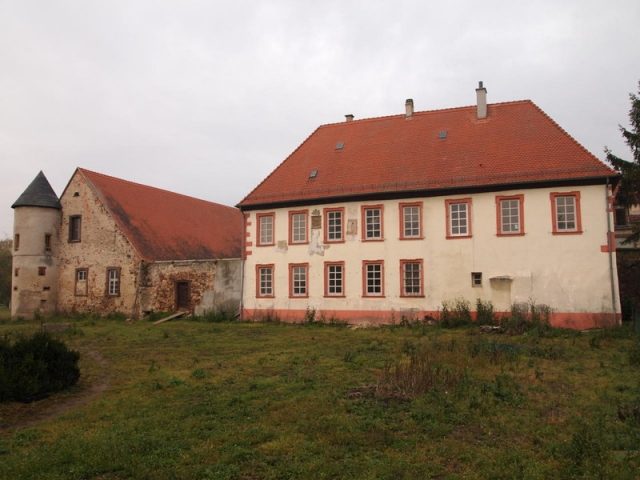
The Episcopal Palace in the Rhineland-Palatinate municipality of Dirmstein was the summer residence of the Prince-Bishops of Worms. Today, only a few original remains of it exist, integrated into a manor house and listed as a historical monument.
The former palace complex is located near the eastern edge of the village on the Eckbach in Niederdorf, which from 1419 to 1705 – together with Oberdorf – was under both electoral and episcopal rule (condominium). It is the oldest, at least partially, still preserved Dirmstein palace. Since the area is enclosed private property, a visit to the complex is only possible from the outside.
Complex+
Overview
The palace complex had a rectangular layout; the surrounding moat was arranged according to the cardinal directions. In the east, where Gerolsheimer Straße now runs, a bridge access led over the moat. There, an additional wall of rubble stone secured the property, as in the north, where it is partially preserved to this day. In the south, the palace pond, fed by the Eckbach, spread out, surrounded by the palace garden.
Courtyard and Corner Towers
The palace and the outbuildings were arranged at right angles around a courtyard in the middle of the area. The corners of the buildings were marked by four towers, whose names are known: Stumber Turm, Pulverturm, and Blauer Hut have disappeared, while the round Diebsturm (so named after the prison subsequently installed) remained. It features late medieval embrasures and keyhole loopholes; a chamfered rectangular window in the subsequently added upper floor shows the year 1598. In the 18th century, the tower had a domed cap; this was later replaced by the current conical tent roof.
North Side
Two rectangular palace buildings stood at right angles on the north and east sides of the courtyard. The older one in the north was demolished soon after privatization in the early 19th century. Only the barrel vault of the cellar and the stump of the stair tower remained. A relief with the coat of arms of Bishop Heinrich was once embedded in its late Gothic pointed arch portal; it is now in the palace museum of Berchtesgaden, where it arrived via art trade.
East Side
The only remaining two-story younger palace building on the east side was converted into an official residence in the first half of the 18th century and shows late Baroque elements from that period. However, significantly older details are also present, especially on the eastern outer wall of the upper floor, a sandstone relief with the coat of arms of Bishop Philipp I (reign 1595–1604) under the Latin inscription:
„PHILIPPUS DEI
GRATIA ELECTUS ET
CONFIRMATUS EPISCOPUS
WORMATIENSIS“
Translated into English, this means:
„Philipp, by God's
grace elected and
confirmed Bishop
of Worms“
Fragments of rich Renaissance wall paintings were found on the east facade and inside. An inscription referring to Bishop Heinrich IV (reign 1523–1552) is carved into a sandstone lintel from the time of the Peasants' War (1525):
„HENRICH V G G COADIUTOR ERWELTER UND BESTETIGTER ZU WORMBS UND UTRECHT PROBST UND HER ZU ELWANGEN PFALZGRAF BEI RIEN UND HERZOG IN BEIERN“
Translated into modern German, this means:
„Heinrich, by God's grace elected and confirmed Coadjutor of Worms and Utrecht, Provost and Lord of Ellwangen, Count Palatine of the Rhine and Duke in Bavaria“
South and West Sides
The south side of the courtyard is formed by outbuildings, predominantly dating to the late 18th century. However, a Renaissance portal inside indicates that an older palace wing once stood here. The simple residential building that now closes off the courtyard to the west was built in the early 1920s.
Construction History+
North of the palace grounds lay Dirmstein's oldest church. It was built in the Romanesque period well before 1044 and was dedicated to the patron saint of the Diocese of Worms, St. Peter. Therefore, it is presumed that it goes back to the initiative of a Worms bishop; possibly the episcopal founder was Burchard I († 1025). In 1809, St. Peter's Church was demolished after about 800 years due to dilapidation. One of its two bells, saved from the French revolutionary troops in 1795 and later recast three times, still hangs in the tower of St. Laurentius Church, made of the same material.
A predecessor building, merely referred to as a "house," is attested from 1240, the actual "palace" for the first time on August 11, 1414. During the Peasants' War in 1525, it was razed by local farmers. Bishop Heinrich IV immediately had it restored. Around 1600, Bishop Philipp I carried out further expansion measures.
Over the next 200 years, the palace was used by the diocese as an agricultural estate; it increasingly fell into disrepair. Between 1732 and 1743, three of the four corner towers were completely or partially demolished due to dilapidation. During this phase, a prison was installed in the fourth tower. The tower in the southwest corner finally fell victim to a fire in 1885 that had engulfed the outbuildings; only the southeast tower has been preserved to this day.
When the French Revolution spread to the left-bank parts of the Electoral Palatinate towards the end of the 18th century, the manor was expropriated and sold. On October 7, 1803, Johann Römer of Dirmstein acquired it for 19,300 francs. Since then, the complex has been in private ownership. Extensive renovation work was carried out at the beginning of the 21st century.
Take Mobile History with you
You are reading this text for free. Premium adds what matters on the road: descriptions read aloud, sites found through your camera, whole regions taken offline.
- Every description, including the ~17,700 Premium sites
- Audio guide: have descriptions read to you on location
- AR finder: see sites through your camera, with distance and bearing
- Unlimited saved sites
14 days free, then from €2.99 a month. Cancel anytime.
Location: 49.5629, 8.2583