Museum
CastleSchleusingen
Bertholdsburg Castle
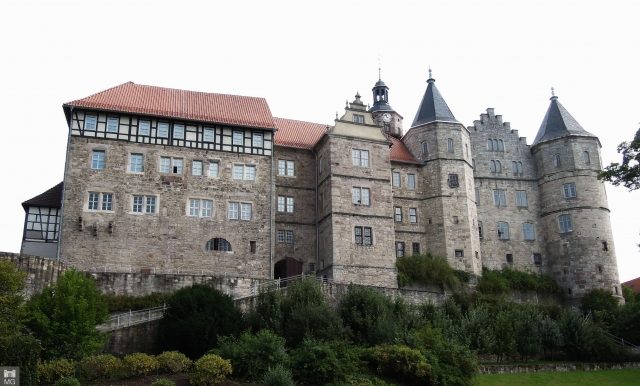
Bertholdsburg Castle is an early modern fortress in the town of Schleusingen in the Hildburghausen district of Thuringia. It is located on the western edge of the old town above the confluence of the Erle and Nahe rivers. The castle was named after Berthold VII, the most important member of the House of Henneberg.
Today, the castle is managed by the Thuringian Castles and Gardens Foundation. It houses a natural history museum and a local history museum. The 38-meter-high main tower, built in 1597, is accessible as a viewing tower.
Complex+
The castle consists of four wings, the inner courtyard enclosed by them, seven towers (of formerly nine), and the castle garden west of the building. On the east side is the Schleusingen town church.
The castle complex was built from 1226 to 1232 by the Counts of Henneberg (Poppo VII). After the Henneberg lands were divided into three lines in 1274, Bertholdsburg became the seat of the Counts of Henneberg-Schleusingen. Under Wilhelm VI, the complex received its current Renaissance appearance around 1500. In 1583, the Henneberg line died out, and the areas around the towns of Schleusingen and Suhl fell to Electoral Saxony and in 1657 to Saxe-Zeitz. They continued to be administered from Bertholdsburg, where the Saxon Supreme Supervisory Office was located until 1815/16.
On February 15, 1685, and October 11, 1765, two fires broke out at the castle, which fortunately could be extinguished in time.
In 1815, the Saxon office of Schleusingen, including Bertholdsburg, fell to Prussia as a result of the Congress of Vienna, which created the Schleusingen district. It existed until 1952 and was administered from Bertholdsburg until 1929, before the district seat was moved to Suhl.
Museums+
Since 1934, Bertholdsburg Castle has been a museum. Initially, it only included regional history collections with today about 3,000 exhibits from the history of Southern Thuringia, Henneberg, and the town of Schleusingen.
In 1988, the Natural History Museum was founded and comprises about 100,000 exhibits. These include fossils, minerals, bone finds, and similar items. The development of Thuringia in the various phases of Earth's history is documented. The museum was completely redesigned in 2000 and is one of the most modern in Thuringia.
Take Mobile History with you
You are reading this text for free. Premium adds what matters on the road: descriptions read aloud, sites found through your camera, whole regions taken offline.
- Every description, including the ~17,700 Premium sites
- Audio guide: have descriptions read to you on location
- AR finder: see sites through your camera, with distance and bearing
- Unlimited saved sites
14 days free, then from €2.99 a month. Cancel anytime.
Source: Wikipedia · Licence: CC BY-SA 4.0 · Image: Mobile Geschichte
This description draws on the facts documented in the linked Wikipedia article; Wikipedia content is licensed under CC BY-SA 4.0. Wording and editing: Mobile History.
Location: 50.5093, 10.7498