To be privately owned
CastleNürnberg-Mögeldorf
Bader Castle
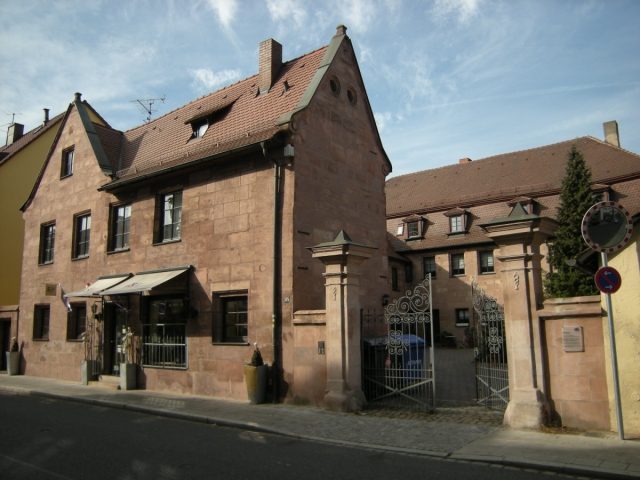
The manor house is said to have originated from two farms originally enfeoffed to the Imperial Ministerial family of Laufamholz, which had been owned by the Ebner family since 1394. In 1516, Hieronymus Ebner opened his dwelling in Mögeldorf to the Nuremberg Council, and in 1545 his son Erasmus Ebner is named as the owner. This seat was allegedly the only one burned by the Margravial troops on May 3, 1553, in Mögeldorf. However, whether the Ebner seat was actually the later "Baderschloss" (Bader's Castle) seems by no means certain, as Erasmus Ebner resided in 1546 at the farm on the site of the "Doktorschloss" (Doctor's Castle).
More reliable information about this manor house only begins after the Second Margrave War. At this time, the feudal lordship had long passed from the Laufamholz family to the Margraves, who passed the property on to the Rieter family, and they, in turn, as sub-fiefs, to Nuremberg citizens. In 1568, a Hans Dietz sold his rights to Jakob Pömer. Around 1579, a Hans Kemplein is said to have erected a new two-story building, a half-timbered construction on a solid plinth.
As early as 1582, Hieronymus Gwandtschneider bought the sub-fief, to bequeath it after 1600 to his son-in-law Georg Pfinzing (1568–1631). Immediately after the acquisition, severe structural damage, recognized as a result of prolonged dampness, became apparent to him. In the spring of 1612, Pfinzing applied to replace the manor house with a solid, larger construction and "to rebuild it with stones". An attached altana, also described as a bay window standing on columns, whose construction method was not entirely innocent of the moisture damage, was to be renewed with ashlar stones.
In 1627, the Dutch merchant Abraham de Brahe appears as a vassal of the Rieter family. In 1637, Johann Georg Heher followed him. The purchase by the Nuremberg legal consultant Dr. Christoph Carl Wölckern in 1673 was canceled after the jurist refused to pay the Handlohn, a fee due upon change of ownership, demanded by the Rieter family. In 1685, Georg Andreas Imhoff, the owner of Hallerschloss, was the vassal, who distinguished himself primarily through larger construction measures on the outbuildings.
The Rieter von Kornburg family sold the seat before 1750 to the Nuremberg city clockmaker Zacharias Landeck, who set up a blacksmith's and watchmaker's workshop in an outbuilding. His son Wolfgang Jacob Matthäus Landeck, now a Margravial vassal after the extinction of the Rieter family, took on the linen printer Johann Conrad Keller as a tenant in the 1770s. In 1776, Keller installed dye vats for a linen printing shop in the forge.
The Landeck family was followed again by the Imhoff family: Hans Christoph Wilhelm von Imhoff applied for a major renovation in 1795. The eaves side of the approximately 13.5-meter-long manor house facing the courtyard, whose half-timbering was damaged, had to be replaced by a construction of sandstone ashlar. In addition, the lord of the castle wanted to redesign the interior of the house, which included moving interior walls. The watchmaker's workshop and later linen printing shop were to be demolished. Instead, it was planned to extend the manor house with an almost 10-meter-long annex.
The renovation begun in 1795 shapes the current appearance. The manor house, which borders the inner courtyard to the north, has since been an elongated building of sandstone ashlar, covered by a mansard roof. A profiled basket-arch portal leads into a ground-floor hall with the staircase from the renovation period. In the parlors, there is simple frame stucco, and in the representative hall on the first floor, a stucco ceiling also decorated with floral decorations. To the west and south, two wing buildings border the courtyard; they once housed economic zones and probably also rental apartments.
In 1805, the master mason Wölfel acquired the property, only to sell it immediately to the merchant Christoph Andreas Burka. After his bankruptcy, it came to the barber Eberhard Leopold in 1810. Leopold also ran into financial difficulties, so the estate, now called "Baderschloss", was auctioned to Andreas Saalwirth in 1836. In 1842, it was acquired by the Mögeldorf building contractor Johann Michael Gößel, and in 1861 by the master carpenter Johann Maurer, whose heirs still owned it in the early 20th century. Since 1962, the "Baderschloss" with its three-wing complex has belonged to the Herzog family and their descendants. A renovation was carried out towards the end of the 1970s.
Take Mobile History with you
You are reading this text for free. Premium adds what matters on the road: descriptions read aloud, sites found through your camera, whole regions taken offline.
- Every description, including the ~17,700 Premium sites
- Audio guide: have descriptions read to you on location
- AR finder: see sites through your camera, with distance and bearing
- Unlimited saved sites
14 days free, then from €2.99 a month. Cancel anytime.
Source: Wikipedia · Licence: CC BY-SA 4.0 · Image: http://schloesserrundschau.de/bayern/schloesser01/nuernberg10.html
This description draws on the facts documented in the linked Wikipedia article; Wikipedia content is licensed under CC BY-SA 4.0. Wording and editing: Mobile History.
Location: 49.4608, 11.1306