The remains of the Iron Age hill fort can be visited
Ancient BuildingWimborne Minster
Badbury Rings
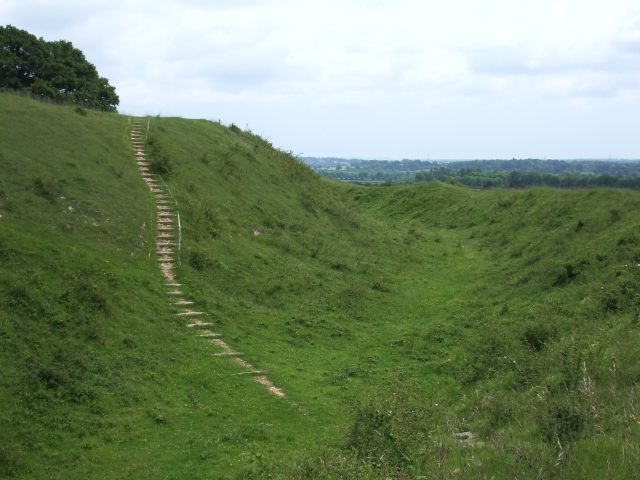
Badbury Rings is an Iron Age hill fort in east Dorset, England, dating from 800 BC and in use until the Roman occupation of 43 AD.
Iron Age+
Badbury Rings sits 327 feet (100 m) above sea level. There are two main phases of construction; the first covered 7.3 hectares (18 acres) and was defend by multiple ditches, while the second was more than twice the size, covering 16.6 ha (41 acres) and defended by a single ditch and rampart. Four Bronze Age round barrows indicate an earlier occupation.
Badbury Rings is the fifth in a series of Iron Age earthworks, starting from Hambledon Hill, and also including Hod Hill, Spetisbury Rings, Buzbury Rings, Badbury Rings and Dudsbury Camp. The Iron Age port at Hengistbury Head forms a final Iron Age monument in this small chain of sites.
Vindocladia+
Badbury Rings is situated at the cross of two Roman roads: Ackling Dyke, which ran between Durnovaria (Dorchester) and Sorviodunum, (Old Sarum); and a road running from Aquae Sulis (Bath) to Hamworthy near Poole.
The Romans established a small fort just to southwest of Badbury Rings, between the hillfort and the modern village of Shapwick. To the east of the Roman fort, there was a small Romano-British town, believed to be that listed in the Antonine Itinerary as Vindocladia.
Saxon era+
Dorset fell to the Saxons late in the Saxon invasion of England, being held up by Bokerley Dyke on the Roman Road from Old Sarum. Local historian Roy Carr (2001) has suggested that the Saxons were held off by the threat of an army in the west, perhaps stationed at Badbury Rings. Carr has suggested that such a force could be one of the sources of the legends of King Arthur, and that Badbury could be the "Badon" of the legend of the Battle of Mons Badonicus.
The identification of Badbury Rings with the Arthurian Mount Badon (c.AD516) was reported by John Hutchins as originating with a supposition by the 'eminent Dr Edwin Guest' in the Salisbury Volume of the Archaeological Institute. It is one of three sites regularly advanced as the location of this quasi-mythical battle, with the city of Bath also recognised as a contender.
Nearly 400 years later another Saxon use of Badbury is less contentiously recorded. Edward the Elder stationed troops at Badbury on his succession to the throne in AD899, to face down a challenge to his claim for the crown by his cousin Æthelwold, based at Wimborne Minster.
The site today+
The site, on the dip slope of Cranborne Chase, is now part of the Kingston Lacy estate owned by the National Trust, with free access.
The site is also used for the popular point to point racing by the Portman hunt.
Take Mobile History with you
You are reading this text for free. Premium adds what matters on the road: descriptions read aloud, sites found through your camera, whole regions taken offline.
- Every description, including the ~17,700 Premium sites
- Audio guide: have descriptions read to you on location
- AR finder: see sites through your camera, with distance and bearing
- Unlimited saved sites
14 days free, then from €2.99 a month. Cancel anytime.
Source: Wikipedia · Licence: CC BY-SA 4.0
This description draws on the facts documented in the linked Wikipedia article; Wikipedia content is licensed under CC BY-SA 4.0. Wording and editing: Mobile History.
Location: 50.8265, -2.0522