Conference center
MonasteryErfurt
Augustiner Abbey
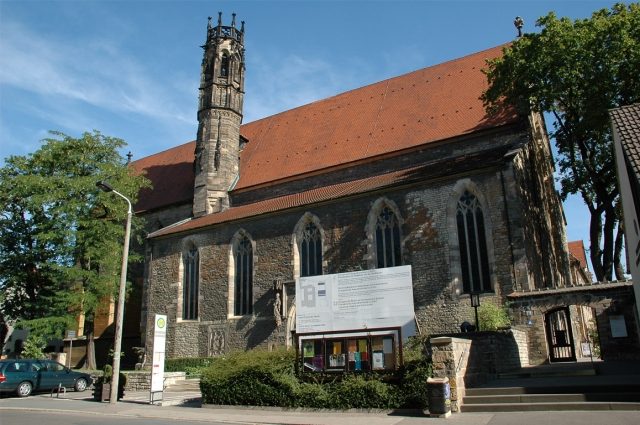
The Augustinian Monastery in Erfurt is a former monastery of the Augustinian Hermits, built from 1277 onwards, where Martin Luther lived as a monk between 1505 and 1512. The Lion and Parrot window in the choir windows of the Augustinian Church of the monastery contains the model for the Luther Rose. After the Reformation, the monastery passed into the possession of the Evangelical Church in 1525; in 1559, it was secularized by the city of Erfurt. In 1945, parts of the monastery were destroyed in an air raid. Since 1994, the Augustinian Monastery has been the administrative seat of the Provostry of Erfurt-Nordhausen. In 1996, sisters of the Evangelical Communität Casteller Ring moved into a part of the building, which is otherwise primarily used as a conference and meeting center. The monastery is a recognized cultural monument under the Monument Protection Act of the State of Thuringia.
Beginnings and Expansion
Since 1266, there was a settlement of the Augustinian Hermits in Erfurt. From 1273, after disputes with the city, they were temporarily expelled but returned permanently in 1276. Their seat became the Church of St. Philippi and Jacobi on Comthurgasse, built around 1131. In 1277, the construction of the monastery began. The funds for the extensive construction work were raised in the following centuries through alms and the sale of indulgences. By 1518, the construction of the library, St. Catherine's Chapel, the chapter house, the church tower, a cloister, the nave, the woad houses, and the New Priory between the library and the woad houses was financed. Particularly noteworthy among the preserved buildings are the stained glass windows of the church, made between 1310 and 1340, as well as the outdoor pulpit, which testifies that sermons were held outdoors for large crowds at that time.
The monastery's school was significant. It offered a Studium Generale, founded by Heinrich von Friemar (the Elder). From the beginning of the 14th century, the monastery library was also built up. In 1516, the library building was completed. Between 1505 and 1511, Martin Luther belonged to the monastery. In 1507, he was ordained a priest and read his first mass here on May 2, 1507.
Reformation
Johannes Lang, a good friend of Luther, became prior of the monastery in 1522 and prepared the Reformation in Erfurt and the surrounding area. In the same year, Lang, along with many of the monks, left the order. In 1525, the church was handed over to the St. John's congregation. In 1556, the last monk died. The monastery was finally secularized in 1559.
From 1561, the west wing and priory were used by the city's Ratsgymnasium. For this purpose, the dormitory was converted into accommodation for the students. The school existed until 1820. The monastery library was damaged during the Reformation but revived in 1646 when the library of the Evangelical Ministry moved in. The Evangelical Orphanage used a part of the former monastery from 1669 onwards.
The Augustinian Hermits resettled in Erfurt in the mid-17th century, but in a different location: they converted the Valentinerhof, located next to the Wigbertikirche, into a monastery. In 1822, this monastery was also dissolved.
19th Century
The New Priory was demolished in 1821 due to its dilapidated state and the lack of funds for renovation. From this time onwards, after the school closed, the west wing of the monastery, along with the Old Priory, the library, and the woad houses, was used by the Martinsstift, an institution that cared for the education of orphans and neglected children. From 1840 to 1846, the west wing and the priory were rebuilt according to designs by Karl Friedrich Schinkel, during which the connecting corridor between the west wing and the library was erected. However, this renovation and modernization remained piecemeal for the time being – the church itself had to be closed in 1844 due to dilapidation.
An improvement only came with a petition to King Friedrich Wilhelm IV. With funds approved by him, the church was converted in 1848, after the failure of the Frankfurt National Assembly, into the seat of the Erfurt Union Parliament in Neo-Gothic style. Otto von Bismarck was also among the members of this parliament. After the end of the short-lived parliament, the premises were again used as a sacred building from 1852, and the church was re-consecrated in 1854.
20th Century
Reconstruction
From 1936 to 1938, the church was reconstructed in the style of the 14th century, along with a part of the monastery, under the direction of architect Theo Kellner. Essentially, the church can still be seen in this condition today after the severe war damage was repaired. The ground floor of the library building was also redesigned for museum purposes. The war prevented the realization of further plans.
Destruction
At the end of World War II, on February 25, 1945, the entire monastery area was severely affected by a British bombing raid with two air mines. The library building and the woad houses were completely destroyed by direct hits, while the cloister, especially the winter refectory with the old priory, the southern part of the west wing, and the connecting building to the library, were severely damaged. The church, the cloister, the orphanage, and the guesthouse were also heavily damaged. All remaining buildings lost their roofs, windows, and doors due to the air pressure of the detonations, including the Augustinian Church itself. Its wooden pointed barrel vault had shifted considerably. The four extremely valuable 14th-century stained glass windows of the chancel were only preserved by timely relocation to the village church of Hohenfelden. The sandstone figures of important Erfurt personalities on epitaphs in the interior had been protected by bricking them up. The large Walcker organ suffered minor damage, while the smaller one suffered considerable damage.
Numerous Erfurt residents, predominantly women and children – many from the Protestant orphanage – had sought refuge in the cellar of the monastery library, designated as a public air-raid shelter. 267 people died in the air raid. From the rubble, a rescue team of soldiers from the Erfurt tank regiment was able to free a 7-year-old girl, the only survivor, who lost an arm. Among the dead was Theodor Mundle, pastor of the Augustinian community. The cellar was subsequently called the "Death Cellar" in the following years. A plaque with the names of the victims at the monastery ruins continued to remind visitors of the tragedy until 2010. In contrast, a plaque on the outer wall of the monastery, which had referred to the "Anglo-American terror attack," was removed after the fall of the Berlin Wall in 1990.
The artistic furnishings of the library building, including the prayer room for the orphans, were completely lost in the air raid. A large part of the valuable books of the Martinsstift was also destroyed. This library had comprised 3200 volumes. However, the book collections of the Evangelical Ministry were largely saved by being relocated to village churches in the vicinity of Erfurt. Losses occurred during the temporary outdoor storage of the books after their return.
After 1945, the Erfurt lawyer Selmar Bühling represented the community and the monastery against claims of ownership by the city of Erfurt and the state of Thuringia, until he fled to West Berlin in 1949 for political reasons.
Reconstruction
Shortly after the end of the war, the reconstruction of the destroyed and damaged buildings began under great difficulties. Siegfried Hotzel, a former Wehrmacht pastor who served the Augustinian community from April 1945 until his retirement in 1960, played a significant role in this. The clearing of rubble was carried out by a "construction team" of politically compromised men, trained on the job, under the direction of architect Jakob Wassum. The direction of the reconstruction was entrusted to the well-known Erfurt architect Theo Kellner, assisted by city building councilor Karl Tetzner. When Kellner moved to Frankfurt am Main, Tetzner took over the full leadership of the reconstruction. He was supported by architect Käthe Menzel-Jordan and civil engineer Richard Fischer. From 1946 to 1957, the church, the cloister, the east wing, and the guesthouse were restored. In 1947, the four medieval church windows in the area of the High Choir, which had been relocated due to the air raids, could also be reinstalled with the help of Hajna, a specialist in church windows who had fled from Prague. Both organs were repaired under the direction of organ builder Laux from Gispersleben with spare parts from West Germany. Luther's cell had become leaky due to damage, was affected by fungus, closed, demolished, and then rebuilt: in monastic simplicity, as it still appears today.
Further Events
In 1960, the Evangelical Preachers' School moved into the monastery, where it remained until 1993. In 1980, an exhibition about Martin Luther was inaugurated on the monastery grounds. In the same year, the library of the Evangelical Ministry also moved in. Since State Council Chairman Erich Honecker recognized the Augustinian Monastery as one of four Luther memorial sites in the GDR, the planned demolition of the west wing and the construction of a swimming pool on the grounds of the Augustinian Monastery did not take place. In 1988, a church conference center was opened, and in 1990, the administrative seat of the Provost of the Erfurt district was moved to the Old Priory.
On September 28, 1989, as part of the Peaceful Revolution, an information evening of the then still opposition collection movement Democratic Awakening took place in the church with nearly 1000 visitors, where the pastor and later SPD Bundestag member Edelbert Richter explained the goals of the movement. In 1989/90, there were further political events in the church.
In 1996, the first four sisters of the Evangelical Communität Casteller Ring moved into rooms of the monastery, thus restoring a use similar to its original purpose.
21st Century
From 2000 to 2003, the monastery buildings were restored and modernized. Since then, large parts of the buildings have served as a conference center. At the end of 2003, the "Stiftung Augustinerkloster zu Erfurt" (Augustinian Monastery Foundation in Erfurt) was established under the care of the German Foundation for Monument Protection through a trust agreement. Its purpose is, in particular, "the renovation, restoration, preservation, maintenance, and reconstruction (library and woad houses) of the Augustinian Monastery in Erfurt, recognized as a cultural monument under the Monument Protection Act of the State of Thuringia, and its associated facilities." In 2004, the Augustinian Monastery was also recognized as a cultural monument of particular national importance. In the same year, the cloister underwent extensive restoration.
A nationwide architectural competition was announced for the planned new buildings in place of the library building and the woad houses destroyed in 1945. An architectural firm from Weimar was awarded the first prize. This was followed by a design with a flat roof for both buildings and two others that showed some similarity to high-rise bunkers.
Since 2002, Lothar Schmelz has been the curator of the Augustinian Monastery. In 2003, some scenes of the feature film "Luther" were shot in the monastery buildings.
On October 31, 2006, retired pastor Roland Weisselberg immolated himself on the monastery grounds in protest against the "creeping Islamization" of Germany, as he wrote in a farewell letter. There is no memorial plaque. Weisselberg's grave is located in the churchyard in Erfurt-Büßleben.
Due to Weisselberg's act, construction work on the monastery library was postponed. From November 2006, the foundations of the woad houses, destroyed in 1945, were restored and the cellar rooms uncovered. In February 2008, the foundation stone was laid for the new library building, with a different function. This was built somewhat lower, otherwise approximately in its former cubature with modern building materials, modern facades, and with a glass building as a stair vestibule on the north side. The work, delayed by the insolvency of the construction company in January 2009, was completed in the summer of 2010. On August 27, the building was inaugurated in a solemn ceremony with a festive church service. The ground floor of the multi-functionally used building contains conference rooms, while church institutions are housed on the two upper floors. Five million euros have been invested in the modern building. The library of the Evangelical Ministry, with 60,000 volumes one of the most important church collections in Germany, remains in the former dormitory of the monastery.
A "Room of Silence" in the basement of the new building commemorates the 267 victims of the British air mine in February 1945. Their name plaques stand in front of the buried emergency exit of the former air-raid shelter. The cross of the International Cross of Nails Community, presented to the Augustinian Monastery in 2008, was also placed in the dignified memorial room.
Already in September 2008, "the Woad Houses" were reopened. This is a modern building on partially newly constructed foundations, which only in its cubature is reminiscent of an Erfurt woad warehouse. It contains 17 guest rooms and a prayer room in the basement.
On September 23, 2011, Pope Benedict XVI visited the former Augustinian Monastery as part of his visit to Germany.
Organ+
The organ system of the monastery church was built in 1938 by the organ building company E. F. Walcker & Cie (Ludwigsburg). The instrument consists of the main organ on the west gallery, with Great, Positive, and Pedal (33 stops), and the choir organ on the south wall of the choir, with Swell and Pedal (21 stops). Both instruments are independent, each having its own console, from which the other organ can also be played. The organs were last extensively restored in 1999.
Take Mobile History with you
You are reading this text for free. Premium adds what matters on the road: descriptions read aloud, sites found through your camera, whole regions taken offline.
- Every description, including the ~17,700 Premium sites
- Audio guide: have descriptions read to you on location
- AR finder: see sites through your camera, with distance and bearing
- Unlimited saved sites
14 days free, then from €2.99 a month. Cancel anytime.
Source: Wikipedia · Licence: CC BY-SA 4.0
This description draws on the facts documented in the linked Wikipedia article; Wikipedia content is licensed under CC BY-SA 4.0. Wording and editing: Mobile History.
Location: 50.9814, 11.0300