The remains of the ancient town can be visited
Ancient BuildingKomotini (Κομοτηνή)
Ancient City Mosynopolis (Μοσυνόπολις)
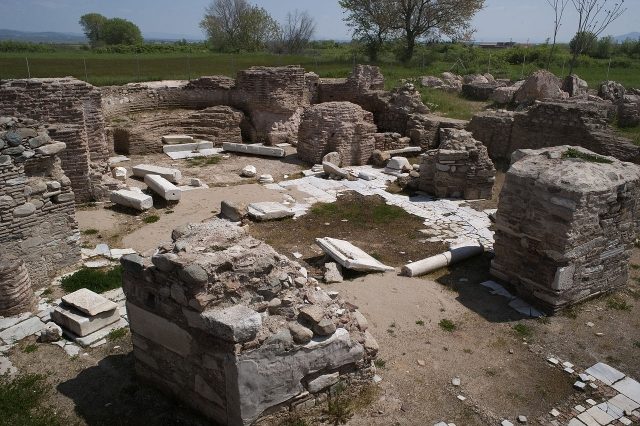
Mosynopolis (Greek: Μοσυνόπολις), of which only ruins now remain, was a city in the Roman province of Rhodope that until the 9th century was known as Maximianopolis (Μαξιμιανούπολις) or, to distinguish it from other cities of the same name, as Maximianopolis in Rhodope.
The city of Maximianopolis appears in written sources from the 4th century on. Its fortifications were renewed by Justinian I, and it was later a base for operations by Emperor Basil II in his wars against the Bulgarians.
In the 11th century, the city was the center of a district (bandon) in the theme of Boleron, and Anna Komnene reports in her Alexiad that there were many Manichaeans living in Mosynopolis in the late 11th/early 12th centuries. The town was captured in 1185 by the Normans, while the monk Ephrem says that the city was captured in 1190 by Frederick I, Holy Roman Emperor. The Battle of Messinopolis, in which the Bulgarians defeated Boniface I, Marquess of Montferrat, took place nearby in 1207, and was speedily followed by the destruction of Mosynopolis by Tsar Kaloyan of Bulgaria.
The fate of the town thereafter is somewhat obscure: it re-appears in 1317 as part of the theme of "Boleron and Mosynopolis", and its bishopric was still active, but the historian Catherine Asdracha, in her 1972 survey of the Rhodope area in the late Middle Ages, suggests that it never recovered from Kaloyan's sack and remained in ruins, proposing that it is to be identified with the town of Mesene, which the emperor and historian John VI Kantakouzenos reported as "destroyed many years ago".
Bishopric+
Bishops of Maximianopolis in Rhodope were present at the 5th and 6th-century ecumenical councils of Ephesus (431), Chalcedon (451), and Constantinople II (553) and in another council of 459. From the 7th to the 9th centuries the see is referred to as archiepiscopal, giving it autocephalous status. In all these instances, the see appears under the name Maximianopolis, but in 879 it is under the name Mosynopolis that it is represented by a bishop called Paul at the Fourth Council of Constantinople. From the following century to the 12th, it appears with reduced status as a suffragan of Trajanopolis in Rhodope. In the 13th century it became a Latin bishopric.
The see is mentioned under the name Mosynopolis also in the Notitiae Episcopatuum of Leo the Wise, about 900; in that for 940; in that for 1170 under the name of Misinoupolis.
After the destruction of the city, the Patriarchate of Constantinople in August 1347 authorized the metropolitan of Trajanopolis to exercise jurisdiction in what had been the see of Maximianopolis or Mosynopolis.
The bishopric is included in the Catholic Church's list of titular sees both as an archiepiscopal see under the name Maximianopolis in Rhodope and as a suffragan diocese of Mosynopolis subject to Trajanopolis in Rhodope.
Take Mobile History with you
You are reading this text for free. Premium adds what matters on the road: descriptions read aloud, sites found through your camera, whole regions taken offline.
- Every description, including the ~17,700 Premium sites
- Audio guide: have descriptions read to you on location
- AR finder: see sites through your camera, with distance and bearing
- Unlimited saved sites
14 days free, then from €2.99 a month. Cancel anytime.
Source: Wikipedia · Licence: CC BY-SA 4.0 · Image: http://en.wikipedia.org/wiki/File:20100418_Maximianoupolis_Mosynopolis_Rhodope_Thrace_Greece_2.jpg
This description draws on the facts documented in the linked Wikipedia article; Wikipedia content is licensed under CC BY-SA 4.0. Wording and editing: Mobile History.
Location: 41.1286, 25.3254