To be privately owned
ManorTaxenbach
Penninghof Manor
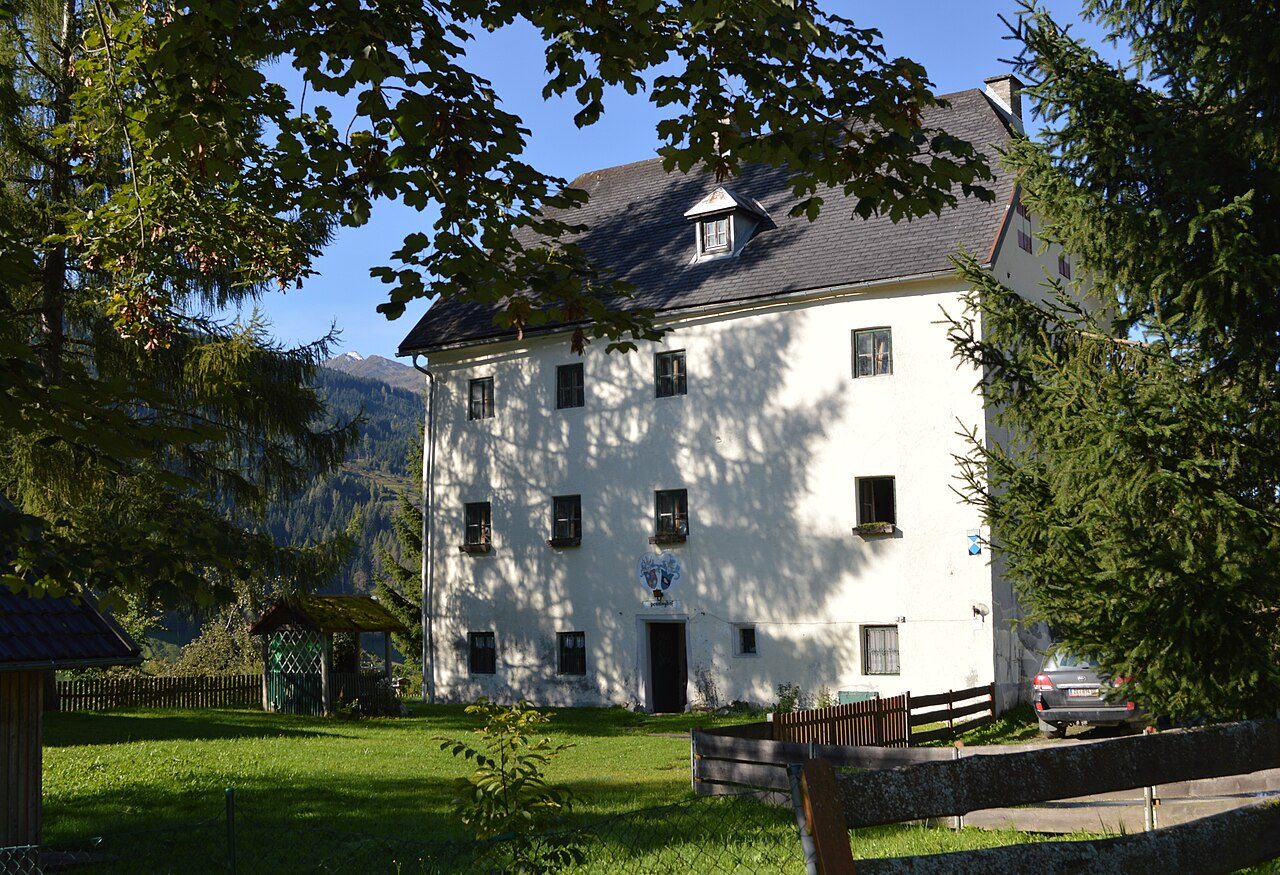
The Penninghof manor (sometimes also called Edelsitz Obkirchen) is located in the municipality of Taxenbach in the Zell am See district of Salzburg (Gschwandtnerberg, house no. 17). Despite the lack of the bay windows or corner towers typical of the Pinzgau region, the building is considered a true Salzburg manor.
The first mention dates back to 1427 and 1429. It states that Hans Strasser zu Straß held an archiepiscopal fief, a property called Obkirchen located in the Tachsenpacher court. Hans transferred this farm as a morning gift in 1433 to his wife Margaretha, daughter of Mathensen des Thürndl. After Hans's death, his widow and Elsbet Hofinger sold the property to the still minor children of Michael Emhofer; their feudal lord was Wilhelm Penninger. The noble family of Penninger originated from Taxenbach; a Gottschalk von Penninger was first mentioned in 1191. Before 1490, the property passed entirely to Wilhelm Penninger. His successors were Ulrich Penninger, married to Ursula, and his brother Andreas. Between 1540 and 1550, Gottfried, Ulrich's son, inherited the property. This Gottfried was married to Anna, née Kölderer zu Höch, and after his death († 1592), he was succeeded by Constantin Penninger. Under Constantin's brother Wilhelm, the farm was first referred to as an Edelsmannsitz zu Obkirchen in 1613.
After him, Jakob Wilpenhofer zu Lerchen und Obkirchen acquired this manor. In 1624, Abel Wilpenhofer obtained an "Einfang-Bewilligung" (permission to enclose) from Archbishop Paris von Lodron. After Abel's death († 1629), his heirs sold the Penningperg castle to Johann Baptist Voglmayr, a regional and forest judge in Rauris. His children sold the property in 1649 to the Paris Lodron Collegium Marianum in Salzburg, which also acquired the manorial rights over it.
The subsequent owners after 1665 used the manor as a residential or farmhouse; these include: Ulrich Schläffer (1665), Christian Schläffer (1692), his son Hans (1726), Simon Schläffer (1773), Alexander Schläffer (1810). Peter Gschwandtner, the innkeeper of Taxenbach, bought the castle in 1842. In 1879, he was inherited by his three stepdaughters Julie, Maria, and Anna Straubinger. They sold the property to Peter Schernthaner in 1887. He was succeeded by another Peter Schernthaner (1912), Peter Schernthaner (1941), and Elisabeth Schernthaner (1965) through inheritance. The Schernthaner family still owns the Penninghof today.
Penninghof today+
The building is now a farmhouse. Due to fires, the house had to be redesigned several times. It is three-story and covered by a gable roof with a hip on both sides. In the ground floor, late Gothic door and window frames and cassette ceilings in two rooms are preserved. Above the entrance, remnants of the Penninger coat of arms are recognizable, otherwise, the building is unadorned.
Penninger coats of arms (a white gauntlet on a red background) from 1500 can also be found on Hohensalzburg Fortress and from 1536 in the Coat of Arms Hall at Goldegg Castle.
Take Mobile History with you
You are reading this text for free. Premium adds what matters on the road: descriptions read aloud, sites found through your camera, whole regions taken offline.
- Every description, including the ~17,700 Premium sites
- Audio guide: have descriptions read to you on location
- AR finder: see sites through your camera, with distance and bearing
- Unlimited saved sites
14 days free, then from €2.99 a month. Cancel anytime.
Source: Wikipedia · Licence: CC BY-SA 4.0 · Image: Wald1siedel / CC BY-SA 3.0 at via Wikimedia Commons
This description draws on the facts documented in the linked Wikipedia article; Wikipedia content is licensed under CC BY-SA 4.0. Wording and editing: Mobile History.
Location: 47.2945, 12.9657