To be privately owned
ManorSt. Michael-Sankt Martin
Heihsgut Manor
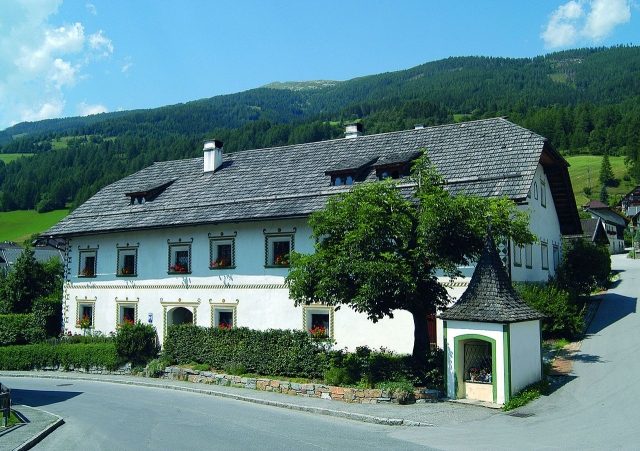
The Heihsgut is one of the oldest continuously inhabited houses in the Salzburg-Styrian Alps. The manor stands at the foot of the Speiereck (Radstädter Tauern) in the center of St. Martin, a district of the municipality of St. Michael. Together with a small chapel and a tithe barn, it forms the secular counterpart to the village church, in whose cemetery a Mithraic sanctuary was found under the charnel house in the 19th century.
In 1478, the family that gave the house its name bought it as their free property from the Styrian Benedictine abbey of St. Lambrecht. It probably belonged to the estate in St. Mörten that was devastated during a dispute between the Bishop of Bamberg, the abbey, and the Counts of Ortenburg, and which Rudolf von Habsburg definitively awarded to the monks in 1278.
At the church, three tombstones represent the rise and fall of the family, linked to the prosperity and poverty of the region: a large but simple stone for the acquirer of the house, a rather magnificent one with the coat of arms granted by Charles V in 1532 for his son Lienhard, and a small plaque for the last owner, the grandson of Andreas v. Heihs, ennobled by Charles VI in 1730, who died in poverty in 1839.
The family's standing in the 16th century is attested by the pine parlor from 1545, a waffle iron with the Heihs coat of arms from 1559, and a large tombstone with a portrait and coat of arms for Lienhard's brother, who died in 1544 as parish priest of St. Michael and Murau and archdeacon of Lungau, in the parish church.
His niece Apollonia, a daughter of Lienhard, and her husband, Hanns Gennsprunner zu Radstadt, enlarged the house by incorporating a brick granary and built the large pine parlor on the first floor. This was in 1545, according to a vanished inscription above the doorframe. However, it is possible that the construction of the large tithe barn, dated 1685, first made it possible to integrate the old granary into the main building of the house.
Current State+
Together with a vaulted cellar and an overlying parlor with a coffered ceiling, a closed building complex was thus created, in which, however, the main entrance moved out of the center of the facade. This coffered room now houses the family archive, which also contains material about the canon lawyer Willibald M. Plöchl, who died in 1984, and his efforts to establish a government-in-exile in the USA.
The pine parlor, renovated in 1999 with the support of the state of Salzburg, is also accessible to the public. During the restoration, the location of the secret spiral staircase, which Ignaz von Kürsinger described in 1853 but no longer saw, was also clarified.
A small collection documents the position of the house and the family in village history; it shows, among other things, some old chests, the waffle iron from 1559, and a few works by one of the most famous artists of the Wiener Werkstätten, Dagobert Peche (1887–1923), who was born in St. Michael.
The Heihsgut is considered a cultural monument under the Hague Convention for the Protection of Cultural Property in the Event of Armed Conflict.
The floor of the old smoke kitchen was fitted with hand-beaten bricks from the Falkinger brickworks in Grafenstein.
Take Mobile History with you
You are reading this text for free. Premium adds what matters on the road: descriptions read aloud, sites found through your camera, whole regions taken offline.
- Every description, including the ~17,700 Premium sites
- Audio guide: have descriptions read to you on location
- AR finder: see sites through your camera, with distance and bearing
- Unlimited saved sites
14 days free, then from €2.99 a month. Cancel anytime.
Source: Wikipedia · Licence: CC BY-SA 4.0 · Image: http://commons.wikimedia.org/wiki/File:Heihsgut.jpg
This description draws on the facts documented in the linked Wikipedia article; Wikipedia content is licensed under CC BY-SA 4.0. Wording and editing: Mobile History.
Location: 47.0999, 13.6538