To be privately owned
CastleFreistadt
Fuchsenhof Castle
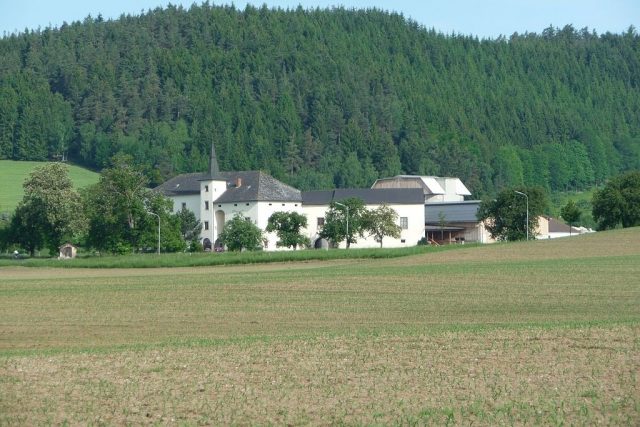
The Fuchsenhof is a former castle complex in Upper Austria, located about 800 meters southwest of the city of Freistadt in the Mühlviertel region. The old names of the building were Rasteinhof and Luzengut. The first documented mention was in 1377 as Rasteinhof, a noble free seat. In the 16th century, the building was part of a long-standing dispute between the owner and the city. In 1623, a Ulrich Fuchs bought the castle, and since then it has borne its current name. Today, the manor-like Fuchsenhof serves as a farm. In 1997, a significant silver treasure was found near the farm.
In 1377, the building was first documented as Rasteinhof (also Rastayn). At that time, the building was a noble seat and was located within the city's Burgfrieden (castle peace area). In 1398, Heinrich von der Au sold the Rasteinhof as a free property to the Freistadt citizen Hans Hafenpier. The next preserved documented mention follows in 1435, when the owner, Hanns Brunner, donated a pound of pennies to the Liebfrauenkirche and two tithes to the hospital. Until his death in 1478, the farm was owned by Friedrich von Rastein. In that year, his grandson sold it to Ulrich Luczer and his wife Katharina, and the farm received the name Luzengut.
In 1528, the former mayor of the city, Gabriel Weissenauer, bought the Luzengut from Dorothea Luczen. The Weissenauers were members of the city's patriciate and wanted to rise to nobility. For this purpose, Schloss Tannbach near Gutau was also acquired. In Weissenauer's opinion, the Fuchsenhof was a noble free seat like Tannbach, and he wanted to remove it from the city's jurisdiction. Nevertheless, the city insisted that the farm was within the Burgfrieden and thus tithes had to be paid to the city. After Gabriel's death, the conflicts with the city escalated into a sometimes violent dispute, until a settlement was reached in 1553 between Andre Weissenauer and the city, which stated that the Luzenhof was a farm and not a noble seat. In 1559, there was a lawsuit between Simon Weissenauer and the city regarding the affiliation of the Luzengut, as the farm was mentioned as a free property in the sales document of 1398. The unclear situation that led to the dispute was finally clarified in 1573 by Emperor Maximilian II. In his document, the city's Burgfrieden was defined, and the Luzenhof was demonstrably listed within it. Thus, its affiliation with the city was finally established, and the dispute ended.
In 1594, Hans Weissenauer sold the farm to Georg Kholneder, who sold it to Samuel Fux in 1599. In 1608, it was sold to Ulrich Fux, Samuel's brother. Already in 1616, the estate passed into the possession of Simon Widerreiter zu Weyregg. With the purchase of the building by Ulrich Fuchs in 1623, the name was changed to Fuchsenhof, its current name. In the following years, the farm remained in noble possession for generations and was converted to its present castle-like appearance. The distinctive tower is likely from the 17th century. Owners during this period included Matthias Castner von Traunegg and Franz Adam, Edler von Wöbern zu Hagenberg (1698).
In the course of the dissolution of the manorial estates, the building was probably sold to farmers and is still used as a farm today. The farm has extensive agricultural land and a large cattle fattening operation. The Böhmerwald Straße in the direction of Bad Leonfelden passes the building at a distance of about 100 meters.
Construction+
The building consists of a three-story front wing with a four-story tower that projects from the wall. The tower has a pointed roof and was probably built in the 17th century. The tower rests on two granite columns, which bear the weight of the tower, half-integrated into the wall. Through this gatehouse, one enters a vaulted hall leading to the courtyard, or to a staircase to the first floor with a large high hall and an adjacent smaller one. The front side faces south, the knight's hall displays the coats of arms of the respective owners and is furnished with old German furniture. To the rear, a residential wing and extensive stables are attached. Due to its appearance, the building stands out significantly from the usual three-sided farms in the area.
Treasure Discovery+
In late autumn 1997, a very significant silver treasure was found near the farmstead while plowing a field. This treasure had been buried there around 1270 and consists of more than 6700 coins as well as hundreds of silver objects and pieces of jewelry. It is presumed that a goldsmith buried his property here during the turmoil of war between Ottokar II Přemysl of Bohemia and Rudolf of Habsburg. The find was not published until 2004 after scientific investigation. The treasure is now exhibited in the Schlossmuseum Linz.
Take Mobile History with you
You are reading this text for free. Premium adds what matters on the road: descriptions read aloud, sites found through your camera, whole regions taken offline.
- Every description, including the ~17,700 Premium sites
- Audio guide: have descriptions read to you on location
- AR finder: see sites through your camera, with distance and bearing
- Unlimited saved sites
14 days free, then from €2.99 a month. Cancel anytime.
Source: Wikipedia · Licence: CC BY-SA 4.0 · Image: http://commons.wikimedia.org/wiki/File:Fuchsenhof_von_Osten.jpg
This description draws on the facts documented in the linked Wikipedia article; Wikipedia content is licensed under CC BY-SA 4.0. Wording and editing: Mobile History.
Location: 48.5010, 14.4886