Local Authorities
ManorSteyerberg
Steyerberg Manor
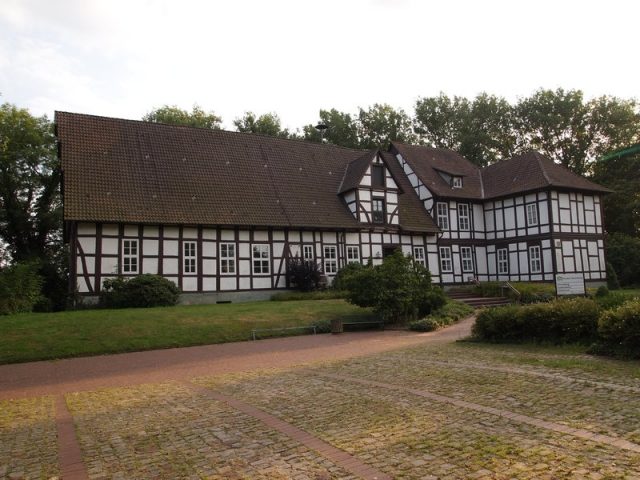
Steyerberg, first mentioned in a document in 1259 in connection with the exchange of a maid at Steyerberg Castle, has a very eventful history, marked by conflicts between the Counts of Hoya and the Bishops of Minden.
Historical records report that the Counts of Hoya intended to establish themselves around the year 1200 in the area between the rivers Aue and Siede, given its strategic and economic importance. Since the Bishop of Minden also laid claim to this stretch of land, conflict was inevitable, especially as the Counts, as an expression of their will to possess, had a castle built, probably even on episcopal land.
The special feature of this castle was that - unlike other fortifications in the local area - it was not built as a moated castle, but as a hilltop castle on the Knappsberg, a steeply sloping spur of the Heisterberge. From the inscription of the first seal of the market town of Steyerberg "Radt undt Borgermester to Steilbarg" it can be concluded that the location of the castle gave the market town of Steyerberg its name.
The Counts of Hoya had divided their dominion into bailiwicks. The bailiwick of Steyerberg comprised a large district, from which the offices of Stolzenau and Steyerberg were formed in the course of the 15th century. These offices were headed by Drosten as administrative officials.
The office of Steyerberg was pledged by the Hoya Counts to the mercenary leader Hilmar von Münchhausen in 1549. In 1550, they built the present Amtshaus (administrative building) on the walls of the old castle. The von Münchhausen family would significantly accompany the history of the market town until their departure from Steyerberg in 1766.
One of the Drosten descended from the von Münchhausen family, Statius von Münchhausen, is buried in Steyerberg's St. Katharinen Church. With the death of Count Otto in 1582, the lineage of the Counts of Hoya died out. The Dukes of Braunschweig-Lüneburg took over the County of Hoya. Their rule ended in 1866, when the Kingdom of Hanover became a Prussian province.
Take Mobile History with you
You are reading this text for free. Premium adds what matters on the road: descriptions read aloud, sites found through your camera, whole regions taken offline.
- Every description, including the ~17,700 Premium sites
- Audio guide: have descriptions read to you on location
- AR finder: see sites through your camera, with distance and bearing
- Unlimited saved sites
14 days free, then from €2.99 a month. Cancel anytime.
Location: 52.5675, 9.0212