Local government
Cultural Events
CastleBad König
Old and New Castle (Bad König)
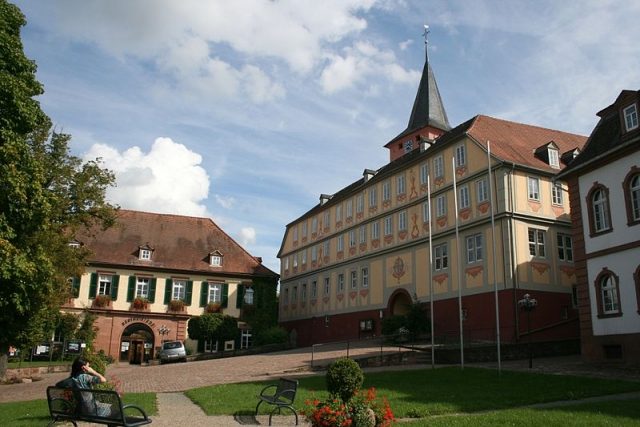
Bad König Castle is a complex consisting of a church and a medieval fortified churchyard, known as the Old Castle, and the New Castle. It is located in the center of Bad König in the Odenwald district in Hesse.
In 820, the fortified churchyard was first mentioned as a castle, and in 1348, it was partially owned by the Counts of Erbach. In 1477, the fortified churchyard became a Kurmainz fief of Konrad Schenk von Erbach, and Archbishop Dieter von Isenburg reserved the right of access. This indicates that the castle and town of König must have been in a fortified state at that time. A church tower was built on the lordly complex in 1478.
In 1556, Count Georg von Erbach began building a castle, and the sheds used by the population were removed. Whether an older castle preceded the Old Castle is speculative. In 1747, the office of König passed to the Erbach line of Erbach-Schönberg, and since 1750, the late medieval bell tower of the current parish church has been used as a church tower.
In 1782, the "New Castle" was built next to the older complex. Of the former fortified churchyard complex, only the four-story tower of the Protestant parish church remains today. Until 1926, the castle was the residence of the Counts (later Princes) of Erbach-Schönberg.
Complex+
The current state shows a modern ensemble of parish church, fortified churchyard, Old and New Castle. The churchyard was converted into a pleasure garden in 1794. At its entrance, there is a two-flight open staircase with a cast-iron railing and a fountain niche. South of the complex is the Rentmeisterei (steward's office), the former town hall from 1804. A plaque on the building points to Carl Julius Weber, who wrote his work Demokritos here.
Embedded in the tower of the parish church at a height of 12 m is a Roman tombstone (copy; original in the gate passage of the Rentmeisterei). Its origin is unclear. It is the upper part of a tomb monument from the late 2nd or 3rd century AD in gable form (width 0.86 m, height 0.92 m) with the inscription D(is) M(anibus) ("to the gods of the dead") and the naming of L(ucius) Sextius Valens.
Old Castle
The Old Castle dates back to the 15th or 16th century in its core and was probably built around 1556. Whether an older castle building preceded the complex is not certain. It was renovated around 1625, and in the 18th century, the half-timbered upper floor with the striking hip roof was renewed. Plaster and painting date from the 20th century. Inside there is a stuccoed garden hall from 1792/93; it is now used as the seat of the city administration.
New Castle
The New Castle (also "Count Christian's Building") was built in 1792/93 according to plans by Franz Ludwig von Cancrin west of the Old Castle. It is a two-story late Baroque building with a mansard roof and a central dormer. Inside there is a remarkable wooden staircase by the carpenter Schillinger and the stucco ceiling in the former dining room by Andreas Ditmar from Gernsheim.
Take Mobile History with you
You are reading this text for free. Premium adds what matters on the road: descriptions read aloud, sites found through your camera, whole regions taken offline.
- Every description, including the ~17,700 Premium sites
- Audio guide: have descriptions read to you on location
- AR finder: see sites through your camera, with distance and bearing
- Unlimited saved sites
14 days free, then from €2.99 a month. Cancel anytime.
Source: Wikipedia · Licence: CC BY-SA 4.0
This description draws on the facts documented in the linked Wikipedia article; Wikipedia content is licensed under CC BY-SA 4.0. Wording and editing: Mobile History.
Location: 49.7414, 9.0075