To be privately owned
CastleKönigshain
Old Castle (Königshain)
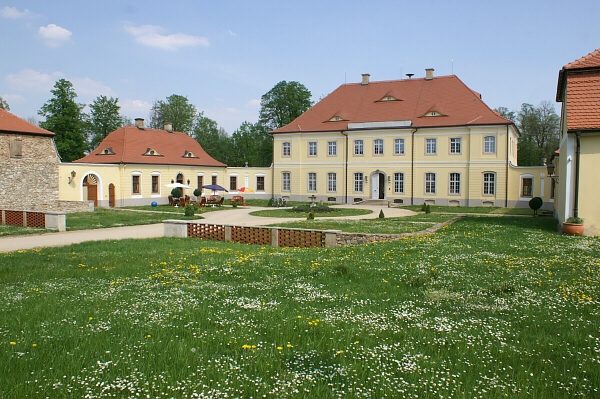
The Königshain Castle complex is probably unique in Saxony. It is one of the most regionally significant castle complexes in Upper Lusatia and consists of the older castle complex with the so-called "Steinstock" and the "Wasserschloss" (Water Castle), as well as the newer "Barockschloss" (Baroque Castle). Two of the castles, the "Steinstock" and the "Barockschloss", have been lovingly restored in recent years and, together with the exhibitions in the outbuildings, the park, and the herb garden, offer excellent opportunities for recreation.
The "Steinstock", a massive two-story building on a rectangular floor plan, is presumably the remnant of a medieval residential tower and knight's seat from the period of German colonization, which began around 1200. Later, the "Steinstock" was used as an economic building. Today, it is available for small exhibitions and events. Above the basement, it contains only one living room. In contrast to the plain masonry and simple building structure, the three windows on the south side and a Renaissance portal on the north side at the entrance to the cellar are made of sandstone.
After extensive restoration, the "Steinstock" has been open to the public for viewing since November 27, 1993.
From 1504, Königshain belonged to the wealthy Görlitz merchant family Frenzel, who realized a noble lifestyle here in seclusion. Joachim Frenzel had the "Wasserschloss" built in 1541, separated from the "Steinstock" only by a narrow alley, still within the moat ring. On the west side, it received strong buttresses due to the marshy ground.
After several changes of ownership, Ernst Moritz von Schachmann and his wife Susanne von Nostitz bought the estate, which had been severely devastated in the Thirty Years' War, in 1660. In 1668, the castle and servants' quarters burned down due to a lightning strike and were rebuilt in their current appearance in 1680 by the later owner Adolf Ernst von Schachmann. In the middle of the front facade is a baroque entrance portal. On the sides are two identical projections in the form of square two-story towers.
After World War II, the "Wasserschloss" served as a residence for several families. In 1992, renovation began, during which old wooden ceilings with 17th-century ornaments were uncovered. The cellar has been used as a winter quarter for bats since January 2000.
The further expansion of the castle complex and the heyday of Königshain began in 1752 when Carl Adolf Gottlob von Schachmann inherited it. He did not live in the "Wasserschloss" for long but had the "Barockschloss" built not far away between 1764-66, based on French Baroque architecture.
The two-story main wing is flanked by two single-story wings – the kitchen house and the cavalier house – connected by quarter-circular connecting passages. The entrance consists of a simple portal, to which a short flight of steps leads. On the park side, there is a three-sided projecting central wing with its own roof.
A charming park surrounds the "Barockschloss". Carefully trimmed hedge paths frame a large lawn parterre. In 1996, a rhododendron show garden was created, predominantly displaying Saxon cultivars. In the approximately 3-hectare castle park, there are monuments to Carl Adolf Gottlob von Schachmann and the von Heynitz family, who last owned the castle. Aviaries with various birds enrich the entire ensemble.
Since 2000, the coach house, which also exhibits historic sleighs and fire engines, has been open to the public.
Take Mobile History with you
You are reading this text for free. Premium adds what matters on the road: descriptions read aloud, sites found through your camera, whole regions taken offline.
- Every description, including the ~17,700 Premium sites
- Audio guide: have descriptions read to you on location
- AR finder: see sites through your camera, with distance and bearing
- Unlimited saved sites
14 days free, then from €2.99 a month. Cancel anytime.
Source: Wikipedia · Licence: CC BY-SA 4.0
This description draws on the facts documented in the linked Wikipedia article; Wikipedia content is licensed under CC BY-SA 4.0. Wording and editing: Mobile History.
Location: 51.1803, 14.8813