Museum
Cultural Events
CastleGaildorf
Old Castle Gaildorf
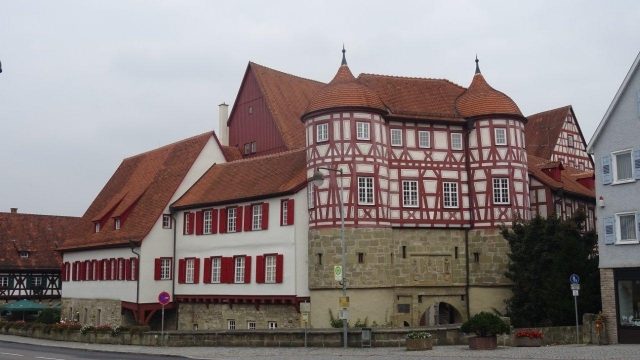
The Old Castle in Gaildorf in the district of Schwäbisch Hall in Baden-Württemberg is an imposing four-winged half-timbered building on a stone ground floor on the banks of the Kocher river. It was built from 1479 to 1482 and significantly expanded and converted into a picturesque Renaissance complex in the 16th and 17th centuries.
Schenk Albrecht von Limpurg-Gaildorf-Schmiedelfeld, from the line that emerged in 1441 through a division of the House of the Schenken von Limpurg, had a castle built in Gaildorf starting in 1479 over a three-year construction period, replacing a previous moated castle first documented in 1399 as a "Veste" but probably dating back to the Staufer era. The foundations of the old moated castle can still be seen today in the large cellar vaults. The castle was initially the seat of the Knights of Geilndorff, to whom the town of Gaildorf, first mentioned in 1255, owes its name. The Geilndorfers were ministeriales (vassals) of the Schenken von Limpurg, whose ancestral castle Limpurg stood near the neighboring imperial city of Schwäbisch Hall. After the Geilndorfers died out, the Schenken used the old castle as a hunting lodge.
The four-winged castle building was completed in 1482. A stone tablet, now placed above the main entrance, commemorates this:
- "We Albrecht, Lord of Limpurg, hereditary cupbearer of the Roman Empire and always free, have begun and completed this building on St. Michael's Day after the birth of Christ in the year fourteen hundred and eighty-two."
Albrecht and his wife Elisabeth von Oettingen henceforth resided in Gaildorf Castle. They were followed by seven more generations of the Schenken von Limpurg-Gaildorf, until the male line died out with Wilhelm Heinrich (1652–1690). The Gaildorf lordship and with it the castle passed to relatives from the Obersontheim line, who, however, also died out in the male line entitled to inherit in 1713 with Schenk Vollrath von Limpurg-Speckfeld (1655–1713). The last three Schenken had left behind ten heiresses, whose descendants further fragmented the already small lordship. Their regents, who also shared ownership of the Old Castle, no longer lived in Gaildorf until the early years of the 19th century.
One of the daughters of Schenk Wilhelm Heinrich and his wife Elisabeth Dorothea, Juliane Dorothea von Limpurg-Gaildorf (she later inherited a large part of the lordship and the castle), married Count Johann Wilhelm von Wurmbrand from Styria in the great hall of the castle in 1700; the hall is now named after him.
From 1817, the new lord of the Solms-Assenheim shares of the Limpurg-Gaildorf lordship, which emerged from the inheritance of the Schenken, Georg Friedrich Karl von Waldeck-Bergheim (1785–1826), resided in Gaildorf Castle. He now called his lordship Waldeck-Limpurg and himself Count of Waldeck-Pyrmont and Limpurg-Gaildorf. After his death, he was succeeded by his widow Amalie Charlotte Auguste (1785–1852), who had meanwhile been elevated to Countess of Waldeck-Limpurg. She was followed as owners of the Waldeck-Limpurg lordship and the castle in Gaildorf by her husband's nephew, Richard Kasimir Alexander von Waldeck-Bergheim (1835–1905), and finally from 1868 by his sister Mechthild Karoline Emma (1826–1899). Through her marriage in 1846 to Count Karl Anton Ferdinand von Bentinck, the castle came into the possession of the House of Bentinck.
Architectural Description+
The complex with its corner towers was expanded into a respectable Renaissance complex in the 16th and 17th centuries, with remarkable stucco ceilings inside. The oak coffered ceiling from the Renaissance in the great hall was built under an older, still partially preserved stucco ceiling; it is self-supporting and represents an extraordinary static achievement. Four wings of different heights enclose an irregular inner courtyard. Galleries and opulent painting around windows and doors adorn the courtyard.
Current Use+
The castle survived the Second World War without major damage. In the post-war years, it initially housed refugees and bombed-out families from Gaildorf and the surrounding area. In the mid-1950s, a textile company was located in the Wurmbrandsaal. In the early 1970s, renovations began; they continue to this day. Improper measures on the half-timbering in the 1930s had led to considerable consequential damage. In the winter of 2002, an entire compartment on the western gate tower detached and fell into the castle moat. Investigations showed that half of all half-timbered infills were loose, the fillings had sagged and were tilting outwards. Cosmetic measures had weakened the visible half-timbering to such an extent that it had almost completely lost its load-bearing function.
Today, artists (city painters) reside in the well-restored building on an annual rotation. The castle also houses the Theresientaler Heimatstuben, the town museum operated by the Historical Society with an additional permanent exhibition on criminal justice in the County of Limpurg, and various club rooms. Chamber music evenings are held in the Wurmbrandsaal.
The Old Castle was named Monument of the Month January 2006 by the Denkmalstiftung Baden-Württemberg.
Take Mobile History with you
You are reading this text for free. Premium adds what matters on the road: descriptions read aloud, sites found through your camera, whole regions taken offline.
- Every description, including the ~17,700 Premium sites
- Audio guide: have descriptions read to you on location
- AR finder: see sites through your camera, with distance and bearing
- Unlimited saved sites
14 days free, then from €2.99 a month. Cancel anytime.
Location: 49.0008, 9.7704