Museum
Restaurant
Hotel
CastleBayreuth - Eremitage
Old Castle Eremitage
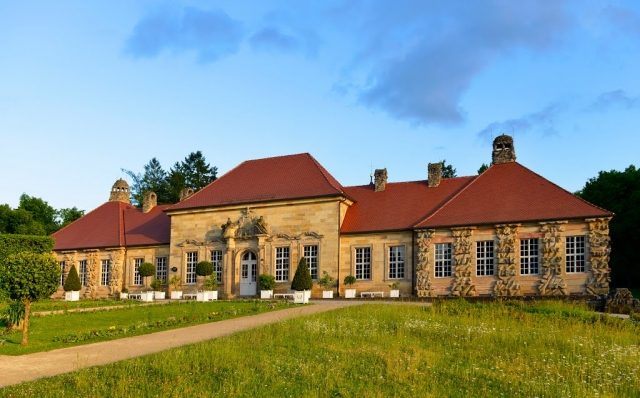
The Eremitage in Bayreuth is a historic park complex with water features, created from 1715 onwards, which is one of the city's attractions. It also houses the so-called Old Palace, the Orangery with the Sun Temple, and other smaller buildings. The Eremitage is officially also a district of the independent city of Bayreuth.
The park is located on a hill on the eastern edge of the Bayreuth valley basin, in direct proximity to the district of Sankt Johannis. To the east and north, it is bordered by the deeply incised valley of the Roter Main, and to the south, it is adjoined by the Eremitenhof district.
Genesis+
18th Century
Through purchase, the Bayreuth margraves acquired an extensive forest area of almost 50 hectares near the village of St. Johannis in 1616. Since 1664, there had been a game park there, a fenced forest area reserved for the court's hunting. Plans for a pleasure house began just one year later.
The Eremitage under Margrave Georg Wilhelm
From 1715, under Margrave Georg Wilhelm, a small summer palace and other smaller buildings (utility buildings, water tower as a reservoir for the fountain systems) were built as the center of a courtly hermitage. The plans originated from the court architect Elias Räntz. Although the inauguration was celebrated as early as 1719, work continued until 1722, as material deliveries are still documented from that year.
In 1718, the so-called Parnassus was created, with statues of Apollo and the nine Muses on an artificial rock. Its name was intended to recall the mountain of the same name in Greece, which was dedicated to the god Apollo. In 1720, the private residence of the engineer Johann Heinrich Endrich was built, which Wilhelmine of Prussia received as a gift in 1732, to whom its name Monplaisir goes back.
The palace was a four-wing complex with a small inner courtyard. In the two side wings, there were twelve small rooms each for the "hermits" or "hermit ladies". The transverse north wing contained a magnificent hall, with spacious apartments for the margrave and margravine on either side.
The margravial couple and the court played at hermitic life: during the day, they stayed alone like hermits in one of the pavilions scattered in the forest. Dinner was taken in the palace. Due to this pseudo-hermitic life of the court, the complex was given the name Eremitage.
Expansion under the Margravial Couple Friedrich and Wilhelmine
After Margrave Friedrich took over the government, he gifted the Eremitage to his wife Wilhelmine in 1735.
She immediately set about extending the small palace with two side wings, the Margrave's Wing and the Margravine's Wing. The architects were initially the court architect Johann Friedrich Grael and, after his death in 1740, the building inspector Johann Georg Weiß. A Japanese cabinet, a music room, and the Chinese Mirror Cabinet, where she wrote her famous memoirs, were furnished there. Two of the magnificent lacquer panels were a gift from her brother, Frederick the Great. The Inner Grotto was added to the southern part of the palace, a room clad with glass slag and shells, from which water can spray from more than 200 nozzles.
From 1737, the Lower Grotto was built by the court architects Johann Friedrich Grael and Joseph Saint-Pierre, and later next to it, the stone Eremitage for the margrave.
Between 1749 and 1753, the New Palace was built west of the existing palace (not to be confused with the New Palace built in the city center from 1753). It consists of two curved wings separated from the central part. This bears a gilded quadriga, steered by a torch-bearing Apollo as a symbol of the sun. Therefore, the building is usually referred to as the Sun Temple. The side wings today form the Orangery of the Eremitage. At the same time, surrounded by pergolas (so-called treillages), the large upper water basin (Upper Grotto) with several groups of figures was created. The entire ensemble embodied the Four Elements.
The landscape park is a jewel of Rococo and a prime example of 18th-century garden culture. It is variedly designed with a grotto, artificial ruins in the form of a ruin theater (1743), an ancient tomb, the Eremitage for the margrave (1743-45), and a lost Eremitage for the margravine, as well as a series of fountains. Anticipating the parks of Romanticism, many hidden corners and constantly changing views and insights were also created.
The garden is divided into geometric districts with bosquets, avenues, and water features. The whole is semicircularly surrounded by dense deciduous forest. Wilhelmine followed Baroque ideas by adopting traditional elements (pergolas, water features, and hedge quarters). The individual parts stand freely next to each other; the symmetry axis customary in Baroque is missing.
19th Century
At the end of the 18th century, the garden, already under Prussian rule, was landscaped and partly used for agriculture. In 1810, after four years of French occupation, it was sold by Napoleon to the Kingdom of Bavaria along with the city. Since Bayreuth was no longer a residential city, such a pleasure garden was no longer needed and was partly used as agricultural land.
In 1830, the Bavarian Duke Pius, who spent several summer weeks in the Eremitage, had the still existing hermitage chapel built. After that, the complex was only sporadically used, for example, during the visit of the Bavarian King Ludwig II on the occasion of the Richard Wagner Festival in 1876.
20th Century
On April 14, 1945, during the otherwise largely bloodless capture of Bayreuth, the Orangery and the Sun Temple were severely damaged by American troops. The Old Palace and the former Marstall were also damaged. The reconstruction of the Orangery was only external; the interiors were not reconstructed.
A large part of the previously sold properties was repurchased, and lost park sections were newly laid out. Efforts were made to restore the park to its state at the end of the margravial era. Thus, the cascade on the north slope was restored, and the canal garden with the bosquets in the southwest of the complex was recreated. The Schneckenberg also received an octagonal pagoda again.
Since 2005, the Old Palace has been/is being extensively renovated. The Marble Hall, the Chinese Mirror Cabinet, the Japanese Lacquer Room, and other magnificent rooms of the Margravine's Wing are now open to visitors again.
Management of the Complex+
The Bavarian Administration of State Palaces, Gardens, and Lakes manages the outdoor facilities and buildings.
Current Use+
The Old Palace serves museum purposes and can only be visited as part of a guided tour.
A café is located in the east wing of the Orangery. The museum shop will be located in the Old Palace of the Eremitage from the 2014 season. The west wing is used for art exhibitions during the summer months. It can also be rented, like the central building, the Sun Temple, for smaller and medium-sized private celebrations.
A restaurant and a hotel are located in the former Marstall.
Since 1969, the Summer Night Festival has regularly taken place in the park. In the past, there have been recurring problems with the weather (including cancellations due to storm warnings) and associated deficits, which are borne by the city.
Since 1982, performances by the Studiobühne Bayreuth have taken place in the Ruin Theater during the summer months.
Water Supply+
Large quantities of water had to be provided for the water features in the Old Palace, the Lower Grotto, and on the Parnassus, as well as the cascade and the drinking water supply. Therefore, the first water tower was built in 1718, which is still in operation. Originally, it received its water from the Pensen ridge east of the Roter Main valley. The supply was carried out in a closed pipeline system of hollowed-out tree trunks according to the siphon principle. It was largely laid underground, but the crossing of the valley floor was done in a lead pipe over a bridge.
Around 1750, in the course of the construction of the Upper Grotto, a second water tower was built. It received water from the Roter Main by means of a piston pump driven by a water wheel via a rod system about 200 meters long.
Transport+
From the Dürschnitz district near the city center, Königsallee leads to the Eremitage. Margravine Wilhelmine had the road laid out as a "Königsweg" (King's Way) on the occasion of the upcoming visit of her brother Frederick II of Prussia. Not far from the Bayreuth-Nord junction of the Bundesautobahn 9, Eremitagestraße begins, which ends on the park grounds.
City bus lines 302 and 303 serve the Eremitage within the tariff network of the Verkehrsverbund Großraum Nürnberg. A parking space for motorhomes is located at the nearby Lohengrin Therme in the Seulbitz district.
Take Mobile History with you
You are reading this text for free. Premium adds what matters on the road: descriptions read aloud, sites found through your camera, whole regions taken offline.
- Every description, including the ~17,700 Premium sites
- Audio guide: have descriptions read to you on location
- AR finder: see sites through your camera, with distance and bearing
- Unlimited saved sites
14 days free, then from €2.99 a month. Cancel anytime.
Source: Wikipedia · Licence: CC BY-SA 4.0 · Image: Jürgen Grösel
This description draws on the facts documented in the linked Wikipedia article; Wikipedia content is licensed under CC BY-SA 4.0. Wording and editing: Mobile History.
Location: 49.9489, 11.6250