To be privately owned
CastleKromsdorf-Denstedt
Old Castle Denstedt
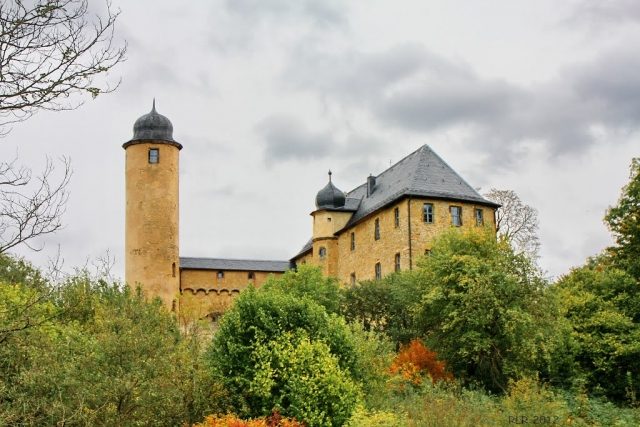
Denstedt Castle is located on a flat mountain spur west of the village. Denstedt belongs to the municipality of Kromsdorf and is located about 8 km northeast of Weimar.
The terrain slopes down to the Ilm in the north and to the Erlenbach in the west. To the south, a park area, through which the Erlenbach flows, adjoins the valley. The striking keep of the castle complex, situated to the west of the village, is visible from afar when approaching from the Tiefurt road.
Regarding the construction period of the castle, with the exception of the annex from 1699, different assumptions can be found in the literature published so far. Despite the lack of clear building evidence, there must have been a predecessor building at the site of the present castle complex. When this was built and what it might have looked like can no longer be traced today.
The first reliable attribution of the place Denstedt is dated to the year 874, as Duenestat (Bad Tennstedt) and Denesteti (Denstedt) are first literally separated. The place name underwent many changes in the following years (Thegenstete – Deginstete – Deinstete – Deynstete) until 1548, when the name Denstedt, formed by contraction (ege – ei – e), first appeared. This name probably goes back to a Thegan (knight's seat or squire's seat) (Old High German Thëgan = young warrior or follower).
Early 12th Century – 1415, Family von Denstedt
Since the knightly family, which named itself after Denstedt, first appeared in historical tradition around 1206 with Gerboto von Degenstede, it is reasonable to assume that this family was the builder of the manor. Already in the 12th century, close economic ties connected the Denstedt manor with the monasteries of Hugistorff (Heusdorf near Apolda) and Oberweimar. A monastery also existed in Denstedt for a short time, whose cellar has been preserved under the restaurant to this day. Between 1170 and 1513, the grain and oil mills below the castle also belonged to this monastery. This property must have been lucrative, as they are mentioned in feudal transfers and were often objects of dispute.
Through the signature of Witego von Deginstete in the documents of the Oberweimar monastery, the first reliable proof of the family von Denstedt emerged in 1249. In addition to Denstedt, Witego possessed the "Pflegegerichtsbarkeit" (custodial jurisdiction) over the villages of Süßenborn, Rödigsdorf, Schwabsdorf and half of Klein-Kromsdorf. The "Gericht über Hals und Hand" (court over neck and hand) enabled the respective manor owners to levy hereditary rents and other taxes and to deliver agricultural products. The numerous members of the family von Denstedt can be found in the 14th-16th centuries in various positions outside the village. When the family died out around 1700, they had long since ceased to reside in Denstedt.
1423–1586, Family Gans
In the following decades, the manor experienced a tremendous upswing under the rule of the von Gans family over the complex, the village, and the Denstedt custodial court. The von Gans were also an old family and had been settled before their enfeoffment in Denstedt. In 1513, the brothers Eckhart and Dieterich received the two Denstedt mills as a fief. On March 12, 1514, the castle and the noble estate of Denstedt are mentioned in the feudal documents, with which they were enfeoffed on that day.
In 1530, Dietrich Gans had the castle built. Other sources assume a redesign of an existing medieval residential building or an addition of the 2nd upper floor. It is also claimed that the curtain arch windows were subsequently inserted into the medieval residential building. According to new investigations, it can be assumed that the castle in its present form dates from the 16th century and was built by the von Gans family, incorporating the late medieval keep. As under the von Denstedt family, the Gans brothers exercised jurisdiction over the Denstedt custodial court. A sign of the extensive building activity of this period is also the high indebtedness of the family. In 1574, Eckart Gans owed the Saxon Chamber Councillor in Weimar, Dr. jur. Lucas von Thangel, 10,000 guilders. On April 29, 1579, the complex was sold to von Thangel "as he could not otherwise be paid, but had to take his Gans estates against his will by purchase". His great-grandchildren Georg Wolf and Heinrich von Thangel lived in the castle and noble estate until 1668. In the church in Denstedt, two well-preserved tombstones with the goose as a coat of arms are still preserved today.
1579–1668, von Thangel
The circumstances of the Thirty Years' War had left the Thangel property heavily indebted. Many farmsteads in the villages belonging to the Denstedt custodial court burned down, fields remained uncultivated, and their inhabitants often fled to Weimar. In 1640, the entire population of Denstedt even had to be evacuated to Weimar for a short time. The castle increasingly fell into disrepair with the indebtedness of its owners. In 1652, the owners tried to sell the property "due to debts". The war also led to the decay of the noble estate, which became part of the bankruptcy estate in 1673. When Georg Heinrich von Thangel finally died without leaving a male heir, the castle was briefly administered by his relatives from Ostramondra. Wolff Adolf Freiherr von Werther from Wiehe/Unstrut, von Thangel's son-in-law, acquired the castle in 1673 for 25,542 guilders.
1698 to 1892, Family Linker von Lützenwick
On December 22, 1689, the Trier diplomat Johannes Lyncker von Lützenwick acquired the Denstedt estate for 33,000 Meissen guilders as a capital investment. After his death in 1698, the castle passed to the "Electoral Mainz Councillor in Erfurt" Johann Daniel Linker, Knight von Lützenwick (1631–1712), his younger brother, who lived in Erfurt. With this acquisition, the Linkers became the judicial lords of Denstedt for the next four generations.
During this period, further extensive construction measures took place. The most important construction is probably the extension of the residential building to the west by a new annex in 1699. A coat of arms shows the inscription "JOHAN DANIEL LINKER 1699" and a lamb, the heraldic animal of the family. Johann Jakob von Linker und Lützenwick (1665–1730) received the estate and the custodial court from his uncle in 1703. He continued the expansion of the manor. A coat of arms above the now walled-up gate entrance of the bailiff's house shows the year 1714, as well as the symbols of the Linker family, the lamb and the pomegranate, and two eagles as shield bearers. In addition to the bailiff's house, which also served as a residence for an administrator, as the owner and his family often stayed in Erfurt, the building northeast of the battlement, the so-called Old Judiciary, was also built around 1713/14.
The entire noble residence was enclosed by a strong wall around the property. The southern terrace between the annex and the wall was created, as was the southern wall with the brick arches. The landscape park, which borders the castle grounds to the south, was started. Since Friedrich Karl Albrecht, Freiherr von Linker und Lützenwick (1773–1844) remained without male descendants for the office of hereditary and judicial lord, Johann decided to bequeath the estate to his son-in-law Dr. Wilhelm von Wegner (1799–1853). The last owner of the estate was the Weimar chamberlain Erich von Conta, married to Mathilde von Wegner, also known as Lincker von Lützenwick und Niedertiefenbach. She sold the estate in 1892.
1892–1945, Family Koch
Rittmeister Johannes August Koch (1866–1944) acquired the estate from the Contas in 1892. The tower and corner rooms on the 2nd upper floor were already vacant at this time. The Linker annex in the west was used as a grain storage and threshing floor on both floors.
After 1945
The estate, expropriated without compensation after the occupation by the Red Army in 1945, was converted into one of their slaughter bases and then became public property. Later, agricultural use determined the appearance of the complex. The VEG Schöndorf had an electric grain mill installed; all outbuildings fell into disrepair due to vacancy. From 1984, the remaining buildings belonged to the Agricultural Production Cooperative Kromsdorf (LPG), which, however, abandoned the complex in the 1990s. The significant interventions in the building fabric of the castle during its use as a grain mill and storage are particularly evident today in the floors of the annex.
In 1991, the entire complex was sold to an investor who wanted to convert the castle into a sports hotel complex. The planning matured to the project and development plan, but was only implemented in the demolition of the outbuildings, barns, the ox yard, and the carriage house in 1994. After the groundbreaking ceremony, the investor disappeared, and the castle increasingly fell into disrepair. Door and window openings were secured by the Denstedt Volunteer Fire Department in the following years, and in 1996, the emergency securing required by the German Foundation for Monument Protection was carried out. In 2001, the current owners bought the castle at auction. Since then, necessary securing work has been carried out. A health club is to be established in the castle complex by 2011.
Take Mobile History with you
You are reading this text for free. Premium adds what matters on the road: descriptions read aloud, sites found through your camera, whole regions taken offline.
- Every description, including the ~17,700 Premium sites
- Audio guide: have descriptions read to you on location
- AR finder: see sites through your camera, with distance and bearing
- Unlimited saved sites
14 days free, then from €2.99 a month. Cancel anytime.
Source: Wikipedia · Licence: CC BY-SA 4.0 · Image: Rainer Gindele
This description draws on the facts documented in the linked Wikipedia article; Wikipedia content is licensed under CC BY-SA 4.0. Wording and editing: Mobile History.
Location: 51.0008, 11.3824