Museum
School
ManorNienburg
Fresenhof Manor
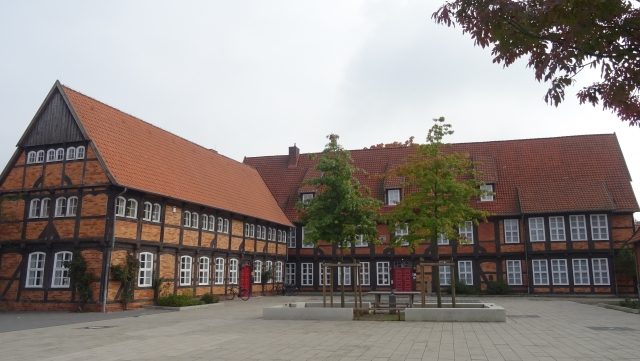
The Fresenhof is one of the oldest buildings in the city of Nienburg. It is a so-called Burgmannshof, a vassal's seat.
The oldest documented record dates back to 1263, when a Hermann de Buren (von Bühren) was the holder of the castle fief. Already 200 years later (1485), this Nienburg line of the family died out with Heinrich von Bühren.
On June 6, 1485, Count Jobst von Hoya enfeoffed Arnold Frese with the Burgmannshof, which included extensive lands. Despite various owners, the von Frese became the namesake of the building.
The von Frese were closely connected with the Count von Hoya, and their wealth can be measured by the fact that they lent Count Johann von Frese the incredibly high sum of 350 gold ducats for that time.
From 1528, the ownership changed several times. Until 1598, the Fresenhof belonged to the von Bothmer family. The year 1585 above the main entrance indicates that structural changes were made at that time.
Over the years, the Burgmannshof was rebuilt several times. In 1610, the building was completely rebuilt and in 1670 it was extended.
A Mr. Poppelbaum took over the old Burgmann's seat from the von Bothmer family. Further owners recorded in the archives are: von Hitzfeld (1682), von Pape (1761), von Cramm, Grütter, and David Lühring (1866). The huge estate was divided and sold from decade to decade due to inheritance disputes. In 1853, when von Cramm was the owner of the court, the building trade school was housed here for a short time. Later, the retired Bartholomäus Cabolet took over the remaining farm, whose son operated a vinegar factory in the outbuilding, and "Champagner – Grütter" stored his wine in the cellar. During this time, the Fresenhof was known to the people of Nienburg as "Cabolet's Hof".
At the end of the 1930s, the entire complex became the property of the city of Nienburg. During World War II, the museum's collection was housed here. Many valuable objects were lost due to theft. Until the new construction of the employment office in 1968, the building served as the administration for this office. Subsequently, the Fresenhof became a youth recreation center. After its relocation, the building stood empty for several years.
Finally, the city, the district, and the state of Lower Saxony provided financial resources for renovation and remodeling, and in 1985, the building could be handed over to the Museum Association for use.
Take Mobile History with you
You are reading this text for free. Premium adds what matters on the road: descriptions read aloud, sites found through your camera, whole regions taken offline.
- Every description, including the ~17,700 Premium sites
- Audio guide: have descriptions read to you on location
- AR finder: see sites through your camera, with distance and bearing
- Unlimited saved sites
14 days free, then from €2.99 a month. Cancel anytime.
Location: 52.6392, 9.2106