German Foundation for Peace Research
ManorOsnabrück
Ledenhof Manor
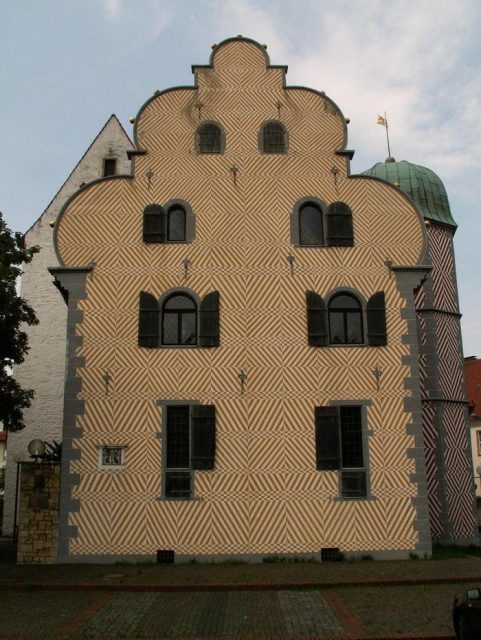
The Ledenhof (formerly also Alte Münze) was the medieval city residence of the patrician and noble family von Leden in Osnabrück (Lower Saxony).
Of the once extensive court complex, the seven-story stone building and a palas with a stair tower have been preserved. Since 2002, the Ledenhof has been the seat of the German Foundation for Peace Research.
The name of the Ledenhof, near the baroque Osnabrück Castle and the late Gothic Katharinenkirche, was first mentioned in a document in 1499. The wine merchant Johann Leden had settled on the edge of Osnabrück's old town in the mid-14th century and built a half-timbered house and a wine cellar there. On the remains of this house, the third Heinrich von Leden, to whom the German king and later emperor Maximilian I granted far-reaching privileges in 1499, built a palas. The Ledenhof was still a closed complex around a rectangular inner courtyard with a gatehouse in the late 18th century, as shown on Du Plat's map of the city from 1787. A mint workshop was probably also located in the Ledenhof. The designation Alte Münze was used for the court complex until the first decades of the 20th century; it was Rudolf vom Bruch who brought the name Ledenhof back into memory with his work Die Rittersitze im Fürstentum Osnabrück, published in 1930. In the 19th century, the Ledenhof had changing owners. Parts of the property belonged to the manufacturer Heinrich Wilhelm Storck, while others had been in the possession of the Counts of Münster until 1781. In the late 19th century, Friedrich August Koch and Ernst Conrad Kromschröder used the Ledenhof for business purposes. Since 1930, the Ledenhof has been owned by the city of Osnabrück. During World War II and in the post-war years, the existing buildings of the Ledenhof threatened to fall into disrepair. Between 1964 and 1976, the stone building and the palas were extensively renovated. For the exemplary monument-appropriate restoration of the Ledenhof, the city of Osnabrück was honored with the Europa Nostra Medal in 1980. The Ledenhof subsequently housed the music library, before the German Foundation for Peace Research took up residence there in 2002.
Stone Building
The most significant part of the Ledenhof is the stone building made of rubble masonry with a gabled roof. It is a special feature of medieval buildings in Osnabrück. The stone building of the Ledenhof, which is dated to the 14th century, has external dimensions of 9.15 by 9.13 meters. Unlike other stone buildings, it was not a fortified granary, as can be concluded from its construction, but served as a warehouse. The entrance to the cellar, which unlike fortified granaries does not have a vault, is at ground level and was thus more easily accessible than fortified granaries with high-lying access, which were easier to defend. Originally, the stone building had no chimney. In the 15th century, the stone building was extended to a keep with seven stories and loading hatches on the south side. The builder of the palas, the third Heinrich von Leden, had an access from the palas created and a "heimlichkeit", a toilet, installed.
Palas
The palas with two ornamental gables was built by Heinrich von Leden, the third bearer of this name in succession, in the 15th century as a representative residence. The ground floor consists of a four-meter-high Deele (hall) of 9.64 by 8.18 meters, which served as a living kitchen, with a chamber section of 3.84 by 8.18 meters behind it, accessible through two doors next to the fireplace. The chamber section, the "kameren boven dem kelder", was probably the bedroom of Heinrich von Leden and his wife Margarete von Bar. A staircase led to the upper floor with a banqueting hall and hall chamber, which was only replaced in the late 16th century by the addition of a polygonal stair tower with a spiral staircase made of oak wood. The banqueting hall with rich ornamentation on the beamed ceiling had access to an outdoor gallery on the east side. The gallery was abandoned when the stair tower was added. From this floor, there was access to the stone building. The palas was decorated with decorative painting on plaster consisting of rhomboid bands in white and yellow, which was renewed during the renovation.
Miscellaneous+
The name Ledenhof was transferred to the area where the Marienstätte monastery had stood during the time when the court complex was called Alte Münze. Today, an underground car park also bears the name Ledenhof. The designation Alte Münze has been preserved in a street name at the Ledenhof.
Take Mobile History with you
You are reading this text for free. Premium adds what matters on the road: descriptions read aloud, sites found through your camera, whole regions taken offline.
- Every description, including the ~17,700 Premium sites
- Audio guide: have descriptions read to you on location
- AR finder: see sites through your camera, with distance and bearing
- Unlimited saved sites
14 days free, then from €2.99 a month. Cancel anytime.
Source: Wikipedia · Licence: CC BY-SA 4.0 · Image: http://www.wehrbauten.de/thread.php?threadid=590
This description draws on the facts documented in the linked Wikipedia article; Wikipedia content is licensed under CC BY-SA 4.0. Wording and editing: Mobile History.
Location: 52.2724, 8.0451