Museum
CastleRinteln
Eulenburg Castle
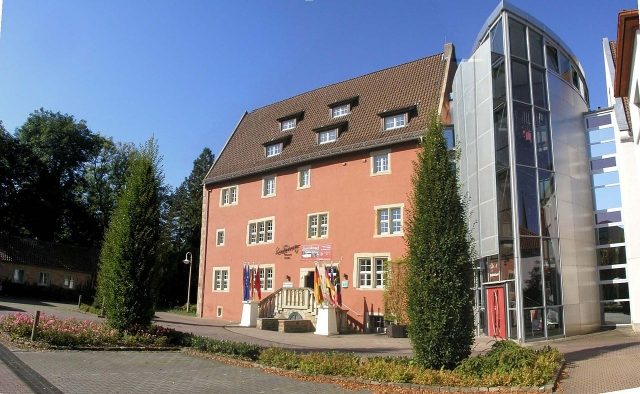
The early history of the Eulenburg likely dates back to the time of the town's founding in the 13th century. The massive foundations, which have the shape of two adjoining squares, suggest a beginning as a high medieval residential tower. However, this is uncertain because no documentary evidence has been preserved. Only an archaeological excavation could, with some luck, bring more definitive insights.
More is known, however, about the early ownership of the Eulenburg. Documents from the late Middle Ages state that it belonged to a noble family von Rottorp, whose members, in turn, were closely connected to the Möllenbeck Abbey for generations. The Rottorps gradually brought the Eulenburg, as well as other possessions, as a donation into the Abbey, which in turn provided them with their former property as a fief, i.e., on loan. At the same time, several sons took on secular functions in the administration of the Abbey, while unmarried daughters entered as canonesses and thus enjoyed a life that was both befitting their status and pleasing to God.
When the branch of the von Rottorper family enfeoffed with the Eulenburg died out in the male line, the Möllenbeck canonesses made the mistake of not reclaiming their property, which had only been loaned. It was then divided among various, more or less close relatives, who claimed full ownership rights. In the mid-15th century, monks of the Augustinian Canons Regular reform order replaced the canonesses in the monastery, and they endeavored to rebuild the old monastic self-sufficiency. They now had no choice but to buy back the lost possessions. This happened by document in 1483. A year later, in 1484, the monks, for safety's sake, had the old freedom of the Eulenburg from all municipal burdens confirmed once again by the Rinteln council. This document also reveals the structural form of the Eulenburg at that time. According to it, it was a "Steenwerk", i.e., a building erected from solid stone masonry. In the architecture of medieval Rinteln, which was characterized by light half-timbering, this was a special feature, mentioned as an unmistakable characteristic of the house.
For the Möllenbeck monks, the Eulenburg served as the town residence of the highest-ranking monk, the prior. Here, behind the protective city walls, the religious could retreat in turbulent times. In times of peace, natural produce deliveries from the tribute-paying farmers were received here.
With the Reformation and the conversion of Möllenbeck Monastery into a Protestant collegiate foundation in 1559, little changed for the Eulenburg initially. It remained unchanged as the town residence of the, now Protestant, prior. In 1591, against the backdrop of a flourishing general economic situation, the canons even agreed to completely renovate their town residence. The Eulenburg largely acquired its present appearance. One can only speculate about the reason for this renovation. It is possible that a large fire had destroyed large parts of the old stone structure, thus necessitating a renovation from cellar to roof. A widespread layer of fire debris, which surrounds the northern part of the present building at a depth of about one meter, could also indicate this.
Presumably using the old foundations, a solid but rather sober administrative building soon rose on the site of the former building, without the festive ornamentation of the Weser Renaissance that was common at the time. This simplicity probably had a good reason. The canons did not want to give new cause for offense to the generally smoldering criticism of the continued existence of monastic life in Protestant northern Germany. Pomp and luxury, therefore, even in economically good times, could not be the calling card of a spiritual foundation. Thus, expensive decorations were dispensed with externally, and elaborate decor was rather confined to the interior rooms, which were not accessible to everyone. They were lavishly painted in the style of the Weser Renaissance. A small remnant of this painting has now been uncovered by a restorer.
The steep gable roof, three full stories with two- and three-part window openings, partly surrounded by a cavetto, and the two-armed open staircase with dog-leg railing (still single-armed in the 18th century) have remained the only characteristics of the Eulenburg to this day. Particularly typical is the steep gable. It was once covered with heavy Solling slabs (like the Nikolaikirche), whose weight could thus be better transferred to the outer walls. Comparable pointed gables from this period can still be found at the Extener Mühle or the former Friesenhausenhof, Ritterstraße 8.
Although little is known about the intention of the construction measures, the inscription of the building from this period provides information about its patron. It reads:
"S P P I M M F F ANNO 1591" and has been interpreted as "Structuram Pater Prior Jodocus Monasterii Mollenbeccensis fieri fecit anno 1591", in German: "Father Jodocus, Prior of Möllenbeck Monastery, had this building made in the year 1591".
The mentioned Father Jodokus was Prior Jodokus Stuken, who came from Recklinghausen in Westphalia. Under his leadership, which lasted from 1581 to 1596, the Möllenbeck Abbey experienced a late flourishing. Stuken, among other things, rendered service to the then highly respected Möllenbeck Latin school. His epitaph, no longer existing today in the monastery church, also praised him as a benefactor of the poor.
A modest stonemason's mark and the initials "H...R" next to the inscription from 1591 refer to the executing contractor. They stand for the Hameln master Henni Rotfeld, who was born in Obernkirchen.
The results of the investigations by the Detmold architectural historian Michael Sprenger also speak for a largely complete new construction of the house in 1591. Sprenger, to whom the documentation of many already demolished buildings is owed through his extensive investigations of Rinteln houses some years ago, determined the felling year of the trees for the ceiling and roof beams. The result: All important, load-bearing timbers were felled in the construction year 1591 – not a single one is older.
After the death of Father Jodokus Stuken, at the turn of the 17th century, the last flourishing of Möllenbeck Abbey came to an end. Economic conditions worsened, the number of "honorary" lay brothers declined, and the previous self-management of the lands had to be gradually abandoned.
Thus, it can be explained that the court was initially given as a fief to the Schaumburg Chancellor Eberhard von Weihe in 1606 and finally, in 1612, sold to the city of Rinteln for 1,100 thalers. The mayor and council, however, were less interested in the building itself than in a special right that had been associated with the possession of the Eulenburg since ancient times. Thus, with their acquisition, they simultaneously obtained the patronage right over the city church of St. Nikolai, i.e., they were henceforth allowed to determine the appointment of the city's parish priest themselves. The Eulenburg remained in the possession of the city for only a few years. Then the regional sovereign acquired it. In 1651, four years after the division of the old County of Schaumburg, Rinteln became the seat of government for the Hessian part. Now, with the new government chancellery and the superior court, the two highest Schaumburg institutions moved into the Eulenburg.
When the government moved in, the building was in poor condition. Settlement cracks, caused by the soft subsoil, endangered its structural integrity. In 1662, extensive renovations were therefore carried out again. Strong oak beams supported the walls and intermediate ceilings against each other internally, and at the same time, the rooms were divided into smaller chambers and writing offices.
Shortly thereafter, between 1665 and 1712, the Mühlenexter was relocated across the Eulenburg grounds. To this day, it flows here for a distance of about 80 meters not outside, but inside the city wall. The reasons for this diversion are nowhere clearly documented. However, it is probable that the symmetry of the new fortress ramparts required a shortening of this strongly projecting city corner. In order not to have to make the entire defense system correspondingly larger, it was preferred to lead the Exter in this area along the inside of the wall. At the same time, the garden of the chancellery director thus received a contemplative-romantic stream of particular charm.
The relocation of the Exter behind the city wall has repeatedly taken its revenge in a special way in the following period. Several times later, the Weser flood first entered the city at precisely this point. In addition, the cellar of the Eulenburg is still so damp that it can hardly be used meaningfully.
These were not to be the only alterations. In 1761, when it was considered whether the upper floor could be converted into an astronomical observatory for the university, this failed due to the different roof trusses of the north and south wings.
For more than 200 years, generations of Schaumburg officials came and went in the Eulenburg. With sonorous titles that bore witness to the baroque love of splendor of their era: government presidents and directors, chancellery, justice, and consistorial councilors, assessors, co-rapporteurs, secretaries, scribes, chancellery clerks and accessists, archivists and registrars, beadles and chancellery messengers.
In the session room, the government's meeting room, a chair always had to remain empty at all official gatherings of the councilors. It was symbolically reserved for the reigning Hessian Landgrave, who could only be present in the form of a large portrait. Such a thing was anything but unusual. It was also handled this way in Hanover, ruled from distant London in personal union. There, on festive occasions, the painting of the absent British monarch was placed directly on the chair at the table, and people even danced around the portrait during the minuet, as if His Royal Highness himself were present. Although this scene seemed strange even to contemporaries, this ritual remained customary until the end of the 18th century.
Not only the government, but also the political regional representation met in the Eulenburg. In the 17th and 18th centuries, the Landtags repeatedly convened here. This first Schaumburg parliament – consisting of representatives of the foundations, the nobility, and the cities – had a say in all tax and financial matters of the Hessian county.
At the beginning of the 18th century, the neighboring Stiftshof was purchased as a residential building for the government president himself. It was located at the front of Klosterstraße and had to make way for the construction of the present town hall in 1898. Between it and the Eulenburg, on the site of today's town hall parking lot, extensive garden areas stretched, the use of which was available to the government president and his service personnel. As late as the 15th century, hops had been cultivated here; in the 18th century, it served partly as an ornamental garden, partly as a vegetable garden. Only after World War II was it leveled and paved into a parking lot for cars.
During the 19th century, Rinteln gradually lost its old significance. The government was downgraded to a government deputation and finally to a district office, and the latter moved into the old Stiftshof on Klosterstraße after 1866. The Eulenburg became deserted and threatened to fall into disrepair. Around 1870, a private individual from Homberg/Efze, the composer and music teacher Wilhelm Valentin Volckmar, acquired it. Volckmar, a childhood friend of Dingelstedt and brother-in-law of the hunting painter Christian Kröner, had grown up in Rinteln and remained closely connected to the Weser town throughout his life. In his advanced age, the successful composer wished to return to his old hometown and acquired the Eulenburg to spend his twilight years there. For the time being, the building remained rented as a residence. However, the move to Rinteln did not happen, and the house slumbered, overgrown with tall ivy vines, in a Sleeping Beauty-like sleep.
A lightning strike on June 16, 1900, which fortunately caused little damage, did the rest; the question now was whether to renovate or demolish the building, sometimes scorned as an "old pile of stones." Fortunately, a new, meaningful use was found – as an Alumnat, i.e., a student dormitory for the Royal Gymnasium. For this purpose, some money was invested in 1904, for toilets, new windows, and a spacious staircase extension to the rear towards the Mühlenexter. Until 1932, external students from wealthy families spent their weekdays here under the direction of a housekeeper and the watchful eye of an assistant teacher. Then, buses and the Extertalbahn made the dormitory superfluous.
A vocational agricultural school used the vacuum for a few years, until the museum was gradually relocated here from Kirchplatz between 1934 and 1938. At the same time, buildings for the purposes of the neighboring hospital were already being erected around the old walls, and after the beginning of the war, the hospital was to gradually take over the Eulenburg as well. In 1946, when thousands of refugees had to be accommodated in Rinteln, the museum was crammed into two rooms and finally completely outsourced – a part of its collections was lost forever.
For more than 20 years, the Eulenburg served the hospital. The administration was located on the ground floor and first floor, above it an apartment for a doctor, and under the high roof, which was developed to the last corner, apartments and chambers for nurses and employees were crowded.
It was also the hospital's management that ultimately almost spelled the end for the Eulenburg. In 1962, a demolition application was submitted, as the area was needed for further supplementary buildings for the hospital. Fortunately, things turned out differently, as plans for a new hospital building in the Nordstadt emerged and gave the historic edifice a breathing space. In 1966, doctors and nurses then finally moved to Sauerbruchstraße.
Only now was there an opportunity to consider a long-term and appropriate use for the Eulenburg. The district council decided to move the museum back in, this time more generously than in the 1930s. The Heimatbund (local heritage association) could use the entire building for its permanent exhibition.
The name "Eulenburg"
The question of the name of the Eulenburg is unresolved. The most probable derivation is from "Eolenborg" = Old Castle. However, other interpretations would also be possible. For example, the student slang corruption of the seat of the princely government chancellery as "Eulenburg". The derivation from "Old Castle" has repeatedly led to the assumption that the stately castle complex documented for Rinteln in a 14th-century document could have been located here. This "castle", if it actually existed, was probably more in the area of Münchhausenhof and Parkhof on the southeastern edge of the city, on a site that still belonged to the Counts of Schaumburg in the 16th century.
Take Mobile History with you
You are reading this text for free. Premium adds what matters on the road: descriptions read aloud, sites found through your camera, whole regions taken offline.
- Every description, including the ~17,700 Premium sites
- Audio guide: have descriptions read to you on location
- AR finder: see sites through your camera, with distance and bearing
- Unlimited saved sites
14 days free, then from €2.99 a month. Cancel anytime.
Location: 52.1848, 9.0774