Public library
ResidenceKoblenz-Altstadt
Palais Dreikönigenhaus
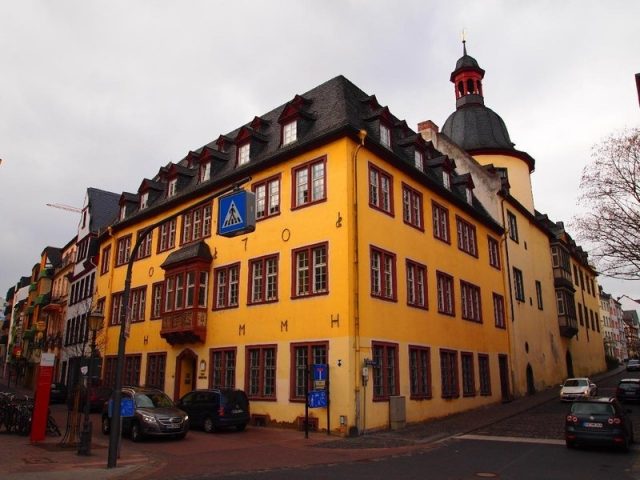
The Dreikönigenhaus (House of the Three Kings) is a Baroque building in the old town of Koblenz. Built in 1701, this noble court received its name after the Three Wise Men.
Before the building was constructed, there was a garden on the site, which was referred to in a 1538 record as the Holy Three Kings Altar Garden. In 1595, a municipal house stood there, which was sold and later became the inn "Zu den drei Königen". This building was probably destroyed during the devastating bombardment during the siege of Koblenz in 1688 by French troops in the War of the Palatine Succession.
The current building was constructed in 1701. The city of Koblenz names councilor Wilhelm von Hauschild as the master builder, while literature refers to the Electoral Trier court architect Johann Christoph Sebastiani as the builder, who had just completed the Jesuit College. However, Hauschild soon leased the newly built house. Among the new tenants was the von Breidbach zu Bürresheim family. The Mainz Archbishop Emmerich Joseph von Breidbach zu Bürresheim (1707–1774) was born in the building.
The house was bought in 1711 by the Trier Cathedral Dean Anton Freiherr zu Eltz zu Rübenach, who demanded "noble immunity" for the building, now called Eltz-Rübenacher Hof, meaning exemption from real and personal burdens. After his death, the building passed to Damian Lothar von Eltz-Rübenach, who had the Carmelite monastery rebuilt in Boppard in 1730. His son, the Electoral Trier Privy Councillor Franz Ludwig von Eltz-Rübenach, extended the Dreikönigenhaus in 1779 with an annex for servants and economic purposes. The basalt plaque with the building inscription is still located on the courtyard facade today.
During the French occupation (1794–1814), the post office was housed in the Dreikönigenhaus. During this time, the French Marshal Michel Ney once took up quarters in the building. The Eltz-Rübenach family sold it in 1817 for 30,500 francs to the merchants Philipp Pfender and Georg Bernhard Sehmer.
In World War II, the Dreikönigenhaus was severely damaged by explosive bombs during air raids on Koblenz. A provisional reconstruction took place as early as 1948. After the final reconstruction and restoration in the years 1976–1977, the Koblenz City Library moved into the building. After the completion of Forum Confluentes in 2013, the city library, which was distributed across several buildings, moved into the new cultural building on Zentralplatz. In the same year, the city of Koblenz sold the Dreikönigenhaus together with the Altes Kaufhaus, the Bürresheimer Hof, and the Schöffenhaus to a private investor (ISSOflorinsmarkt GmbH & Co. KG), who intends to renovate the buildings and then house a university-affiliated institute.
Construction+
The three-story, two-winged Baroque building has a hip roof with dormers. On the plain plastered facade are iron anchors with the year 1701 and the initials WH and MMH (H probably stands for the builder Hauschild). Above the entrance, a rectangular bay window with a three-part relief depiction projects. The relief, which is one of the last remaining examples in residential construction in Koblenz from the 17th and 18th centuries, depicts the Adoration of the Magi (Mt 2:11 EU). The original entrance door and the Baroque stair railing in the stairwell are preserved. The building is partially basemented, originally probably for storing beer barrels. In the rubble stone vaulted cellar, there is a deep bricked well.
Take Mobile History with you
You are reading this text for free. Premium adds what matters on the road: descriptions read aloud, sites found through your camera, whole regions taken offline.
- Every description, including the ~17,700 Premium sites
- Audio guide: have descriptions read to you on location
- AR finder: see sites through your camera, with distance and bearing
- Unlimited saved sites
14 days free, then from €2.99 a month. Cancel anytime.
Source: Wikipedia · Licence: CC BY-SA 4.0 · Image: http://www.wehrbauten.de/thread.php?threadid=614
This description draws on the facts documented in the linked Wikipedia article; Wikipedia content is licensed under CC BY-SA 4.0. Wording and editing: Mobile History.
Location: 50.3617, 7.5980