Monastery operation
MonasteryMarienmünster
Marienmünster Abbey
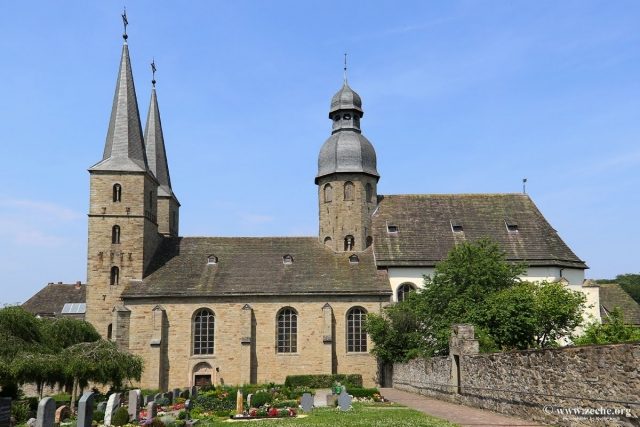
Marienmünster Abbey is a former Benedictine monastery in the North Rhine-Westphalian town of Marienmünster. The monastery was dissolved in 1803. Since 1965, Passionists have lived there, providing pastoral care to the surrounding parishes.
In 1127, Widekind I became Count of Schwalenberg. The following year, he and his wife Lutrud von Itter, on the advice of his cousin or brother-in-law, Bishop Bernhard I von Oesede of Paderborn, founded the Benedictine abbey as an atonement monastery. They provided land and property in the immediate vicinity of their ancestral castle, the Oldenburg, had the church and monastery buildings erected, and endowed the monastery with goods for the monks' livelihood.
On the Feast of the Assumption of Mary on August 15, 1128, Bishop Bernhard I consecrated the monastery and church in honor of the Blessed Virgin Mary, the Apostle James the Elder, and Saint Christopher. Twelve monks from the Benedictine Abbey of Corvey took over the spiritual care. The first abbot was Gerhard.
In the 12th and 13th centuries, the monastery reached its heyday. During the interregnum at the end of the 13th century, the surrounding area had become desolate due to the destruction of farms and villages. Abbot Hermann secured the monastery by fortifying Vörden and Bredenborn (today districts of Marienmünster) with a castle.
During the Thirty Years' War, the monastery and church were attacked and plundered twice by the "Mad Christian". Hessian and Swedish troops laid the monastery and church to rubble and ashes from 1641 to 1646. Abbot Ambrosius Langen had the church rebuilt starting in 1661. The master builder Ludwig Baer from Lüdge created the plans and had the formerly Romanesque basilica converted into a hall church. A new choir was also built.
During the Seven Years' War (1756 to 1763), military actions with troop movements occurred in the area, which included billeting and reparations. In 1760, Brunswick and Hanoverian troops plundered the monastery and used it as a stable for horses. In 1761, a battle with considerable destruction took place in the area around Marienmünster. The abbot of Marienmünster's report on the events in and around Marienmünster and the payments demanded from the monastery spanned 90 pages. After the war, the economic foundation of the monastery was destroyed.
From the beginning, the abbey church also served as a parish church for the surrounding villages.
After the secularization on March 31, 1803, the church and monastery became the property of the Kingdom of Prussia. The 39 monks of the monastery were dismissed and received a pension. After the handover, the inventory, which included valuable works of art, and the library were auctioned off.
Half of the monastery buildings, except for the church and one wing, as well as the extensive land holdings, were sold to a Catholic and a Protestant interested party, who converted the monastery into an agricultural enterprise.
However, after the dissolution of the monastery, the parish remained and is responsible for the care of the parishes in the area. For this reason, two monks were allowed to stay and continue their work. The other parishes were served by diocesan priests. Fathers of the Congregation of the Passionists took over pastoral care in 1967. They provided pastoral care to the surrounding communities and hospitals.
Marienmünster Abbey became the namesake of the newly formed town of Marienmünster in the municipal reform on January 1, 1970.
Current Use
Marienmünster is still a recognized pilgrimage site due to the image of the Sorrowful Mother of God. The former abbey church is the parish church of the parish of St. James the Elder, which belongs to the Marienmünster pastoral association in the Höxter deanery of the Archdiocese of Paderborn.
Until September 2014, about five fathers of the Passionist order lived in the abbey. The order, suffering from a lack of new recruits, left the abbey at the beginning of September 2014. After a renovation of the living quarters, these will be occupied by the new parish priest.
The monastery courtyard was used for agriculture until the 20th century. In 2006, the Marienmünster Cultural Foundation was established, which led to the repurposing of parts of the agricultural enterprise as a public meeting and educational center with a musical focus. For this purpose, the three large farm buildings of the sheepfold, travel barn, and farmhouse were converted in 2007. Since then, events and concert series have taken place in these premises. The concert hall, set up in a former farm building, is used as a recording and rehearsal venue for classical and chamber music. In 2015, a visitor center costing around 1.3 million euros is being built at the monastery courtyard.
Abbey Church+
The original abbey church was built after 1150 in the Romanesque style. It was a three-aisled, two-bay basilica with a transept, a single-bay choir, and an apse. It had a westwork with two towers and an octagonal crossing tower. Only the nave and transept, as well as the lower part of the crossing tower, remain from this period.
In the 17th century, the church was significantly rebuilt. From 1661, the basilical nave was converted into a hall. The crossing tower was raised in 1679 and fitted with a baroque spire. To the east, the church was extended by a three-bay choir, to which a sacristy was added in 1700.
In 1854/55, the south aisle and the two west towers were renovated in the Neo-Romanesque style, following the example of St. Kiliani.
The extensive baroque inventory of the church includes the high altar and two side altars, which were created by Paul Gladbach in the 1680s and restored between 1956 and 1966. The organ was built by Johann Patroclus Möller between 1736 and 1738.
Take Mobile History with you
You are reading this text for free. Premium adds what matters on the road: descriptions read aloud, sites found through your camera, whole regions taken offline.
- Every description, including the ~17,700 Premium sites
- Audio guide: have descriptions read to you on location
- AR finder: see sites through your camera, with distance and bearing
- Unlimited saved sites
14 days free, then from €2.99 a month. Cancel anytime.
Location: 51.8317, 9.2125